
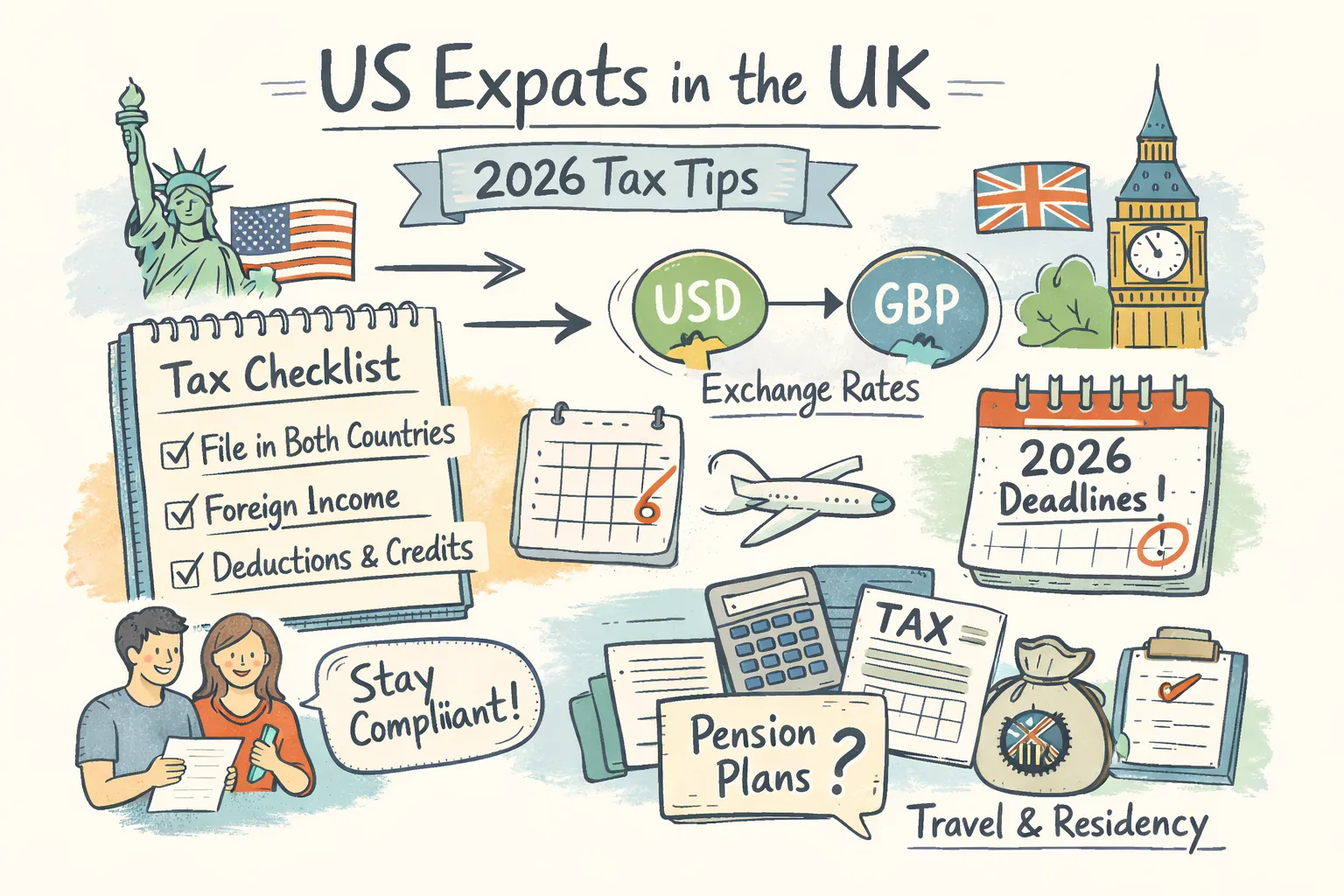
Intro — Cut the worry: A clear path for the 2026 filing season
If you’re an American living in the UK, the tax picture can feel like overlapping rules: worldwide U.S. taxation, FBAR/FATCA reporting, and the tricky treatment of UK pensions and ISAs. This guide gives a practical checklist for the 2026 filing season and a short decision path so you can act with confidence.
By the time you finish this piece you’ll know what returns and informational forms matter and when they’re due; how to choose between the Foreign Earned Income Exclusion (FEIE) and the Foreign Tax Credit (FTC); what to watch for with FBAR/FATCA and pensions/ISAs; and when a specialist is the right call. ExpatsUK’s one‑page checklist and community threads make it easier to collect documents and find UK‑based advisors while you assemble your numbers.
At‑a‑glance: your U.S. & U.K. filing obligations and deadlines
Short version: U.S. citizens and green‑card holders must file Form 1040 reporting worldwide income if thresholds are met. FEIE (Form 2555) and FTC (Form 1116) are the two main tools to prevent double taxation. FinCEN Form 114 (FBAR) and Form 8938 (FATCA) cover foreign accounts and assets. Below is a focused list of the core forms and what they do.
- Form 1040 — your U.S. federal return; reports worldwide income (file if filing thresholds are met).
- Form 2555 — claim the FEIE (2026 limit: $132,900) if you meet the physical‑presence or bona‑fide residence test.
- Form 1116 — claim the Foreign Tax Credit for qualifying UK income and capital gains taxes.
- FinCEN 114 (FBAR) — report aggregate foreign financial accounts > $10,000 at any time in the year (file electronically via BSA E‑file).
- Form 8938 (FATCA) — report specified foreign financial assets when you exceed FATCA thresholds (expat thresholds typically $200k year‑end / $300k any time for a single filer).
- Form 4868 — use to extend to Oct 15; note expats receive an automatic extension to June 15 for filing, but taxes owed are generally due April 15.
Practical next step: pull last year’s Form 1040, P60/P45, pension summaries, and account statements showing highest balances. Mark April 15 (tax payment due), June 15 (automatic filing extension for those abroad) and Oct 15 (final extension via Form 4868) on your calendar. In the UK, employees are usually handled through PAYE; if you file Self Assessment, check HMRC deadlines for any additional filings and see our UK Taxes resources for local guidance.
FEIE vs Foreign Tax Credit — a friendly five‑step decision path
Which usually wins? Run both—but start with this decision path to prioritise your work.
- Separate your income: identify earned income (wages, self‑employment) versus passive income and capital gains.
- Confirm FEIE eligibility: do you meet the 330 full days in any 12‑month period or bona‑fide residence test? (FEIE limit for 2026: $132,900.) Read the IRS guidance on theforeign earned income exclusionif you need the official rules and tests.
- Calculate UK tax actually paid on that foreign‑earned income (use your Self Assessment or PAYE summary).
- Compute U.S. tax on worldwide income before credits and compare the result after applying FEIE versus taking the FTC on the same income.
- Factor special items: housing exclusion, self‑employment tax, the U.S.–UK totalization agreement, and employer pension contributions.
Rules of thumb: if most of your income is earned wages and falls below the FEIE cap and you meet the test, FEIE often simplifies your return. If you pay high UK income tax (typical of higher London salaries) or you have large pension distributions, the FTC frequently preserves more tax value. Always run both scenarios with your actual numbers or use a reliable calculator—ExpatsUK’s downloadable checklist helps you gather the inputs first. For a practical primer on settling and residence issues that affect FEIE eligibility, see our Practical Move & Settlement Guide.
Mini example: low‑salary case—if your earned income is $75,000 and you qualify for FEIE, that income can be excluded entirely, rendering FTC unnecessary. High‑salary case—if you earn $180,000 and pay substantial UK tax, FEIE only excludes $132,900 and FTC may provide a larger offset for the remainder.
Reporting foreign accounts and assets: FBAR, FATCA and common traps
There are two parallel reporting regimes. FBAR (FinCEN 114) covers foreign financial accounts and triggers at an aggregate $10,000 maximum value at any point in the year; it’s filed electronically to FinCEN. FATCA (Form 8938) covers a broader set of specified foreign financial assets with higher thresholds and is attached to your Form 1040.
Common traps to avoid: ISAs and many SIPPs aren’t tax‑favoured by the U.S. and may need reporting on Form 8938 even if they don’t appear on FBAR; conversely, some account types appear on FBAR but not 8938. FBAR uses the highest balance during the year for aggregation—not year‑end—and you must document currency conversions (follow IRS/ Treasury exchange guidance). Keep screenshots or statement PDFs showing USD equivalents and the dates used.
Also be aware of PFIC risk: many UK funds inside ISAs can be PFICs, requiring Form 8621 and potentially onerous tax rules. If you have missed filings, explore Streamlined Procedures or Delinquent FBAR programs—don’t assume small balances eliminate risk; FBAR penalties can be severe. Practical action: collect statements, note highest balances and account types, and keep a simple spreadsheet of foreign assets. See FinCEN’s official FBAR reporting page for filing details and links to the BSA E‑file system.
Pensions and ISAs: how the U.S. sees them and what to report
UK pensions and ISAs are tax‑favoured in the UK but treated differently by U.S. rules. Expect many UK pensions to be taxable in the U.S. on distribution. The common UK 25% tax‑free lump sum is generally taxable for U.S. persons. The State Pension is typically reportable as U.S. income. These positions interact with the US‑UK tax treaty and the treaty’s saving clause, so treaty claims often require Form 8833.
For employer pensions and SIPPs, growth inside the plan is often treated as tax‑deferred under treaty rules, but distributions will be taxed by the U.S. Employer contributions and complex trust features may trigger Form 3520/3520‑A if trust reporting applies. For ISAs: the U.S. does not recognise the ISA’s UK tax exemption—earnings are subject to U.S. tax annually, and many funds are PFICs, which triggers Form 8621 reporting.
Practical asks now: request pension valuations and P60/pension savings statements, download ISA annual statements, and ask providers for fund domicile and ISIN details so your accountant can check for PFIC classification. For further reading on treaty interactions and pension treatment, see our practical guides: US–UK Double Tax Treaty: Key Rules & How to Claim Relief and the U.S.–U.K. Tax Treaty Explained. Also consult the IRS on the taxation of foreign pension and annuity distributions for official U.S. positions.
How the Foreign Tax Credit works with UK taxes — mechanics and a short example
The FTC gives a dollar‑for‑dollar credit for foreign income taxes paid, limited to the U.S. tax attributable to the same foreign‑source income. In plain steps:
- Identify foreign‑source taxable income for the category (general vs passive).
- Compute your U.S. tax liability on worldwide taxable income before credits.
- Apply the FTC limit: (foreign‑source taxable income / worldwide taxable income) × U.S. tax before credits.
- Claim up to that limit of actual foreign tax paid on Form 1116; excess credits can be carried back one year or forward ten years.
UK income tax and capital gains tax qualify for FTC; National Insurance does not. Don’t try to both exclude the same earned income under FEIE and claim FTC for that same amount; they are mutually exclusive. Keep UK tax receipts and Self Assessment summaries to substantiate the credit. For the IRS’s official explanation of the credit and filing requirements, see the Foreign Tax Credit guidance.
Practical checklist, red flags and when to call a US‑UK tax specialist
Start with one small action (collect account statements). When ready, use this printable checklist to work through filings or to hand to an adviser.
- Collect last year’s Form 1040 and any UK Self Assessment return.
- Gather pay slips, P60/P45 and employer pension summaries (SIPP/LGPS).
- Download ISA and investment statements and note fund ISINs/domiciles.
- Capture highest balances for each foreign account (screenshots/PDFs).
- Record UK tax paid (P60, Self Assessment calculation).
- Log travel dates to support the 330‑day physical presence test; assemble bona‑fide residence evidence if used.
- List all foreign accounts with institution name and account number.
- Flag any offshore trusts, large lump sums or pension transfers.
- Check for PFIC exposure and note funds requiring Form 8621.
- Run a preliminary FEIE vs FTC comparison with actual numbers.
- Prepare required forms: 2555, 1116, 8938 and plan FinCEN 114 filing if needed.
- Schedule payments and calendar filing dates; keep conversion documentation for at least six years.
Red flags that warrant a specialist now: large UK pension balances or imminent lump sums; significant ISA holdings with potential PFIC exposure; missed FBAR/FATCA filings; self‑employment or UK rental income; residency disputes. ExpatsUK provides the free one‑page printable checklist, practical guides and community threads where members share bank and adviser experiences; if you hit a red flag, use our vetted advisor links to find a US‑UK tax specialist. For FBAR filing instructions and resources, FinCEN’s site is the official source noted above, and our community threads often include provider recommendations and user experiences.
Conclusion — two clear next steps
The rules are complex but manageable: collect your statements, run FEIE vs FTC with real numbers, and treat pensions/ISAs as priority items for specialist review. Download ExpatsUK’s printable 2026 tax checklist, join our community threads to crowdsource practical tips, and if you have pension lump sums, missed filings or PFIC exposure, book a consult with a US‑UK tax specialist. For a broader roadmap and a practical playbook on tax planning in the UK, see our Practical Tax Playbook Guide.