
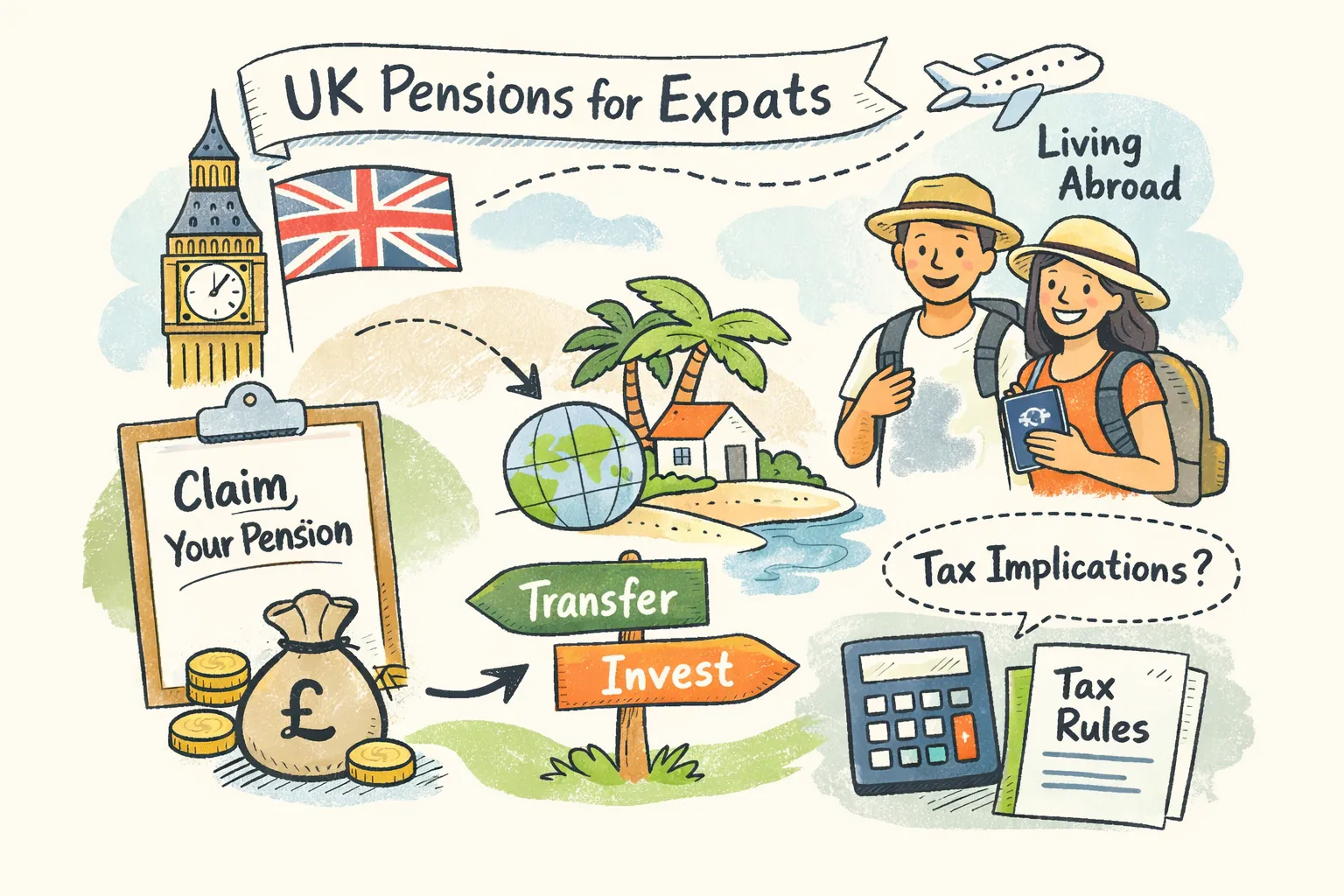
A quick, practical guide that gets you moving
When Anna moved to Perth she assumed her State Pension would rise with the cost of living. Two years after settling in she discovered her UK State Pension had been “frozen” at the rate it was when she left — and that revelation changed everything. Suddenly she faced questions: claim now or later, leave her SIPP in the UK or transfer it overseas, and how would taxes look in Australia?
This article walks you from the very first phone call to the decision about transfers. By the end you’ll know how to claim a State Pension from abroad, how uprating (or freezing) works, the practical differences between keeping a SIPP and transferring to a QROPS, key tax realities in popular destinations, and the exact documents and steps to get started. Need a printable checklist or a country-by-country deep dive? ExpatsUK hosts downloadable Claim & Transfer checklists and country pages to help you go deeper.
Claiming your UK State Pension from overseas — a clear step‑by‑step plan
If you want the least confusing route to a UK State Pension from abroad, call the International Pension Centre (IPC). The phone route (Option 3 on the IPC menu) is usually the fastest and lets the team trace your National Insurance (NI) number, check your entitlement and take your IBAN/BIC for overseas payments without waiting for forms to cross borders.
What to do four months before State Pension age
You should receive a letter from the IPC about four months before you reach State Pension age explaining how to claim. If you haven’t seen the letter two or three months before your birthday, call the IPC right away to avoid delays.
Phone claim — what you need
Call the International Pension Centre and choose the international pensions option (Option 3). Have these to hand:
- Your NI number if you have it (the IPC can trace it if you don’t).
- IBAN and BIC for the account you want payments paid into, or a UK account number and sort code.
- Passport or national identity document details, and recent addresses/employers if asked.
Phone is fast because the IPC can request electronic checks and set up payments more quickly than the postal route.
Postal claim — how to do it properly
If you prefer post (or your situation needs forms), use the international claim form. Which one depends on your State Pension age:
- IPCBR1 — older State Pension claim form (check GOV.UK for the correct version).
- IPCBR1NSP — for New State Pension claimants (State Pension age on/after 6 April 2016).
Attach the country‑specific payment form if your country appears on the IPC list. Post to:
International Pension Centre The Pension Service 11 Mail Handling Site A Wolverhampton WV98 1LW United Kingdom
You can request large-print or alternative formats from IPC if needed.
Practical timeline and common delays
Allow time. Many people get their first payment within 6–12 weeks after a phone claim; postal claims usually take longer. Typical causes of delay are missing ID or address details, gaps in contribution history that need confirming, or cross-border checks when you’ve worked abroad. If the IPC can’t trace your NI number, supply P60/P45s, payslips, or employment dates to help them locate your record.
How the State Pension behaves when you live abroad — payments, forecasts and eligibility
Understanding the rules up front stops unpleasant surprises. The basics are straightforward: your entitlement depends on National Insurance contributions; payments can be made to a UK or local bank account; and whether your pension rises each year depends on the country you live in.
Who qualifies
If you have sufficient UK National Insurance contributions you qualify for a State Pension. Check your forecast via GOV.UK before making major choices — it is the single most useful number to use when comparing private pension options. If you need background on how the system works, see our FAQ on How do pensions work?
Payment mechanics
The IPC can pay into a UK account in GBP without conversion charges or into an overseas account in local currency. If you choose local currency expect a small conversion fee (approximately 0.39%). Provide an IBAN and BIC for international transfers; double‑check the account name and format before you submit it. For guidance on choosing suitable accounts while living abroad, see our Best UK Bank Accounts for Expats.
Working overseas and coordination
If you have social security history in the EEA, Switzerland or Gibraltar, claims may be coordinated via the local authority where you currently live — for example, your local pension institution may make the initial contact and coordinate the UK element. Tell the IPC about foreign work history and provide local authority contact details if asked.
Quick tip: get a State Pension forecast before you decide on private pension transfers — it’s your baseline for any decision about moving money overseas.
Uprating vs frozen pensions — why it matters and how to check
The single most important long‑term difference between living in different countries is whether your State Pension will receive annual uprates.
Uprating means your UK State Pension increases each year in line with the UK’s annual rise (the “triple lock” basis – highest of earnings growth, CPI inflation or 2.5% where applicable). That automatic increase applies if you live in the EEA, Gibraltar, Switzerland or certain countries with social security agreements with the UK. In many other countries your pension is frozen at the amount it was when you left the UK.
Countries that usually get annual increases
Uprating applies in the EEA, Gibraltar, Switzerland and certain countries with social security agreements (examples include the USA, Israel and Jamaica). Important exceptions: Canada and New Zealand have agreements but pensions are frozen there.
What a “frozen” pension means in practice
Frozen does not mean illegal or wrong — it simply means your pension amount does not rise. The practical result is purchasing‑power erosion. For example, if your State Pension was £10,000 when you moved and inflation averages 2.5% per year, that £10,000 would be worth roughly £7,800 in real terms after 10 years and about £6,100 after 20 years.
That gap can be decisive when you plan housing, healthcare and lifestyle abroad. For more on health cover when living outside the UK, see UK Health Insurance for Foreigners: A Friendly Guide.
Country spotlights
Australia, Canada and New Zealand are common retirement destinations where pensions are often frozen despite social security links. If you’re moving to one of these countries, factor the freeze into your income forecasts and consider private pension strategies to protect purchasing power.
How to check: use the ExpatsUK country pages for a concise summary and always validate with GOV.UK’s official guidance for the most up-to-date uprating position.
Keep it in the UK or move it overseas? SIPP vs QROPS explained
This is the crossroads many expats reach: keep a Self‑Invested Personal Pension (SIPP) in the UK, or transfer to an overseas scheme (QROPS). The right answer depends on residency plans, tax rules where you live, fees and how long you expect to stay in one place.
| Aspect | QROPS | SIPP (stay in UK) |
|---|---|---|
| UK transfer tax | Potential 25% Overseas Transfer Charge (OTC) unless exempt | No transfer tax |
| Eligibility | Must be an HMRC-listed ROPS; residency and age tests apply | Open to UK-based schemes; no residency hurdle |
| Local currency | Often held and paid locally — lower currency risk | Paid in GBP; currency conversion when you withdraw |
| Ongoing costs and transparency | Varies — watch setup and annual fees | Platform and advice fees; usually better-known UK fee structures |
| Best for | Long‑term residents in one country with favourable local rules | Short‑term expats or those who might move again |
Key rules to note: a 25% OTC applies from 30 October 2024 unless you are tax resident in the same country as the receiving QROPS at transfer. There is also a “five‑year residency” risk: moves shortly after transfer can trigger retrospective charges. Always confirm the receiving scheme is on HMRC’s ROPS list at the transfer date and get written confirmation.
Real‑world examples
Example 1 — Australia: an Australian resident aged 60 might consider QROPS to avoid currency risk and to benefit from Australian tax treatment. But check Australian tax interactions, age minimums for tax-free transfers and whether the OTC applies. Example 2 — New Zealand: from April 2026 certain transfers face a 28% Transfer Scheme Withholding Tax (TSWT) if the TSWT route is chosen, though transitional exemptions exist for new migrants.
If you’re uncertain, don’t transfer. Keeping a SIPP is often the safer option for people who might move again, who face uncertain local tax rules, or who have moderate pot sizes where the transfer tax and fees would wipe out the benefit.
How your UK pension will be taxed where you retire — DTAs and common country examples
The basic tax principle is straightforward: the country where you are tax resident usually has primary taxing rights on pension income. Double taxation agreements (DTAs) allocate taxing rights and provide relief so you are not taxed twice. For a plain-language walkthrough of residency rules, reliefs and filing, see our guide on UK Taxes for Expats: Residency, Reliefs & Filing Made Simple.
United States
If you are a US tax resident or citizen you must report worldwide income on Form 1040. The UK‑US DTA usually gives the US the right to tax private pensions, and the State Pension is generally taxed in the US. You may need to file FBAR or Form 8938 if overseas accounts exceed thresholds. Use the foreign tax credit to avoid double taxation where UK tax has been withheld. If you are moving between the two countries, our practical Moving from the USA to the UK: Your Practical 10‑Step Plan may also be useful.
Spain
Spain taxes pension income at progressive resident income rates and the UK-Spain DTA typically assigns taxing rights to Spain for private pensions. Regional surtaxes and filing rules vary; check local rules and declare UK pensions correctly on your Spanish return.
Australia
Australia generally taxes UK pensions as assessable income for Australian residents. The UK-Australia treaty usually gives Australia primary taxing rights. Be aware of Medicare levy implications and differing treatment of lump sums versus regular income.
Practical steps: notify HMRC of your non-UK residence, keep careful bank and tax records, and seek local tax advice before making large withdrawals or transfers. A treaty can prevent double tax, but you must claim relief in the correct way and keep documentation.
Choosing how to take your pension abroad — lump sums, drawdown and annuities
Your choices for defined‑contribution pots are similar to those in the UK, but local tax and currency rules change the trade‑offs.
25% tax-free lump sum: universally available under UK rules (subject to scheme rules) but local tax may apply to the remainder. Check how your country treats that tax-free element — it may be taxable locally once converted into your resident tax system.
Flexi-access drawdown: offers flexibility and control but creates ongoing tax reporting in your residence country and exposure to currency swings if your pot remains in GBP while you spend locally.
Annuities: give guaranteed income and security. They can be good if you want certainty and are staying in the same country long-term, but rates and value may look different if life‑expectancy or currency factors diverge from the UK population assumptions.
Who should consider what? If you want guaranteed income and won’t move, an annuity is sensible. If you plan phased withdrawals or may move between countries, keeping a SIPP and using drawdown — with careful tax planning — is often better. Use Pension Wise for baseline, non-commercial guidance; for cross‑border tax decisions and transfers to QROPS you should use regulated, cross‑border advisers.
Practical checklist and timeline — documents, forms and exact next steps
Gather these documents now — they speed claims and transfer conversations:
- Passport and national identity documents
- National Insurance number (if you have it) and recent P60/P45 or pay evidence
- Employment history with dates and addresses
- Current pension provider contact details and recent pension statements
- Bank IBAN/BIC for overseas payments
- Proof of address history (to show residency periods)
Key forms and filings to know
- IPCBR1 or IPCBR1NSP — international State Pension claim forms
- Country-specific payment form from IPC (where required)
- APSS263 and APSS251B — provider/HMRC forms involved in QROPS transfers and reporting
Recommended timeline
12 months before planned retirement: review pension statements and get rough forecasts from private providers. 4 months before your State Pension age: expect the IPC letter — if you don’t get it, call. From 4 months before SPA to the month after: make your claim. If you plan transfers, start the provider transfer pack process at least three months before your intended transfer date to allow advice and cooling‑off periods.
Copy‑ready templates
Phone script for IPC: “Hello — I’m calling about an International State Pension claim. My name is [your name], I will reach State Pension age on [date], and I live in [country]. My NI number is [if known]. I want to make a claim and have my pension paid to IBAN [xxxx]. Can you confirm what you need from me and the expected processing time?”
Email to request a transfer pack from provider: “Please can you send the full transfer pack and forms required to transfer my pension to an overseas scheme? My full name is [name], DOB [date], NI [if known], and current address [address]. I would like details of exit charges, adviser fees and the timescale for transfer.”
What to tell a local tax adviser: explain that you have a UK State Pension and a defined-contribution pot you may transfer; provide forecasted values, intended timing, and your residency change date. Ask for a written note on how transfers/withdrawals will be taxed locally and whether treaty relief applies.
Finally, download the ExpatsUK Claim & Transfer checklist and visit the country page for your destination for tailored notes on uprating and tax. Join the ExpatsUK discussion board to hear recent, real-world experiences while you arrange formal advice.
When to get professional help — Pension Wise, regulated advisers and red flags
Free resources first. Pension Wise and MoneyHelper provide good, non-commercial explanations of the options (lump sums, drawdown, annuities). They are excellent for understanding choices, but they do not replace cross‑border tax or transfer advice.
Seek regulated advice if you are considering a QROPS transfer, if your pot is large or complex, if an adviser offers a single-scheme “solution,” or if local tax consequences are unclear. Always choose an adviser who is FCA‑authorised (or the equivalent in your country) and has cross‑border pension experience for your specific destination.
Red flags to watch for: unsolicited transfer recommendations, schemes not on HMRC’s ROPS list, opaque or high fees, large upfront commissions, and promises of guaranteed returns or tax “loopholes.” Ask advisers to put recommendations in writing, declare conflicts of interest and show their authorisation details.
Quick checklist of questions for any adviser
- Are you FCA-authorised (or locally regulated)? Provide reference number.
- Do you have recent experience with transfers to my country of residence?
- What exactly are your fees and do you get commissions?
- Will you provide a written recommendation and all assumptions used?
Use ExpatsUK message boards to crowd-source provider experience while you arrange formal advice — peers often flag recent HMRC list changes or poor-performing schemes long before they make headlines.
Conclusion — immediate priorities and next steps
Your immediate action list: get a State Pension forecast from GOV.UK, gather the documents on the checklist, and expect the IPC letter four months before State Pension age — call if it doesn’t arrive. Don’t transfer a pension overseas without checking HMRC’s ROPS list and taking regulated, cross‑border advice. If you’re unsure, keeping your SIPP in the UK is often the lower‑risk option.
Download the ExpatsUK Claim & Transfer checklist, visit the country uprating pages for detailed notes on your destination, and drop a short help request to your local ExpatsUK discussion board to see how others just like you handled transfers and taxation. Clear information and a little planning now will save months of worry later.