
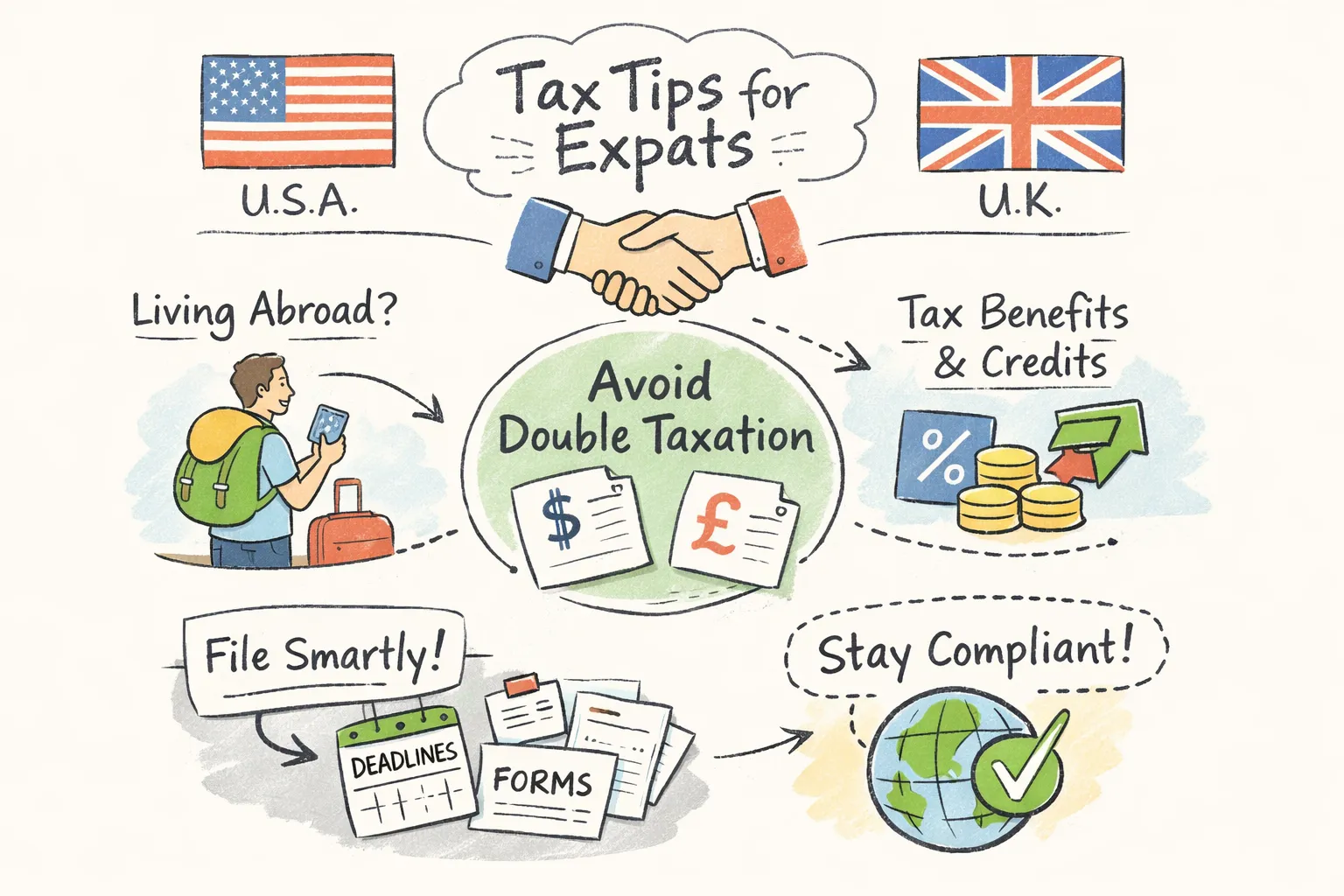
Answer three quick questions to see if the U.S.–U.K. tax convention affects you:
1) Do you live, work or own property in both countries? 2) Are you a U.S. citizen or green‑card holder, or are you a U.K. resident for tax purposes? 3) Do you receive pensions, dividends, interest, rental income or capital gains tied to the other country?
If you answered yes to any of these, the treaty is probably relevant — but how it helps depends on your residency, the type of income and whether you’re a U.S. person. ExpatsUK has a downloadable residency checklist and sample wording for Form 8833 to help you gather the right documents; follow the steps below to decide what to do next.
1) Quick take: who benefits and what to do first
The short answer: the treaty is most helpful when you are a non‑U.S. person who is a U.K. tax resident, or when you receive income that the source country would otherwise tax heavily. It limits withholding and clarifies which country may tax certain income types — but it’s constrained for U.S. citizens and green‑card holders by the “saving clause.”
Scan this practical checklist:
- Who typically benefits: people who are U.K. tax residents (but not U.S. citizens/residents), cross‑border workers paid by the source state, and non‑U.S. entities that meet the Limitation on Benefits rules.
- Who is constrained: U.S. citizens and lawful permanent residents. The U.S. “saving clause” largely preserves U.S. worldwide taxation of its citizens and residents.
- Three immediate actions: gather proof of residence (leases, mortgage, HMRC correspondence), confirm exactly what kinds of income you receive (pension, dividends, interest, employment, capital gains), and keep withholding statements (P60/P45, 1099s, broker 1042‑S/1042 withholding certificates).
These steps set expectations. Read on for the practical rules that apply to your income type and the forms you’ll need to file.
2) What the treaty actually covers — taxes, dates and core articles
The U.S.–U.K. Income Tax Convention (signed in 2001, amended by a 2002 Protocol) applies to taxes on income and capital gains and generally governs taxable years beginning on or after 1 January 2003. It applies to U.S. federal income taxes (Social Security taxes are excluded) and to U.K. income tax, capital gains tax, corporation tax and certain petroleum taxes.
Here are the practical articles you’ll see referred to:
- Residence (Article 4): decides which country counts you as a treaty resident using a sequence of tests (permanent home → centre of vital interests → habitual abode → nationality → competent authority).
- Business profits and permanent establishment (Article 7): the source country can tax profits only if a permanent establishment (PE) exists there.
- Dividends, interest, royalties (Articles 10–12): set maximum withholding rates in the source country (for example, treaty caps on dividend withholding; interest and royalties are generally low or zero taxed).
- Capital gains and real property (Articles 6/13): gains generally taxed in the country of residence, but gains from U.K. real property or from a PE may be taxed in the U.K.
- Pensions (Article 18): most private pensions are taxable only in the recipient’s residence state; certain government pensions are exceptions.
- Relief from double taxation (Article 24): the residence state provides a credit or exemption to avoid double taxation.
- Saving clause and Limitation on Benefits (LOB): the saving clause preserves U.S. taxation of its citizens/residents; the LOB anti‑abuse rule limits treaty benefits to qualifying persons or entities.
Practical effect: the treaty is a distribution of rights, not an automatic wipeout of tax. It reduces withholding and coordinates taxing claims, but your domestic status and documentation determine how you benefit. For a short FAQ on how tax treaties work to prevent double taxation, see Are there tax treaties to avoid double taxation?, expatsuk.net.
3) How common types of income are treated — rules, examples and immediate takeaways
Below are plain‑English rules and short examples that show what to expect for typical expat income types. Each paragraph ends with what to collect now.
Employment income
The U.K. may tax pay for work performed in the U.K. The treaty also includes a 183‑day test: if you’re present in the source country fewer than 183 days in any 12‑month period, paid by a non‑resident employer, and the employer’s cost is not borne by a PE in the source state, the source state generally cannot tax that employment income. If you’re split between London and New York, days worked in each country matter and you should track them carefully.
Example: a contractor who spends 120 days in London and 245 in New York may still be taxed by the U.K. on U.K. work days; conversely, a U.K. resident who is only temporarily in the U.S. may avoid U.S. source taxation if the 183‑day and employer tests are met.
Immediate takeaway: if this describes you, collect employer letters stating pay arrangements, a calendar of days present, payslips and any PE‑related cost allocation documents.
Pensions
The treaty generally gives taxing rights over private pensions to the recipient’s state of residence. That means a U.K. resident’s private pensions are usually taxable in the U.K. rather than the U.S. Government pensions are treated differently and may be taxed at source in some cases. Also note: pensions are typically outside the Foreign Earned Income Exclusion (FEIE) for U.S. citizens.
Example: a U.S. citizen who retires in the U.K. will generally report U.K. pension income on their U.K. return; for U.S. tax, they still may be taxed under the saving clause but can usually claim a foreign tax credit for U.K. tax paid.
Immediate takeaway: collect pension statements, pension provider residency confirmations and proof of tax withheld.
Dividends
The treaty caps source‑country withholding on dividends (for example, a 5% cap where the shareholder owns at least 10% of voting stock, and a 15% cap for portfolio holdings in many circumstances). To claim reduced withholding from a U.S. payer or broker, a non‑U.S. beneficial owner supplies Form W‑8BEN or W‑8BEN‑E. Brokers and banks will often require these forms before applying treaty rates.
Example: a U.K. resident with a U.S. brokerage account must provide a W‑8BEN to avoid default 30% withholding on certain U.S.‑source payments.
Immediate takeaway: if you receive dividends, ensure your broker or payer has a valid W‑8 form and retain dividend vouchers and a record of tax withheld.
Interest and royalties
Interest and royalties are generally exempt from source‑country withholding or taxed at low/zero rates under the treaty. In practice, banks and payers will ask for a W‑8BEN/W‑8BEN‑E to apply treaty relief. Some specific types of interest (e.g., bank deposit interest) are often treated favorably, but always confirm with the withholding agent.
Example: a U.K. resident receiving U.S. bond interest should give their U.S. custodian a W‑8BEN to avoid default withholding.
Immediate takeaway: give your payer a W‑8 and keep the acknowledgement; keep periodic 1042‑S/withholding statements.
Business profits & permanent establishment (PE)
Business profits are taxable only in the resident state unless the enterprise has a PE in the source country. A PE is typically a fixed place of business or a dependent agent habitually exercising authority to conclude contracts. A travelling consultant who has no office and uses local short‑term client space normally won’t create a PE; an on‑site office or local agent could.
Example: a freelance consultant living in the U.K. who visits U.S. clients for short projects usually won’t create a U.S. PE and so pays tax in the U.K. on business profits — but a U.S. office or local contracting company could change that.
Immediate takeaway: collect contracts, invoices, client addresses and evidence of where work is performed.
Capital gains
Capital gains are generally taxed by the country of residence, with exceptions for gains from real property (taxable in the country where the property is located) and gains attributable to a PE. Selling U.K. property can give the U.K. primary taxing rights even if you’re a U.S. resident for other purposes.
Example: selling a U.K. rental property will likely trigger U.K. capital gains tax; you may claim a U.S. credit for tax paid on your U.S. return if applicable.
Immediate takeaway: for disposals, retain conveyancing statements, purchase/sale contracts, and evidence of any tax paid.
4) Residency tie‑breaker rules — step‑by‑step and real examples
If you meet both countries’ domestic residency tests, Article 4 resolves dual residency for treaty purposes by applying tests in order. The first test that produces a result determines treaty residence for that year.
Sequential tests and what matters:
- Permanent home: where you have a dwelling available year‑round. Evidence: property deeds, long leases, utility bills.
- Centre of vital interests: where your personal and economic ties are closer — family, business, bank accounts, insurances.
- Habitual abode: where you actually live most of the time in the relevant period (days present).
- Nationality: citizenship can decide if earlier tests are inconclusive.
- Competent authority: if still tied, HMRC and the IRS negotiate a resolution (this can take time).
Three short, practical case studies:
A. Green‑card holder relocated to the U.K. for work. They lease a home in London, their spouse and children live there, their banking and employer are in the U.K. Although they retain a U.S. green card, the treaty tie‑breaker points to U.K. residence (permanent home and centre of vital interests). They should prepare to file U.S. disclosures (Form 8833) if they rely on the treaty to reduce U.S. taxation on certain items.
B. Dual U.S./U.K. citizen splitting time equally. Homes, family and economic ties are balanced and habitual abode is roughly equal. Nationality won’t break the tie. The competent authorities may need to resolve residency for treaty purposes; until then, expect both countries to assert rights and rely on credits or provisional filings.
C. Short‑term consultant spending six months in each country. If neither country has an available permanent home and vital interests are mixed, habitual abode (days present) could decide the case. Track days precisely and collect client contracts and travel records in case you need to show where you habitually lived.
Evidence checklist to copy now: leases or deed, mortgage statements, household registrations (council tax, electoral roll), family registrations (spouse/children school records), pay slips and employment contracts, bank statements and tax filings. Keep dates and originals or certified copies.
Note: the tie‑breaker addresses treaty treatment only. It does not change domestic residency for Social Security or other non‑treaty matters. Also, if your treaty position departs from usual U.S. filing, Form 8833 may be required (see section 7).
5) The saving clause — what it means for U.S. citizens and green‑card holders
Plain‑English: the saving clause lets the U.S. continue to tax its citizens and residents on worldwide income despite what the treaty says. The treaty doesn’t let most U.S. persons avoid U.S. tax simply by becoming residents of the U.K. There are limited carve‑outs (for example, certain social security payments and a few other specified items).
Practical consequences:
• If you are a U.K. resident but retain U.S. citizenship or a green card, you generally remain subject to U.S. tax on worldwide income. You can use U.S. domestic reliefs — the Foreign Earned Income Exclusion (Form 2555) for earned income meeting the bona fide residence or physical presence tests, or the Foreign Tax Credit (Form 1116) for foreign taxes paid — but you cannot simply rely on treaty exemptions that would otherwise benefit foreign residents.
Example comparison: a U.K. citizen who becomes a U.K. tax resident will generally be taxed in the U.K. on worldwide income and use the treaty to prevent the U.S. from taxing that same income. A U.S. citizen who becomes a U.K. resident still owes U.S. tax; they usually claim the FEIE or FTC for relief instead of relying on treaty benefits that the saving clause preserves against. For a detailed playbook targeted at Americans in this position, see U.S. Citizens in the UK: A Practical Tax Playbook Guide, expatsuk.net.
Bottom line: if you’re a U.S. person, plan around FEIE and FTC rules and keep precise records of foreign taxes paid — the treaty helps, but the saving clause limits its reach.
6) Common traps, anti‑abuse rules and documentation to avoid surprises
These are the frequent pitfalls expats run into and quick fixes so you don’t learn them the hard way.
Limitation on Benefits (LOB): This anti‑abuse rule prevents entities and some taxpayers from “treaty shopping.” If your company does not meet the LOB tests, you may lose treaty withholding relief. Remedy: get professional confirmation of LOB status and meet documentation requirements before claiming benefits.
Failing to file Form 8833: If you claim a treaty position that changes U.S. tax results (including certain dual‑resident positions), Form 8833 is often required; failure to file can trigger penalties. Remedy: prepare and attach Form 8833 when you file your U.S. return and retain supporting evidence.
Mismatched withholding: Brokers and banks may withhold at default U.S. rates (30%) if they don’t have your W‑8BEN or W‑8BEN‑E. Remedy: submit complete W‑8s early (these generally last up to three years) and confirm with the payer that preferential rates are applied.
Pension misclassification and split‑year moves: Moving mid‑year or misclassifying pension payments can lead to double or missed taxation. Remedy: document move dates, request tax certificates from pension providers, and consider split‑year calculations where available.
Trusts, complex corporate ownership and employee equity: these areas trigger LOB, PE and residency complexity. Remedy: specialist advice — bring a clear set of facts and the ExpatsUK checklist to your adviser. If you’re affected by non‑dom changes or anticipating the end of legacy regimes, see UK Non‑Dom Ends: 2025 Changes and 6 Practical Steps, expatsuk.net for practical next steps.
Record‑keeping rule of thumb: keep payslips, P60/P45, 1099s, Forms 1042‑S/1042, pension statements, bank statements, contracts, property conveyancing papers and any certificates of tax paid for at least seven years if you’re filing cross‑border claims.
7) How to claim relief — forms, sample wording and what to send
Before you file: what to collect and who to tell
Start early. Collect proof of residency (lease, mortgage, council tax, HMRC letters), employer letters (who pays you and where the employer is resident), pay documents (P60s, W‑2s, 1099s), and withholding statements from banks/brokers. For U.S.‑source payments, give your U.S. payers or broker a valid Form W‑8BEN (individuals) or W‑8BEN‑E (entities) to claim treaty rates. U.S. persons give a W‑9 to certify U.S. status when required.
If you are a non‑U.K. resident seeking relief at source for UK‑withheld tax, the DT‑Individual form is the route for repayment or relief at source; UK residents generally use Self Assessment (SA100 plus SA106).
On your U.S. return: Form 8833, 1040 vs 1040‑NR, FTC and FEIE
Which return to file depends on your U.S. status. U.S. citizens normally file Form 1040 each year. Nonresident aliens who qualify for treaty benefits may file Form 1040‑NR. If you are taking a treaty position that affects U.S. tax, attach Form 8833 to disclose the treaty basis and the facts supporting your claim.
When to use other forms:
• Claim FEIE with Form 2555 for qualifying earned income. • Claim Foreign Tax Credit with Form 1116 for foreign taxes paid on income that remains taxable in the U.S. Note: income excluded by Form 2555 cannot be credited on Form 1116.
Sample two‑line Form 8833 wording you can adapt (edit facts and amounts):
“Under Article 4 (Residence) of the U.S.–U.K. Income Tax Convention, the taxpayer claims treaty residency in the United Kingdom for tax year 20XX. Facts: permanent home at [address]; family and economic ties centred in the U.K.; present in the U.K. >183 days. Impact: Certain employment income and pensions treated as U.K. source and not taxable in the U.S. to the extent permitted by the Convention.”If you are a U.S. citizen relying on an exception to the saving clause, explicitly state the exception you rely on and the treaty article; these positions are scrutinised, so include dated evidence. Remember the penalty for failing to file Form 8833 can be $1,000 for individuals unless reasonable cause applies.
On your U.K. return and with HMRC
Most individuals claim double taxation relief through Self Assessment. Use SA100 and complete the SA106 “Foreign” pages to declare overseas income and tax paid. HMRC typically asks for evidence only if they query your claim, but keep certificates of foreign tax paid, employer letters and bank statements handy.
If you were taxed incorrectly at source and are non‑resident or eligible for relief at source, you may use DT‑Individual to request repayment or relief. Complex claims (large pensions, corporate issues, trusts) often require formal applications or professional help. When in doubt, attach clear explanatory letters and reference the treaty article numbers used. For a broader guide to UK filing, see UK Taxes for Expats: Residency, Reliefs & Filing Guide, expatsuk.net.
What to attach — quick checklist
- Copies of foreign tax returns and assessments.
- Employer letters detailing where work was performed and who bears employment cost.
- Withholding statements: P60/P45, Form 1099, Forms 1042‑S/1042, broker statements.
- Proof of residence: lease/mortgage, council tax, utility bills, bank statements.
- Contracts, invoices and bank receipts that tie income to a country or PE.
8) Plain‑English checklist, timeline and where ExpatsUK can help
Action first — follow this checklist over the next 30–90 days:
- Confirm treaty residence using Article 4 tests and copy key documents (permanent home, family ties, days present).
- Gather documents for all income types you have (pensions, dividends, interest, employment, capital gains).
- Provide W‑8BEN/W‑8BEN‑E to U.S. payers and brokers (or W‑9 if you are a U.S. person) to avoid default withholding.
- Choose your U.S. relief route — FEIE (Form 2555) for qualifying earned income, FTC (Form 1116) for foreign taxes, or a treaty claim with Form 8833 where applicable.
- File the U.K. Self Assessment (SA100 + SA106) if you’re a U.K. resident and claim relief; retain all supporting documents.
Timelines for common situations:
Moving mid‑year: track move dates carefully and prepare evidence to support split‑year treatment where applicable. Retiring to the U.K.: gather full pension records and confirm whether pensions are taxable only in the U.K. under the treaty. Cross‑border contractor: log days worked and keep contracts showing where services are performed.
How ExpatsUK can help: download our practical toolkit with a residency checklist, copy‑ready Form 8833 sample wording, and a template email to send to banks and employers requesting treaty withholding treatment. We’re also building local groups and message boards where you can ask peers about HMRC/IRS experiences in your city — a great place to compare how others handled the same forms and payers. U.S. nationals may also find the American Expat in the UK: Your No‑Nonsense 90‑Day Guide, expatsuk.net a useful companion when organising immediate post‑move tasks.
Final note: if your situation is straightforward, follow the checklist and keep excellent records. If you’re dealing with LOB questions, trusts, large pensions, or treaty positions that override the saving clause, get a specialist — and bring our checklist and sample Form 8833 wording to the meeting to speed things up.
If you want the downloadable checklist and the sample 8833 wording mentioned above, visit the ExpatsUK tools page to start building your documentation pack — and consider joining an upcoming local group to swap experiences with others who’ve just filed cross‑border returns.
Short summary: confirm treaty residence, collect clear evidence, submit the right forms (W‑8s early; Form 8833 if you rely on a treaty position), and choose FEIE or FTC carefully if you’re a U.S. person. Keep tidy records — it makes the rest far easier.