
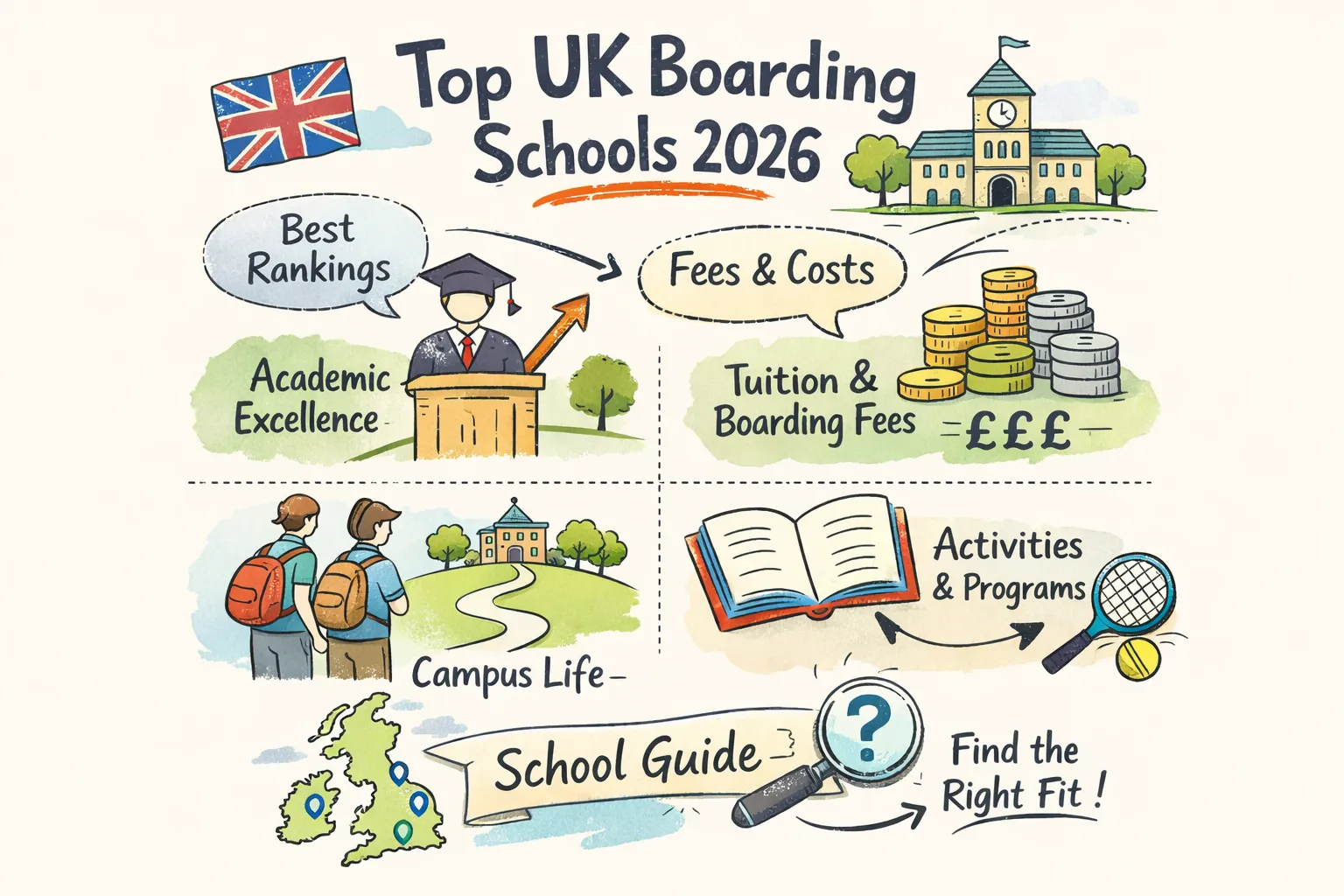
If you’re reading this, you’re probably juggling spreadsheets, school brochures and a deadline that feels uncomfortably close. The UK boarding scene is full of world‑class options, but the noise in league tables and the dozens of specialist terms can make it hard to know where to start.
ExpatsUK has pulled together the 2025 performance highlights, realistic fee ranges and a step‑by‑step admissions checklist so you can start shortlisting with confidence.
In the next 10 minutes you’ll get a readable snapshot of the top 2025 performers (useful for 2026 choices), a parent‑friendly decision framework, clear money and aid guidance, a sample admissions timetable and practical next steps for international families.
Quick snapshot: who’s leading the league — and what those numbers mean
Publicly available measures are mostly 2025 exam results; 2026 figures were not published at the time of writing. Different rankings emphasise different things (A*–A vs A*–B, cohort size, IB average), so treat any table as one signal among several.
- St Paul’s School — A‑level strength (A*–B ≈ 98.2%) and top GCSE metrics (≈97.6% A*/A/9‑7).
- Brighton College — GCSE leader (~98.0% 9‑7/A*‑A) with very strong A‑level results.
- Westminster School — consistently near the top at both GCSE and A‑level (high A*/A proportions and A*–B figures).
- Eton College and Wycombe Abbey — steady top‑five performers across exams (Wycombe Abbey ≈92.4% A*–B at A‑level; ≈96.7% at GCSE).
- IB leaders to note: Royal High School Bath (≈40.1 average IB points), Ardingly College (≈40.0), Bromsgrove (≈39.7).
Quick reading tip: IB averages (out of 45) are not directly comparable with A‑level percentages. Small cohorts magnify swings in percentages, and selective intake policies affect league positions. Use these figures as anchors — then test fit with your child’s learning style and university plans.
How to shortlist schools that actually fit your child
Rankings tell you who’s top; this framework tells you who’s right. Reduce overwhelm by focusing on five core, practical criteria and accepting the trade‑offs each brings.
Academic programme (A‑level vs IB). IB suits students who thrive on breadth and global university applications; A‑levels favour depth and subject specialism. If your child is undecided, lean to a school that offers both or places strong emphasis on university guidance. For background on the system and useful terminology, see ExpatsUK’s How UK Schools Work: A Complete Guide for Expat Parents 🇬🇧🎒, expatsuk.net.
Boarding type. Full boarding suits families wanting a consistent residential education; weekly or flexi‑boarding is better for those who want regular weekends at home. Consider travel time and how often you want to be physically present.
Pastoral support & house system. House culture drives day‑to‑day wellbeing. Ask about tutor ratios, mental‑health resources and how houses handle homesickness — especially important for younger international boarders.
Size and teaching attention. Large schools offer breadth and niche activities; smaller schools can mean closer relationships with teachers. Look for published pupil:teacher ratios, but verify by asking during tours.
Extracurricular profile. If your child is a musician, actor or athlete, check the strength and timetabling of that department. Top exam results don’t guarantee elite music or sports pathways.
Scoring exercise: write five non‑negotiables and three nice‑to‑haves, then score each candidate school 0–3 against them. Example: a child aiming for both UK and US universities might score IB provision and dedicated university counselling higher. Use your scores to create a shortlist of three schools to visit.
Practical nudge: download ExpatsUK’s one‑page shortlist template and use local message boards to ask parents the single question that matters to you (bedtimes, laundry, weekend routines). Real family answers reveal fit faster than any table.
Fees, scholarships and realistic cost planning
Top boarding schools commonly fall in the mid‑£50k to mid‑£60k per year range (2025–26 figures). Some London or VAT‑inclusive fees edge towards £66k.
Fees typically include tuition, boarding, meals and many core activities. Extras usually excluded are overseas travel, individual music tuition, specialist trips, uniform and pocket money. Expect deposits in the region of £1,200–£2,500 and recent annual fee rises around 5–7% year‑on‑year. (If you’re relocating and need finance options, see ExpatsUK’s UK Expat Mortgages: A Practical Guide to Apply Abroad, expatsuk.net.)
Scholarships vs bursaries: merit scholarships reward academic, musical, sporting or creative excellence and tend to reduce fees rather than cover them entirely. Means‑tested bursaries are awarded on financial need and can be partial or, in some cases, cover full fees; larger schools often use independent assessors (Clarity or similar) to verify need.
- Apply for bursaries early and in parallel with admissions; schools often set separate deadlines. Typical documents: recent tax returns, bank statements, and supporting letters. If you need help, politely ask admissions for the bursary timeline before you accept a place.
- Plan for extras: instrument hire, exam fees, travel and uniform can add several thousand pounds a year.
Examples (2025 data): Harrow ≈£63,735/year; Westminster ≈£65,976; Wycombe Abbey ≈£61,500. Always confirm 2026 figures directly with the school.
Admissions timeline and a step‑by‑step checklist for 11+, 13+ and 16+
Common entry points are 7–13 (prep), 11+ (Year 7), 13+ (Year 9) and 16+ (sixth form). For competitive places begin 12–24 months ahead — 13+ often requires the longest lead time.
Registration: submit the school’s registration form and fee as early as possible. Some schools close registration long before assessments.
Open and taster days: observe boarding houses at lunch, a weekend if possible, and speak to tutors and house staff. Watch how the school handles free time — that reveals pastoral priorities.
Assessments and interviews: 11+ focuses on maths, English and reasoning; 13+ often uses ISEB, school papers or pre‑tests; 16+ includes subject tests and interviews or portfolio review for creative subjects. Offers are commonly conditional on test results and references.
Post‑offer: pay the deposit, submit medical forms, arrange guardianship if required and order uniform. Keep a parent‑owned folder with registration numbers, offer letters, bursary forms and deadlines.
Sample 13+ timeline (12–18 months): 18 months out — compile longlist and book open days; 12 months — register and sit any pretests; 9–6 months — attend assessments and interviews; 3–4 months — offers issued; 1–2 months — accept, pay deposit and prepare travel/guardianship.
Strategy tip: apply to 3–4 schools (dream, stretch, realistic, safety). Keep all paperwork and deadlines in one calendar so nothing slips through.
What schools test for, how they assess candidates and healthy prep plans
Typical formats: 11+ tests are maths, English and verbal/non‑verbal reasoning; 13+ uses school papers or standard pretests (ISEB/UKiset style); 16+ often combines subject papers with interviews and predicted grade scrutiny. Some schools add practical or creative assessments.
International candidates: many schools accept UKiset for initial assessment and offer English language support or foundation routes. Ask about EAL provision before applying.
- Start with familiarisation — past papers and the format of the tests, not over‑teaching content.
- Use targeted tuition only where gaps exist. Regular small sessions beat last‑minute cramming.
- Prepare for interviews with gentle mock conversations about interests and school life rather than grilling on facts.
- Prioritise wellbeing: maintain routines, sleep and hobbies to avoid burnout.
For sixth form: keep subject options reasonably broad if your child is undecided. Offers are often conditional on predicted grades or IB target points — make sure the school’s expectations align with your child’s current performance.
Practical next steps for international families — visas, guardianship and settling in
Immediate admin: most overseas boarders aged under 18 will need a Child Student visa; check the Home Office guidance early. Schools expect confirmed guardianship arrangements for under‑18s and will list required documents (passport, recent school report, immunisation record, proof of guardianship and financial guarantees). If you or a family member need to join on a visa, see ExpatsUK’s UK Dependant Visa: Step‑by‑Step Guide for Family, expatsuk.net for practical options and timelines.
Arrival and settling: choose a guardian before arrival, arrange travel that minimises jet lag and confirm medical arrangements. Understand whether your child will use the NHS (if eligible) or if private insurance is required; keep medication details and any specialist letters handy. Second‑hand uniform networks and parent groups can make the first month cheaper and smoother.
First 30 days checklist: introduce your child to their housemaster/housemistress, meet tutors, finalise transport to/from term breaks and arrange a short local orientation walk so they learn the nearest pharmacy, station and GP.
Community support: join ExpatsUK local groups and message boards to ask alumni one practical question (for example: “How does the house manage weekend leave?”), source guardians, and find second‑hand uniform or families arriving at the same time. Also download the ExpatsUK printable admissions checklist to keep documents and deadlines in one place. For broader family‑life and settling‑in advice see ExpatsUK’s Raising Children in the UK as an Expat: An In‑Depth, Practical Guide, expatsuk.net.
After you do this three things — complete your one‑page shortlist, book two open days and set reminders for bursary deadlines — you’ll be in a much stronger position to choose the right school for your child.