
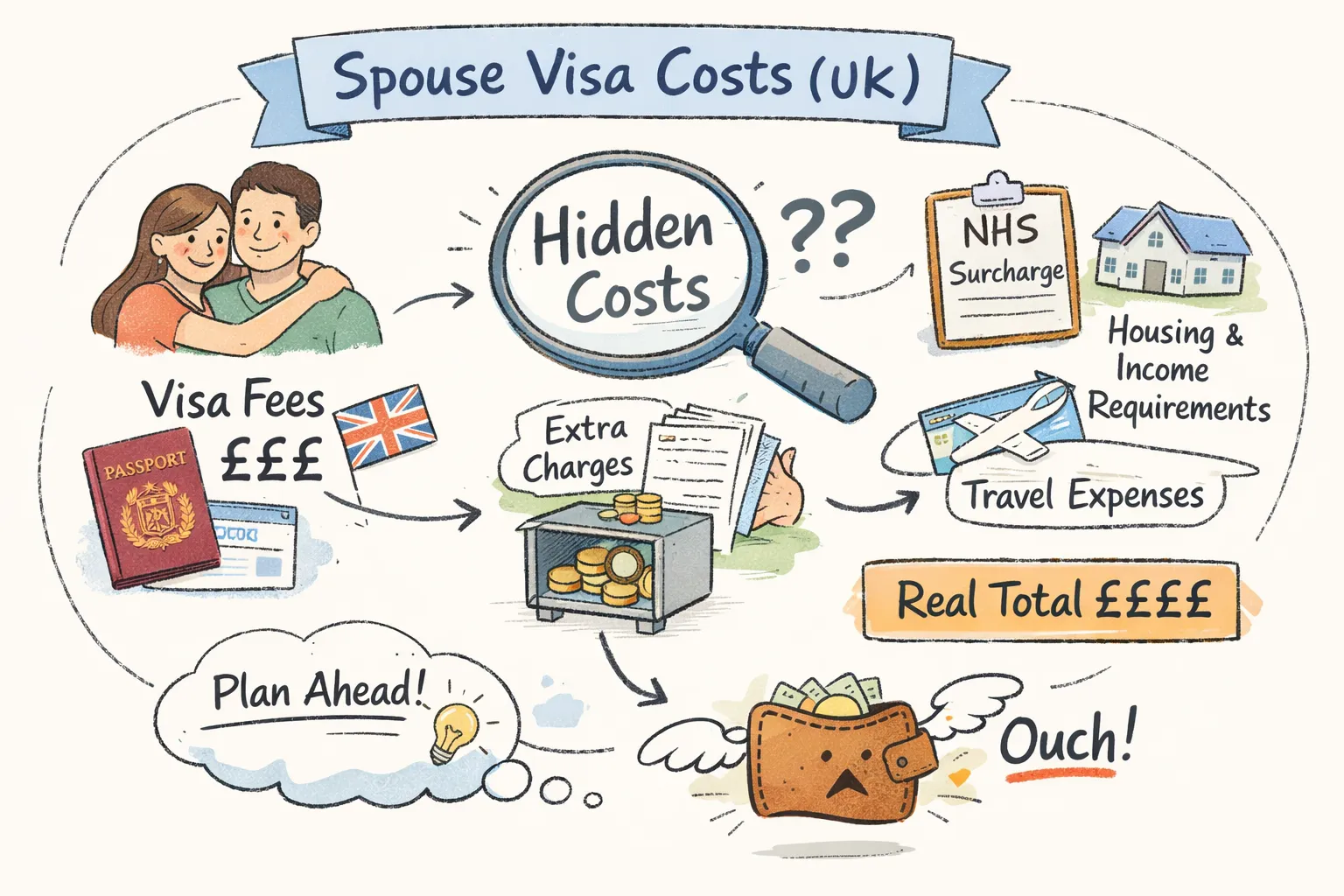
Spouse visa UK cost — the quick answer (read this first)
Spouse visa UK cost is straightforward if you treat it like a sum of parts, not a single price. Quick answer — outside the UK: application fee £1,938 plus IHS (30 months) £2,587.50 = minimum typical total £4,525.50. Inside the UK: application fee £1,321 plus the same IHS = minimum typical total £3,908.50.
Those are the starting numbers. Most applicants then add a handful of predictable extras. Keep reading and you’ll be able to calculate your full total, line by line, and download a printable checklist from ExpatsUK to avoid surprises.
Spouse visa UK cost: At-a-glance totals (2026)
| Scenario | Base application fee | IHS (30 months) | Minimum typical total (no extras) |
|---|---|---|---|
| Applying from outside the UK | £1,938 | £2,587.50 | £4,525.50 |
| Applying from inside the UK | £1,321 | £2,587.50 | £3,908.50 |
These are the sensible starting points. If your case is straightforward, that’s often all you’ll pay. But most people add at least one or two extras — tests, translations, or a priority decision.
Why the Home Office fee is only the start
The Home Office application fee is the headline number. It’s visible and fixed. It also makes people stop reading. That’s the problem.
The real cost comes from mandatory and situational extras. The biggest of those is the Immigration Health Surcharge (IHS). It’s charged per year and paid up front. That means the IHS can double or triple your headline fee.
Then there are tests you can’t skip (TB for some nationalities), translations, document certification, and optional services like priority processing or legal help. Each one by itself can feel small. Together they become the bill.
If you know the pieces, the math is simple. Break the cost into clear lines and add a modest contingency. That’s the practical approach.
Full cost breakdown (UK spouse visa fee items)
Mandatory items
- Home Office application fee Outside the UK: £1,938. Inside the UK: £1,321. This is the base charge for the partner/spouse route. Each dependant usually pays the same fee as the main applicant.
- Immigration Health Surcharge (IHS)£1,035 per year for most adult applicants. For common initial periods (30 months / 2.5 years), that equals £2,587.50. The IHS is paid when you apply.
- Biometric enrolment Biometrics are required. The collection itself is normally part of the application flow, but local Visa Application Centres (VACs) may have small administration or appointment fees. Check your VAC.
- Tuberculosis (TB) test Required for applicants from certain countries. Typical price range at approved clinics: £65–£110 (local variation applies).
Common optional / situational costs
- English language test Some applicants must show CEFR-level English (often A1 or higher). Approved tests (IELTS, Trinity) typically cost £150–£200.
- Document translations and certificationsReputable freelance translators or official translators listed by local authorities are usually cheaper than premium agencies; translations commonly cost £20–£80 per page, depending on supplier and turnaround.
- Priority services Optional if you want a faster decision. Typical UK rates: Priority ≈ £500; Super Priority (next working day) ≈ £1,000. Prices vary; check GOV.UK.
- Legal / immigration adviser fees For help with preparation and submissions. Typical range: £1,000–£3,000 for standard cases. Complexity and reputation increase the fee.
Small but real extras
- Travel costs to VACs, test centres or medical clinics.
- Postage and courier fees for returning passports and BRPs.
- Bank transfer and currency conversion fees when paying from overseas.
- Costs multiply per dependant — add the same application fee and usually IHS for each family member.
How to calculate the spouse visa UK cost — the simple formula
Here’s the one-line formula. Copy it. Paste it. Use it.
Total = (application fee × number of applicants) + (IHS per applicant × years granted) + mandatory tests + translations/certifications + VAC/courier fees + optional services (priority, legal) + contingencyStep-by-step walkthrough
- Confirm inside or outside the UK. That sets the application fee: outside £1,938; inside £1,321.
- Calculate the IHS per applicant. Use £1,035/year and multiply by the period of leave (e.g., 2.5 years = £2,587.50). For short stays, different rules apply — check the official calculator.
- Add mandatory tests (if required). TB test for certain nationalities. English test if not exempt.
- Add translations, document certification and any VAC fees. These are easy to forget but common.
- Add optional services you’ll use. Priority decision? Legal help? Add these line items now, before you book anything.
- Add contingency. 5–10% is reasonable to cover small, unexpected charges.
Use simple addition. Keep a labelled list of every payment: date, amount, reference number. That keeps your budget tidy and makes troubleshooting easier if something goes wrong.
Worked examples — copy these numbers and adapt
These three examples mirror everyday cases. Replace numbers with your own to get a precise total.
Example A — Outside UK, main applicant only, no priority, no lawyer
- Application fee: £1,938
- IHS (30 months): £2,587.50
- TB test (if required): £90
- Typical translations and misc: £80
- Total ≈ £4,695.50
Example B — Inside UK, main applicant, priority decision
- Application fee: £1,321
- IHS (30 months): £2,587.50
- Super Priority decision: £1,000
- English test and translations: £250
- Total ≈ £5,158.50
Example C — Outside UK, main applicant + 1 child, with legal advice
- Application fees: £1,938 × 2 = £3,876
- IHS adult (30 months): £2,587.50
- IHS child (30 months): £1,940
- Legal fees: £1,500
- TB tests/translations: £200
- Total ≈ £10,103.50
Notes on these examples: they’re illustrative. Replace each line with your own numbers. The most common mistake is forgetting the IHS or treating it as a small add-on — it’s almost always the second-biggest item after the base fee.
Common places applicants underestimate cost
- Thinking the application fee is the only cost.
- Forgetting the IHS is paid up front for the whole leave period.
- Underestimating translation, notarisation and certification fees for foreign documents.
- Using unnecessary priority services because of anxiety, not need.
- Paying high adviser fees for straightforward applications that don’t need legal input.
Where to pay, confirm and get the official totals
Always verify official figures before you pay. The Home Office sets the fixed fees. GOV.UK is the authoritative source.
- Family visa fees (partner routes) — check the GOV.UK visa fees pages for the latest application fee.
- Immigration Health Surcharge (IHS) — use the official IHS information and calculator to get the exact amount for your leave length.
- TB testing — the GOV.UK list shows approved clinics and the requirement by nationality.
- Visa Application Centre (VAC) — local VAC pages list appointment, handling and courier charges in local currency.
Payment flow summary
- Application fee and IHS are paid through the online application / GOV.UK system. You’ll get payment references.
- For outside-UK applications, VACs can ask for local service fees or return-postage charges in local currency — check before booking.
- Keep screenshots and save reference numbers. Treat them like receipts.
ExpatsUK tip: save the exact GOV.UK links you used when calculating the cost and take screenshots of the payment confirmations. ExpatsUK also provides a downloadable budgeting checklist to keep track of every line.
Legal help — when it’s worth the extra cost
If your case is straightforward, a clear guide and a checklist are usually enough. Most people can prepare an application without paying legal fees.
Consider paying for an adviser when:
- Your income proof is complex (self-employed, multiple income streams).
- You have previous immigration refusals or complicated immigration history.
- You have unusual family circumstances or dependent arrangements.
If you hire a lawyer, expect something like £1,000–£3,000 for a standard application. Always ask for a written, fixed-fee estimate and a clear list of what’s included.
How to avoid surprises and shave costs
- Don’t pay for priority unless you need the faster decision. Few cases require it.
- Saving Money in the UK: Tips Most Expats Miss— use reputable freelance translators or official translators listed by local authorities instead of premium agencies.
- Book tests (English, TB) early to avoid rush fees and appointment premium charges.
- Check exemptions for the English test — you may not need it.
- Reuse certified documents where possible to avoid paying for new certificates.
Checklist — what to do today (copy and paste)
- Confirm whether you apply inside or outside the UK.
- Note the correct Home Office application fee for your situation.
- Use IHS rate (£1,035/year) to calculate the total for the exact leave period.
- Check if TB or English tests are required for you and your dependants.
- Estimate translation, postage and travel costs.
- Decide on priority service or legal help. Get written quotes.
- Add 5–10% contingency for small incidental charges.
- Save payment references and screenshots of all payments.
- Download ExpatsUK’s budgeting checklist and keep the GOV.UK fee pages bookmarked.
Final takeaways — short and useful
The Home Office application fee is the headline. The IHS is often the largest line after that. Do the math before you book anything.
Use the formula. Add sensible contingency. Verify every figure on GOV.UK. And if you want a ready-made layout, use ExpatsUK’s printable checklist to track every payment and document.
If you need local details — VAC charges, approved TB clinics, or where to translate documents affordably — check the official pages and ask the ExpatsUK community for tips from people who’ve just gone through it. If you’re moving from the USA, read our Moving to the UK from USA — A Calm, Practical Plan, or if you’re arriving to study see our Apply for UK Student Visa: 2026 Step‑by‑Step Guide.