
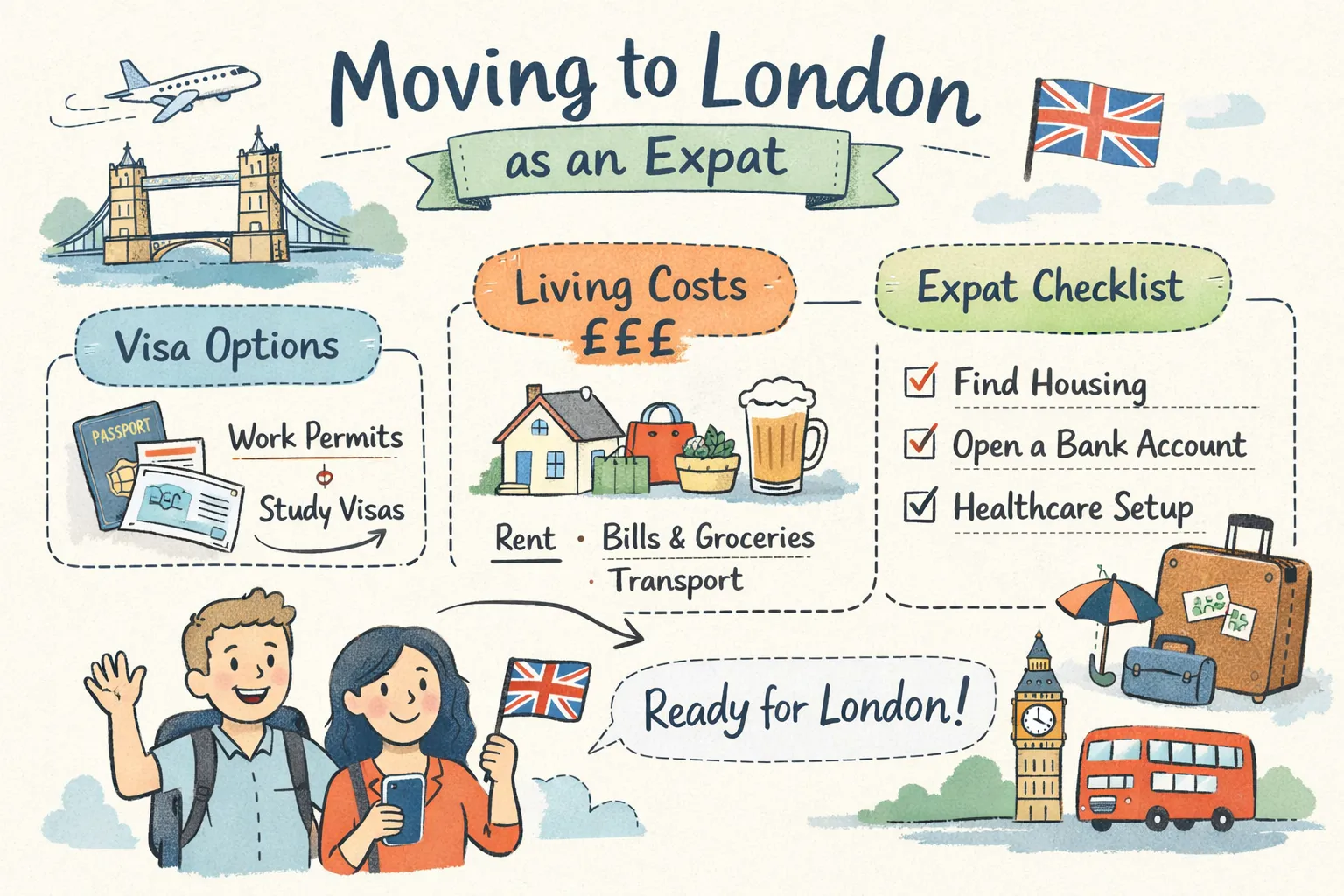
If you’re moving to London, you don’t need to empty the internet—just this plan. Read once, act fast: choose the right visa route, set a realistic budget, shortlist three neighbourhoods to view and complete the arrival admin that matters in your first month. This article gives the practical steps and numbers you’ll use on day one and the templates you’ll want on your kitchen table.
- Pick a visa path and gather documents.
- Estimate upfront cash (deposit, flights, temporary housing).
- Shortlist three neighbourhoods by lifestyle and commute.
- Book shipping/pet move early; reserve temporary housing.
- Complete week‑one admin: BRP, GP, NI, bank and SIM.
Download the free ExpatsUK printable London checklist and join your city’s ExpatsUK local group for neighbourhood tips and agent recommendations while you plan.
Which visa route is right for you? A simple decision map
Match where you are in life to the most likely routes and read that section first: employer-sponsored workers start with Skilled Worker; academics and exceptional talent read Global Talent; students follow the Student route; those with UK family links or ancestry look at Family or Ancestry options.
Skilled Worker — Employer sponsorship required; route commonly leads to settlement once salary and time thresholds are met. Prepare a certificate of sponsorship, passport, proof of funds and professional qualifications.
Global Talent — Endorsement-based for leaders in science, research, arts and now extended design roles; a route to settlement for many holders. Get an endorsement application ready first.
Student — Requires a confirmed place and maintenance funds. Note: from 11 November 2025 higher maintenance amounts apply (approx. £1,529/month in London; £1,171 outside London); check your sponsor letter and solvency rules.
Family — For partners, children or dependent relatives of UK residents; financial and accommodation evidence is key. This can lead to settlement if conditions are met.
Ancestry — For qualifying Commonwealth citizens with a UK-born grandparent; typically allows work and can lead to settlement after qualifying residence.
High Potential Individual (HPI) — For recent graduates from top-ranked universities; capped (8,000 applications annually) and since 8 Jan 2026 requires B2 English. No job offer needed but check the cap and eligibility carefully.
Global Business Mobility (GBM) — For intra-company moves and secondments; note these routes do not usually lead to settlement. From 8 April 2026 some secondment requirements changed (e.g., eligible overseas employment reduced from 12 to 6 months).
Practical flags: Skilled Worker, Family and Ancestry commonly offer routes to indefinite leave to remain; Global Talent and HPI often do too but each has its own qualifying period. Keep passports, certified degrees/transcripts, marriage/birth certificates and employer letters organised. When large sums, complex family cases or settlement questions are involved, a solicitor can save time and risk.
- Decide your starting route by answer: employer sponsor? choose Skilled Worker; endorsed leader? Global Talent; studying? Student; family ties? Family/Ancestry.
- Gather certified IDs, degree transcripts and relationship documents now.
- Confirm recent policy changes onUK visa requirements (March 2026)and useExpatsUK’s visa comparison checklistfor timelines and example documents.
Budgeting for London: realistic monthly and one‑off costs
Honest numbers beat surprises. Below are 2026 benchmark ranges so you can build realistic buffers rather than wishful spreadsheets (see recent cost‑of‑living data for London).
Monthly non‑rent costs: single professional ≈ £1,100–£1,483; family of four ≈ £3,900–£5,240. Adding rent gives these totals: single (1‑bed, Zones 1–2) ≈ £2,500–£4,400; family (3‑bed) ≈ £6,800–£10,800 depending on area and lifestyle.
| Apartment | Zones 1–2 (city centre) | Outside centre (Zones 3+) |
|---|---|---|
| 1‑bed | £1,700–£3,150 | £1,500–£2,300 |
| 2‑bed | £2,500–£4,000 | £2,000–£3,000 |
| 3‑bed | £3,000–£5,500 | £2,400–£4,000 |
One‑off moving costs to budget for include: security deposit and several weeks’ rent as deposit, first month’s rent, international shipping (approx. $2,000–$15,000 depending on size and method), temporary furnished housing (£1,500–£4,000/month for central short stays), and pet relocation costs (~$2,000–$5,000 per pet). For up‑to‑date rental trends and indexes consult the HomeLet Rental Index.
Worked example: a single professional moving into a Zone 2 1‑bed should plan ~£6,000–£9,000 upfront to cover deposit, first month, a short furnished stay and flights as a safe buffer.
Money‑saving pointers: consider flatshares to lower rent; use challenger banks like Monzo or Starling to avoid transfer fees; book sea freight outside peak season and consolidate shipments where possible.
Shortlist neighbourhoods by lifestyle: pick three areas to view
Choose neighbourhoods by commute, schools, broadband and green space — not by headline brand alone. Pick three to view: one safe bet, one aspirational, one value option.
Young professionals: Shoreditch (Hackney), Camden and Clapham. Expect 1‑bed rents roughly £1,700–£2,500 and 15–25 minute access to central hubs via Overground and Tube. These areas have cafés, co‑working and nightlife.
Families: Richmond, Wandsworth and Sutton. Look for good Ofsted ratings, parks and family‑friendly amenities. Typical 2–3 bed rents range £2,000–£3,500 with commutes of 25–45 minutes to central jobs depending on the line.
Remote workers/quiet life: Walthamstow, Chiswick and Bexley. These neighbourhoods offer better space and value, reliable broadband and quieter streets; expect commutes of 25–45 minutes when needed.
How to shortlist: use commute‑time tools, check Ofsted reports for schools, test local cafés and broadband at different times of day, and visit on a weekday evening to sense noise and transport queues. For micro‑advice on particular streets, ask your local ExpatsUK group — real neighbours know which landlords and agents are reliable.
Pre‑move timeline: documents, shipping, pets and temporary housing
3–6 months before
Start the visa process and gather certified documents: passport, birth/marriage certificates, degree transcripts and any police checks required. Research shipping quotes and compare door‑to‑door vs port pickup prices.
2 months before
Book shipping (sea for large moves, air for essentials). Begin your pet plan: microchip, rabies vaccination and required blood tests; some processes need months. Reserve a temporary furnished apartment for arrival week(s).
1 month before
Finalise travel, print key documents and confirm tenancy viewings or a short‑term rental. Cancel non‑essential subscriptions at home and notify banks about overseas moves to avoid card blocks.
Two weeks → 48 hours
Pack a carry‑on with passport, visa paperwork, BRP collection letter (if applicable), chargers, meds and emergency cash. Reconfirm pet flight details and arrival transit from the airport.
Shipping & pet notes: door‑to‑door sea freight commonly ranges from a few thousand to $10k+ depending on origin and volume; transit is typically days to several weeks. Pet moves require veterinary lead time and booking with specialist handlers—start early.
Key action: use the downloadable ExpatsUK timeline checklist to slot bookings and certificates into calendar dates so nothing is left to chance.
First month in London: step‑by‑step admin (NHS, NI, bank, SIM)
Do the essentials in week one and the rest over weeks two to four. Immediate admin unlocks work, healthcare and daily life.
- Collect your BRP (if you have one) and store visa documents safely.
- Register with a local GP surgery—registration is usually quick and doesn’t always require a proof of address.
- Apply for a National Insurance number online; you can start work while you wait for the NI number to arrive by post.
- Open a UK bank account—bring passport, BRP/visa and a tenancy agreement or official letter where possible (Monzo/Starling offer fast app setups; high‑street banks like HSBC/Barclays have branch routes).
- Buy a PAYG SIM at the airport or a local shop to get online immediately.
Weeks 2–4: register for council tax or confirm who pays it, set up utilities or confirm landlord arrangements, order broadband and check TV licence rules if needed. Apply for an Oyster card or register contactless for daily travel; investigate monthly or annual saver options once your commute is locked down.
Practical time‑savers: bring photocopies of key documents to viewings and bank appointments; some banks provide remote pre‑approval which cuts branch time. Use the ExpatsUK checklist to tick off each registration and keep scans of everything in a single folder.
Common pitfalls: signing tenancy contracts without viewing in person, wiring deposits to unknown accounts, or trusting adverts without references—always verify the estate agent and request deposit protection details.
Settling in & next steps: housing, schools and community
For longer‑term tenancy, ensure references are in order, deposit protection is confirmed and any negotiated repairs are written into the contract. Never transfer a deposit without a signed tenancy and verified agent details.
Schools and childcare: check catchment maps and Ofsted ratings, contact admissions early and have birth certificates, proof of address and previous school records ready. For competitive primary or secondary places, apply as soon as possible and ask local groups for school-specific admissions tips.
Community and belonging: join ExpatsUK local groups to meet others, swap service‑provider names and learn those small local cues (bin days, doctor surgery reputations, quiet streets). What to achieve in the first 90 days: permanent home, GP registration, National Insurance, a UK bank account, broadband and at least one local contact who can help with practical questions.
Download the ExpatsUK first‑month checklist and join your city’s group to ask questions and get recommended agents and contractors.
Moving to London is big, but it’s doable. Lock your visa path, secure temporary housing and complete the week‑one admin. Grab the free ExpatsUK London checklist and join your local group for real‑time tips — save the checklist and bookmark this plan before you fly.