
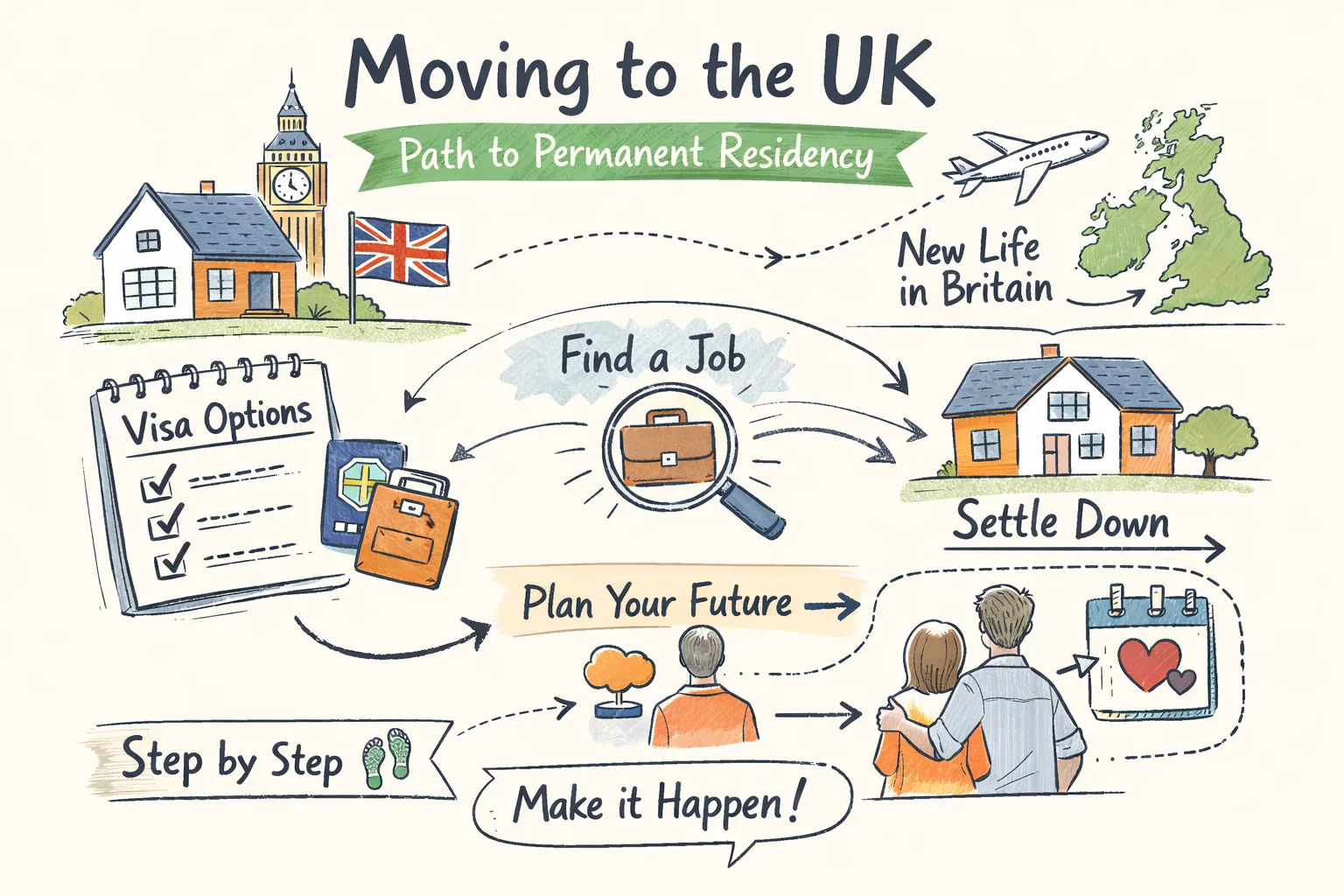
Moving to the UK permanently is a big life decision; it’s also an administrative one. This guide turns a complex path into clear choices and tasks you can act on today. Read it and you’ll be able to choose the route most likely to lead to Indefinite Leave to Remain (ILR), estimate likely fees and processing times, assemble a complete document pack, and know your next three action steps.
At ExpatsUK we’ve mapped the new 2026 rules and built a printable checklist — use it as you read. We also flag where to join upcoming local groups and message boards so you can swap real-world tips with peers who’ve already navigated the move.
1. Start here: Which routes actually lead to permanent residence?
“Permanent” in UK terms usually means Indefinite Leave to Remain (ILR): the right to live and work in the UK without time limits. After ILR most people can then apply for British citizenship if they meet additional tests and absence rules.
Different routes fit different stories. Here’s a compact decision map in plain language: if you have a UK employer prepared to sponsor you, you’re likely in the Skilled Worker / sponsored work pathway. If you’re married to or in a durable partnership with a British citizen or settled person, the family (Appendix FM) path is appropriate. If you can prove a UK-born grandparent you may qualify for UK Ancestry. Entrepreneurs and founders typically consider Innovator Founder or Global Talent; highly skilled researchers or artists often use Global Talent. Refugees and those with humanitarian protection follow separate, protected paths.
Quick filter — immediate next steps by persona: if you have a sponsor and meet the going-rate salary, start with Skilled Worker; if you’re married to a British citizen, open the Appendix FM family pathway guidance; if you have a UK grandparent gather ancestry documents; if you’re an entrepreneur, prepare endorsement evidence and a business plan for Innovator Founder or Global Talent; if you are a refugee or humanitarian claimant, check protected routes and legal support options.
If you want a printable checklist now, download ExpatsUK’s quick filter. This section points you to the detailed route breakdown and the 2026 Earned Settlement changes described below.
2. What changed in 2026 — the Earned Settlement and what it means for you
The headline reform introduced in April 2026 is the Earned Settlement model. In short: most sponsored work routes now have a 10-year baseline to settlement instead of the traditional five years. The 10-year long residence route has been abolished. The model introduces accelerators for higher earners and penalties related to public funds use and poor compliance. Certain family pathways — notably partners of British citizens — remain protected with a five-year route.
Practically, this changes planning. If you’re mid-career and expecting to qualify after five years on a sponsored visa, you now need to check whether you meet accelerator conditions that reduce the period to five or three years. Accelerators typically require a sustained taxable income above specified thresholds: for example, around £50,270 for a 5-year acceleration if consistently earned, or approximately £125,140 for a 3-year accelerator for very high earners. Roles at lower qualification levels may see baseline periods extended to 15 years.
Student, Graduate and short-term visas generally won’t count toward settlement unless you switch into a qualifying work or family route and build the required continuous period from that switch date. English language requirements have been raised in many pathways (B2 in some cases), so plan tests early. Continuity rules remain strict: excessive absences and gaps in lawful presence can reset counting.
Mini-case A: Emma, a nurse on a Skilled Worker visa, expected five years to ILR. Under Earned Settlement her role falls under a shortage occupation that still allows an accelerated 5‑year route because of the shortage listing and her salary. Emma must keep employer letters, payslips and absence records to prove continuous employment.
Mini-case B: Daniel married a British citizen. His partner pathway is protected at five years under Appendix FM. He should focus on relationship evidence and the usual financial threshold rather than the new earnings accelerators.
Reader takeaway: if you already meet or nearly meet the old five-year rules, consider applying before April 2026 where transitional provisions allow, otherwise review whether you should accelerate (accept higher paid roles), switch route, or stabilise your documentary record now.
3. Route-by-route: eligibility, timelines and the fastest paths to ILR
Every route has different criteria, evidence and timeline. Read the short blocks below to find the route that maps to your circumstances.
Skilled Worker (sponsored employment)
Eligibility: continuous employment with a Home Office-licensed sponsor, an assigned Certificate of Sponsorship (CoS), and meeting the going-rate salary. Timeline: under Earned Settlement the baseline is 10 years for many sponsored workers; accelerators to 5 years (sustained earnings around £50k for several years) or 3 years (very high earners) are possible. Evidence typically required includes the CoS, employer letters confirming start/leave dates and duties, recent payslips, P60s and bank statements showing salary credits.
Who should read this? Professionals moving on employer sponsorship. Next step: confirm with HR that your role meets the going-rate and that a CoS will be issued; gather payslips and P60s.
Health & Care and Shortage Occupations
Eligibility and timeline: many healthcare roles are on the shortage list and benefit from faster settlement accelerators. For some shortage roles the qualifying period is reduced (commonly 5 years). Evidence is similar to Skilled Worker but emphasises professional registration (e.g., NMC, GMC), job descriptions and employer confirmation of shortage-list status.
Who should read this? Nurses, doctors and care workers on shortage-coded jobs. Next step: obtain registration and a clear employer letter stating the shortage code.
Innovator Founder, Global Talent and Investor routes
Eligibility and timeline: these are the fastest realistic routes to settlement for entrepreneurs, researchers and high-achievers. Global Talent and Innovator Founder often lead to ILR in 2–3 years if endorsement conditions and business milestones are met. Evidence includes endorsement letters, business plans, evidence of funding or impact, and ongoing achievements (e.g., revenue, investment raised, publications).
Who should read this? Founders, senior researchers, or exceptional talent with a proven track record. Next step: secure an appropriate endorsement and prepare a concise evidence pack of your achievements.
Family routes (partner/spouse of a British citizen or settled person)
Eligibility and timeline: partners of British citizens on Appendix FM generally retain a protected 5‑year route to settlement. You must prove a genuine relationship, meet the financial requirement (typically a minimum combined income threshold—example starting point £18,600) or savings alternative, and show cohabitation and shared life. Evidence includes marriage/civil partnership certificates, joint tenancy or bills, photographs and correspondence.
Who should read this? Those with a British or settled partner. Next step: begin gathering relationship evidence and check whether you meet the financial requirement, or whether savings or other income sources can be used. For a practical, step-by-step checklist on partner applications see our UK spouse visa step-by-step guide.
If your case involves children or other dependants, our UK Dependant Visa: Step‑by‑Step Guide for Family explains common evidence packages and how to include dependants on an application.
UK Ancestry
Eligibility and timeline: Commonwealth citizens with a UK-born grandparent can apply for a five-year Ancestry route leading to ILR. Evidence: the grandparent’s UK birth certificate, your linking documents (birth/marriage certificates), and proof of work/residence in the UK during the qualifying period (payslips, tenancy, council tax).
Who should read this? Commonwealth nationals with a UK grandparent. Next step: collect vital records linking you to your grandparent and a record of UK employment — our detailed British Ancestry Visa guide walks through the documents you’ll need and the application steps.
Refugee and humanitarian routes
Eligibility and timeline: refugee and humanitarian protection routes have different arrangements and protections and are treated as “protected” categories in many respects. Settlement timelines can vary, and special rules govern absences and public funds. Evidence is often bespoke — decisions and legal documentation from asylum processes are central.
Who should read this? People granted refugee status or humanitarian protection. Next step: get advice from an immigration lawyer or voluntary sector adviser experienced in refugee law and secure copies of all protection decisions.
Other and legacy routes
Eligibility and timeline: victims, certain legacy visa holders and other special cases have bespoke or transitional rules. Many legacy paths require checking personal status against recent changes. If you think this applies to you, check official guidance and save any legacy documentation.
Who should read this? Holders of older visa types or those with unusual circumstances. Next step: review your paperwork and consult UKVI or a regulated adviser for a status check.
Summary: the fastest realistic routes are usually Innovator/Global Talent (2–3 years), while work and family pathways are typically the most common but may now require more time unless accelerators apply. The cost-effort trade-offs are real: endorsement-based fast routes require concentrated evidence and financial commitments; work/family routes rely on steady documentation and time.
4. From ILR to British citizenship — timing, tests and absence rules
ILR is permanent residence. Naturalisation is the grant of British citizenship and typically follows from ILR. Most applicants follow the pattern: complete the qualifying residence period (commonly five years for many routes), hold ILR for 12 months, then apply for citizenship — though spouses of British citizens sometimes use a shortened (three-year) route. Rules and exceptions vary; always confirm on GOV.UK before applying.
Key requirements: pass the Life in the UK Test, prove English language competence (or an accepted exemption), demonstrate good character (tax, criminal checks) and meet residence/absence limits. In human terms, you must have lived mainly in the UK; common practice is to avoid aggregate absences above 450 days in five years or more than 90 days in the 12 months immediately before applying, but exact thresholds depend on your route — check GOV.UK for the precise figures that apply to your case.
Practical strategy: time your Life in the UK test and English test so they remain valid at the citizenship application date, and fix any unresolved tax or criminal matters before applying. If you’re one year short of ILR, it usually makes sense to wait until you can show the cleanest continuous evidence.
Example timing: a standard five-year work applicant would take the Life in the UK test after ILR or shortly before the ILR application so the certificate is ready for both stages; a spouse-of-British-citizen on a three-year path should plan tests and document gathering to coincide with the earlier eligibility date.
5. Money and timing: fees, IHS and processing expectations
Budgeting for settlement is more than the application fee. Factor in the Immigration Health Surcharge (IHS), biometric appointments, potential sponsor costs, translation and certification, and any adviser fees.
Key numbers (as of April 2026 — always verify on GOV.UK): the IHS is roughly £1,035 per adult per year. For a five-year application that’s about £5,175 paid upfront. Home Office application fees vary by route and whether you apply in or outside the UK; Skilled Worker fees might range from around £769 to £1,751 depending on duration and immigration salary list status. Naturalisation fees are typically over £1,400–£1,600. Sponsors face separate fees like a Certificate of Sponsorship (example £525) and an Immigration Skills Charge which can be over £1,000 per year for medium/large employers.
Processing times: standard ILR decisions can take up to six months; priority services usually aim for a five-working-day decision (additional fee), and a super-priority option targets next-working-day decisions in straightforward cases for a higher fee. Outside the UK, many visas reach a decision in three weeks for straightforward applications but settlement applications can take longer.
Worked example — Skilled Worker 5-year route: suppose you apply for ILR after five years. Estimated costs might include an ILR application fee (variable, ballpark £2,500–£3,500 depending on the exact category and increases), biometrics and UKVCAS charges (c. £100–£200), and the IHS already paid on previous visas may or may not apply — expect to pay IHS at earlier visa stages; total outlay across the five years (including earlier visa fees) can reach several thousand pounds. Always verify current figures immediately before applying.
Worked example — Innovator Founder 3-year path: in addition to visa fees you will have endorsement costs and business-related expenses. The faster path can reduce years of IHS payments but often increases upfront business and adviser costs.
Budgeting tips: set aside an extra 10–20% for premium services, translations, and potential legal help. Purchase priority services only when timing is critical and your documents are already complete.
6. Complete document checklist and how to assemble a bulletproof application
Start assembling evidence early and organise it into broad categories: identity, immigration history, residence records, finances, tests and route-specific materials. The stronger your chronology, the fewer questions UKVI will have.
Core documents for most ILR/settlement applications include your current passport and BRP (or travel documents), all previous passports covering the qualifying period, your Life in the UK test certificate, English language evidence or an accepted exemption, proof of continuous residence (bank statements, council tax bills, tenancy agreements, utility bills), police certificates if required, and certified translations of any non-English documents.
Route-specific must-haves (short list):
- Skilled Worker: Certificate of Sponsorship, employer letters, last 6–12 months of payslips, P60s, PAYE records.
- Partner/Spouse: marriage/civil partnership certificate, joint tenancy, joint bank accounts, photos and communications that show shared life.
- Ancestry: birth/marriage certificates linking you to a UK-born grandparent, and proof of employment in the UK.
- Innovator/Global Talent: endorsement letters, business milestones, evidence of impact (contracts, investment, publications).
Assembly tips: create a one-page contents cover letter that lists and indexes every document you upload. Keep digital files named with a simple convention (e.g., 01_ID_Passport.pdf, 02_Immigration_BRPs.pdf). Scan at legible resolution (300dpi for photos of documents), save originals, and make two copies of anything certified. For translations use certified translators and include the translator’s declaration. Fix red flags before applying: unexplained passport gaps, inconsistent names, or long unexplained absences.
ExpatsUK provides an editable checklist and a sample cover-letter template you can download to index your files. Use these templates to save time and reduce mistakes that lead to requests for more information. For a week-by-week arrival plan that helps you collect the right documents in the first month, see our first month checklist.
7. If your application is refused — next steps, appeals and when to get expert help
A refusal isn’t the end. Read the decision letter carefully and act quickly. First, secure the full refusal letter, note any deadlines and record the precise grounds for refusal. Many remedies rely on short windows: an administrative review or reconsideration for factual errors, an appeal where rights exist, a judicial review in narrow circumstances, or a fresh application when the grounds permit.
What to do in the first 48–72 hours: save the email and the decision letter, photograph and back up the document, check whether the decision includes an appeal right and a deadline, and gather any missing evidence cited by the refusal. If the refusal is due to missing documents you may have a short opportunity to submit fresh evidence in some processes, but in others you must lodge a new application.
When to hire a specialist: bring in regulated help if you have complex immigration history, criminal records, repeated refusals, discretionary or human-rights considerations, or if deadlines for appeal are tight. Ask for OISC-regulated advisers or solicitors authorised by the Solicitors Regulation Authority (SRA). A short eligibility call with a regulated adviser is normally available and worthwhile when stakes are high.
How ExpatsUK helps: our community threads collect peer experiences of successful challenges, we list OISC-regulated advisers and solicitors commonly used by readers, and we offer a forum thread template you can use to post an anonymised version of your case to get initial peer input (not legal advice). Preventative step: before reapplying, get a pre-check of your application to close the gaps that led to refusal.
8. Your 30/90/365 day action plan — exactly what to do next
Leave this page with a simple, executable plan. The three timelines below are practical and sequential.
- 30 days — immediate: confirm which route applies to you; download ExpatsUK’s route checklist and start a digital documents folder; book the Life in the UK test and an accepted English test (slots fill fast); if you have an employer sponsor, speak with HR about salary, going-rate compliance and the CoS.
- 90 days — medium-term: collect 3–5 years of financial and residence evidence (bank statements, council tax, tenancy), resolve any name or document inconsistencies (passports, marriage certificates), document any salary increases or role changes if you plan to accelerate on earnings, and decide whether to consult a regulated immigration adviser for a pre-check.
- 365 days — long-term: keep a running record of absences in a calendar, back up all documents monthly, reassess eligibility against Earned Settlement accelerators annually, and save towards fees and IHS; plan for priority service only if your timing is critical and your documents are complete.
Small habit that helps: each month, save a single “snapshot” PDF containing your latest payslip, bank balance, council-tax or tenancy evidence and a brief note of any travel — build the residency chronology before you need it.
Strong CTA: use the ExpatsUK printable checklist and join the relevant local group for peer tips — download the First 30 Days in the UK checklist and, if needed, book your Life in the UK test now.
Conclusion
Settling in the UK is a practical project you can plan for: choose the route that matches your circumstances, gather the evidence early, and time tests and finances to fit that route. Two key points to remember are (1) the April 2026 Earned Settlement changes make documentary continuity and earnings central to planning, and (2) the fastest paths are endorsement-based but most people follow work or family routes that require steady records over time.
If you’re unsure which route suits you, use the ExpatsUK checklist to map your situation, post an anonymised summary in a local group for peer experience, or book a short call with an OISC-regulated adviser. Start with the checklist — it will show you the exact documents to collect today.