
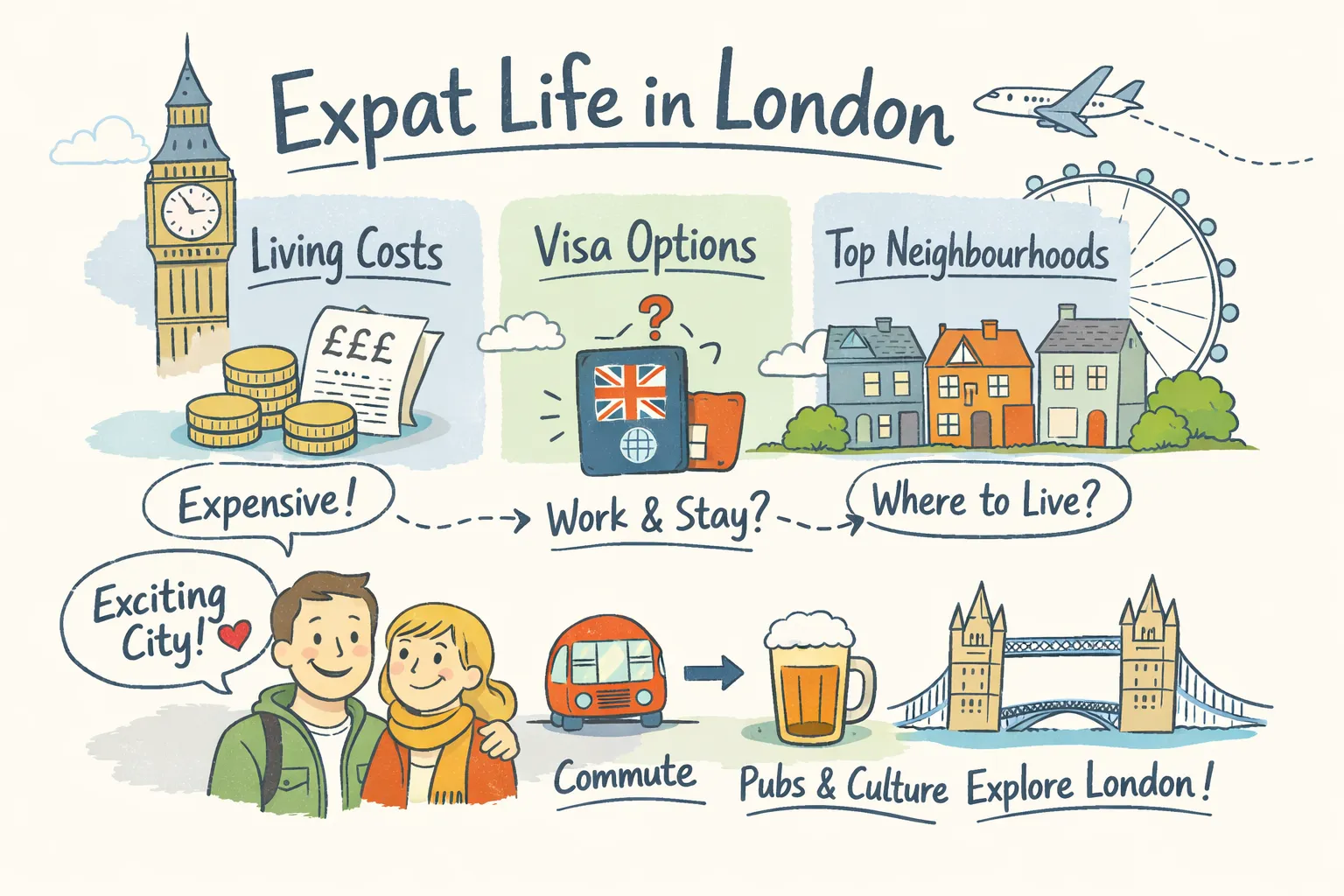
A quick reality check: London is magnetic — and complicated
London draws people for work, culture and the sheer momentum of opportunity. It also demands time, money and paperwork. Read this guide if you want a fast, practical decision: by the end you should know whether London fits your priorities, have a realistic monthly budget you can adapt, a plain-English visa roadmap, a shortlist of neighbourhoods that match your life, a 30/90/365 moving plan, and low-friction ways to meet people.
ExpatsUK is the neighbourly compass in this article — we’ll point you to local guides, downloadable checklists and community groups you can use next. Think of this as the friendly, sharply practical briefing you’d get from a neighbour who’s already moved three times across town.
Why this guide — and how to use it
Spend five minutes on the short self-test below. Answer honestly: it’s designed to save you weeks of wasted searches if London isn’t the best match right now.
- Career: Do you have or realistically expect a London-level salary or a sponsored job in your field? (Yes / No)
- Budget floor: Can you cover rent and essentials comfortably at roughly £1,500–£2,500 a month as a single person depending on location? (Yes / No)
- Family needs: Do you need specific schools, a garden or childcare options that aren’t negotiable? (Yes / No)
- Commute tolerance: Are you willing to trade commute time (30–60+ mins) to lower rent? (Yes / No)
- Social priorities: Do you want a fast social life (short-term networking) or steady local ties (schools, clubs)? (Fast / Steady)
If most of your answers are “No” or “Steady + No” you may be better off testing another UK city (Manchester, Birmingham, Edinburgh) or delaying the move until you have a stronger job offer. If you answered “Yes” to career and budget floor, London is worth exploring now.
How ExpatsUK helps: use our neighbourhood profiles to compare travel times and schools, download the budget spreadsheet to plug in your numbers, and join a local message board to ask current residents targeted questions. We also maintain updated immigration and rent trackers so you’re not relying on months‑old listings or rules.
Realistic London budgets: sample monthly plans and the trade‑offs
Rent is the single biggest variable. Move a few miles outward and you can halve housing costs, but your commute and weekly time budget will change. Below are three honest monthly templates based on 2025–26 data you can adapt in the downloadable spreadsheet.
- Tight single (shared flat in outer borough): ~£1,400–£1,900 total/month — rent £850–£1,000, bills & groceries £650–£900.
- Comfortable single (Zone 1–2 one‑bed): ~£2,500–£3,200 total/month — rent £1,900–£2,700 plus utilities and transport.
- Family of four (3‑bed, outer borough): ~£3,800–£5,000 total/month — rent £2,000–£3,500; childcare and schooling add widely varying extra costs.
Typical monthly line items to plug into your own plan: utilities and broadband often average around £317; transport ranges £132–£180 (monthly Zones 1–2) depending on travel patterns; groceries £200–£300 per adult; entertainment £80–£125; private top‑up health insurance roughly £85–£125 per person if you choose it. These non‑rent costs add up — a £2,000 rent pushes the total roughly into the £3k+ zone unless you actively economise.
Common money trade‑offs are predictable. Live further out to save on rent but check fast train options (some outer towns have excellent commuter links that keep door‑to‑door times reasonable). Flatshare to dramatically lower housing costs, especially in expensive central wards. If you have children, budget for childcare or school fees early — these can eclipse transport savings.
Practical savings checklist (quick wins): choose a realistic Tube zone and lock that into your search; split utility bills in shared flats; use budget supermarkets for basics; avoid searching at peak rental season (late summer); and use ExpatsUK’s spreadsheet to test scenarios (zone vs rent vs commute time) before signing anything.
Visa routes & timelines: a plain‑English roadmap
There are a handful of routes most internationals use to move to London. Below are the essentials and realistic timelines so you can plan the move, not just dream about it.
Skilled Worker
What it is: a sponsored job route. You need a Certificate of Sponsorship from a licensed employer and to meet the skills and salary thresholds. Practical threshold guidance for 2026 sits around £41,700 as a common benchmark; the role must meet the required skills level. From 8 January 2026 many routes require B2 English (an upgrade from B1).
Timelines & pathway: employers usually issue a CoS, you apply and decisions typically follow within around three weeks (priority services can be faster). Initial permission is granted for up to five years; path to settlement has been updated to a longer timeline for many roles (around 10 years for standard routes unless higher income fast‑tracks you).
Global Talent
What it is: for leaders or potential leaders in science, arts, tech and other designated fields. You need endorsement from an approved body, not a job offer, making it attractive for researchers and senior creatives.
Timelines & pathway: endorsement can take a few weeks, visa decisions commonly around three weeks. Settlement can be notably quicker — some holders reach settlement in about three years depending on category.
Family visas
What it is: for joining a partner or family member who is settled or a citizen. The sponsor typically needs to meet an income threshold (around £29,000 under current guidance), provide accommodation evidence and prove the relationship is genuine.
Timelines & pathway: initial grants are commonly 30 months (extendable). Processing can take a few weeks to months depending on complexity. Reforms have raised settlement timelines in many cases, so check the latest rules if you rely on family sponsorship for settlement.
Students and ETA/eVisa context
Student routes remain straightforward for enrolled courses; short‑term visitors should check the new ETA requirement for visa‑free nationals (rolled out in 2026). The UK is also moving to digital eVisas by late 2026 — plan for biometric appointments and earlier application for peak seasons.
Practical pre‑apply checklist:
- Valid passport and clear scans; certified translations of any non‑English documents.
- Sponsor documents or employer CoS where relevant; a template sponsorship/cover letter for your employer helps speed approvals.
- Proof of funds if required (bank statements, asset letters) and supporting living‑cost calculations.
- English test certificate where required (note B2 changes) from an approved provider.
- Biometrics appointment booked promptly and Immigration Health Surcharge (IHS) paid during application when applicable.
Red flags and quick wins: double‑check appointment slots immediately; pay IHS at the same time as the application to avoid processing delays; use priority services for urgent decisions; and keep template scripts handy to ask employers about sponsorship paperwork. ExpatsUK provides visa checklists and employer email templates you can copy for speed. For complex or high‑value cases consider regulated legal advice and always check gov.uk for live rules.
Healthcare & insurance: how to use the NHS and when private cover makes sense
On arrival you’ll usually register with a local GP practice — practices cannot routinely refuse registrations based on immigration status and you don’t normally need proof of address to register. A GP handles routine care, referrals and prescriptions; A&E is for true emergencies, and walk‑in centres cover minor urgent needs.
The Immigration Health Surcharge (IHS) is charged as part of many visa applications. For 2026 the standard adult IHS is roughly £1,035 per year (students and certain categories pay a reduced rate). The IHS gives you hospital and specialist access through the NHS without further charge, but it does not replace private insurance: dental care, some prescriptions and faster private outpatient access normally sit outside the IHS.
When to buy private international health insurance: short‑stay visitors and anyone who wants faster specialist access should consider it. Families often find employer‑sponsored plans the best value; private providers commonly used by internationals include Bupa, Cigna, Allianz and AXA as examples. Private plans are especially helpful if you have pre‑existing conditions, need direct billing for specialists, or want global cover.
Practical NHS checklist for the first week: register with a GP, find your nearest A&E and a convenient walk‑in clinic, get a local SIM (for appointment confirmations), and check whether your employer offers private top‑up cover. If you pay IHS as part of your visa, keep the confirmation in your records — it will speed hospital admin if needed.
Where to live: neighbourhoods that match your priorities (and how much they’ll cost)
Central vs outer trade‑offs are about money, time and lifestyle. Central wards cost substantially more; outer boroughs save rent but increase commute time. Use the short table below as a practical matchmaker, then score neighbourhoods on budget, commute and lifestyle. For more detailed neighbourhood profiles see the London Expat City Guide, expatsuk.net.
| Priority | Neighbourhoods (example) | Typical 1‑bed rent signals |
|---|---|---|
| Young professionals / creative | Shoreditch, Hackney, Camden, Bermondsey | Higher: central premiums, Zone 1–2 |
| Finance / City workers | Canary Wharf, Islington, Westminster, Zone 2 commuter towns | High in City/Canary Wharf; commuter towns cheaper with fast links |
| Families (space & schools) | Richmond, Wimbledon, Chiswick, Dulwich | Higher rents, more family housing and good schools |
| Budget‑conscious newcomers | Croydon, Bexley, Barking & Dagenham, Sutton | Lower rents; longer commutes |
| Quiet / village feel | Greenwich, Putney, Hampstead | Varies widely; green space but can be pricey |
Shortlisting method: make a simple 3×3 grid with budget (low/medium/high), commute tolerance (short/medium/long) and lifestyle (nightlife/family/quiet). Score each neighbourhood and shortlist the top three for viewings.
During viewings ask concrete questions: how noisy is the flat at night, what is the heating system and its running costs, which council tax band applies, and what is a typical commute door‑to‑door at peak time. Avoid scams: use established platforms (Rightmove, Zoopla, SpareRoom), never pay large sums before viewing in person or verifying the landlord, check the Energy Performance Certificate (EPC) and request written tenancy terms. Deposits typically equal five to six weeks’ rent and are protected in a government scheme — make sure you get the deposit protection details in writing.
Working in London: salaries, taxes and how to negotiate an offer
Salaries vary by sector. Typical medians (2025–26 context) put finance and senior technical roles higher (finance ≈ £59k+, tech ≈ £53k+; healthcare practitioners and some professional roles often sit in the £60k range). London’s overall median salary sits around the mid‑£40k area, so comfortable single living commonly requires offers in the £45k–£50k region depending on rent.
Tax basics: you pay income tax and National Insurance through PAYE. The personal allowance is roughly £12,571; basic rate income tax applies up to around £50,270, and higher rates apply above that. National Insurance contributions reduce take‑home pay further. Use a current net‑salary calculator for precise monthly figures — as a rule of thumb, a £50,000 gross salary produces net pay in the high £30ks annually after tax, NI and common pension deductions, leaving room for a decent central or outer London lifestyle depending on rent.
Negotiation points for internationals: request a London weighting or relocation allowance, ask whether the employer covers sponsorship costs, negotiate a housing or settling allowance for the first months, and seek private healthcare where appropriate. For senior hires ask about equity, bonus structure and home‑leave flights for families. Recruiters, industry meetups and targeted LinkedIn outreach work well; ExpatsUK’s local groups are also useful for informal referrals and insider salary expectations.
Moving day to one year: a practical 30/90/365 checklist
Pre‑move (6–12 weeks)
Confirm visa and passport, book temporary housing for your first 2–4 weeks, gather certified copies and translations, give notice on your current accommodation, decide what to ship vs sell, arrange pet travel paperwork if needed, and subscribe to a basic travel/health insurance for transit and early arrival.
Arrival week
Collect your Biometric Residence Permit if applicable, register with a GP, buy a local SIM, open a simple bank account (many challenger banks allow fast onboarding), and get an Oyster/Travelcard or activate contactless payments for travel. Keep hard and digital copies of all immigration paperwork in one place.
First 30 days
Apply for your National Insurance number if required (see the week-by-week checklist), finalise long‑term housing, set up utilities and broadband, register children with schools, and begin local admin such as council tax setup and TV licence if needed. Join a local class or group to force a few social interactions — it’s the simplest habit that speeds up belonging.
30–90 days
Move fuller services to UK providers (GP transfers, dental registration), set up pension contributions, firm up long‑term finance arrangements, and make appointments for any specialist healthcare needs. Use the time to test commute options and refine your budget spreadsheet with real costs.
First year
Review finances and insurance, consider settlement or citizenship timelines if relevant, open longer‑term investment or savings accounts, and map out schooling or career development plans. ExpatsUK offers a downloadable one‑page moving checklist that mirrors this timeline — print it and tick boxes as you go. American readers may also find the American Expat in the UK: Your No‑Nonsense 90‑Day Guide – expatsuk.net helpful for a US‑focused perspective.
Making friends and building community: practical ways to belong
Meeting people in a city of eight million is about lowering friction. Start with places where conversation is natural: local school gates, hobby classes, Meetups, co‑working spaces, volunteering and regular sports clubs. Small repeat commitments — a weekly tennis slot, a monthly dinner invite list of five people — compound into a reliable circle within months.
Two short outreach templates you can use on local forums or message boards:
“Hi — I’m new to London and moving to [neighbourhood] next month. Any recommendations for family‑friendly GPs or a playground nearby?”
“Hello — moving into a 2‑bed in [area] and looking for a friendly flatmate. Flexible start date, tidy, works in tech. DM for details.”
Use ExpatsUK to plug in: find your nearest local group, start a meet‑up thread, post a flatshare note or ask for trusted tradespeople. The portal is intentionally peer‑sourced — it’s where newcomers trade the practical tips that save time and avoid headaches. If loneliness or culture shock hits, look for expat therapy groups, local counsellors or short‑term volunteering to add meaning and structure.
Wrap + next steps
Takeaway: after this article you should be able to (1) pick a realistic monthly budget and see how rent drives every decision, (2) choose the most likely visa route and gather the documents you’ll need, and (3) shortlist three neighbourhoods and follow a 30/90/365 plan that gets you settled fast.
Immediate actions: download ExpatsUK’s one‑page moving checklist and the budget spreadsheet, join your local ExpatsUK group to ask specific neighbourhood questions, and bookmark the relevant gov.uk pages for live visa and IHS updates. If you’re comparing cities, run the five‑question self‑test again after two weeks of research — decisions based on facts will save you time and stress. Also read the Things I Wish I Knew Before Moving to the UK, expatsuk.net article for practical surprises to expect.
The leap is big, but London rewards thoughtful planning. If you want a next step right now: open the spreadsheet, plug in your rent target and commute tolerance, and start a thread in your local ExpatsUK group asking about real‑life commute times on a weekday morning. We’ll be there to answer the practical questions you’ll only learn from people who’ve done it.