
Short visitor (<6 months): Yes — buy travel or short‑term international medical cover that includes medical evacuation and repatriation.
Visa-holder who paid the IHS: Usually no — the IHS gives NHS access; consider private only if you want faster elective care or continuity for a family.
Family with young children: Consider — add outpatient, dental and paediatric access if rapid specialist appointments or continuity of care matter to you.
Retiree / frequent traveller: Yes — choose an international plan with worldwide cover and medical evacuation; note USA inclusion sharply raises premiums.
Quick decision flow — answer yes/no/consider
- Are you staying more than six months and have you paid the IHS (or are otherwise resident)? If no → you need travel/short‑term insurance (yes).
- Do you value faster access to private consultants, diagnostic tests or elective treatment? If yes → consider private cover (yes).
- Do you travel frequently or need medical evacuation/repatriation? If yes → choose international cover (yes).
- Do you have significant pre‑existing conditions but can wait longer for NHS treatment? If yes → you may rely on NHS; if not, consider private with favourable underwriting (consider).
Why this matters now: the 2026 Immigration Health Surcharge (IHS) update and ongoing NHS capacity pressures mean residency status and wait times matter more than ever when you plan health cover. This guide walks you through NHS eligibility, the 2026 IHS rules and rates, what private insurers actually buy you, typical costs, recommended providers and a step‑by‑step buying checklist. ExpatsUK produced this practical checklist — you can download a printable version from our resources page to work through quotes and registrations.
Who can use the NHS — eligibility, the IHS and key exceptions
The simple legal test for free NHS access is whether you are “ordinarily resident” in the UK — in plain English, that means you live in the UK lawfully and your life is settled here for the time being. Ordinarily resident is about your residence status and intentions, not whether you pay UK tax or National Insurance; the NHS will ask for evidence when necessary. If you have specific questions about entitlements, see Can I use the NHS as an expat?
For most non‑EEA nationals the practical route to NHS access is the Immigration Health Surcharge (IHS). If your visa is for more than six months and you have paid (or are exempt from) the IHS, you are treated as eligible for NHS services on the same basis as a UK resident. Visitors who arrive for six months or less are not covered for routine NHS care and should have travel or short‑term international medical insurance instead.
2026 IHS headline rates The headline IHS rates in 2026 are £1,035 per year for most adult visa applicants (dependants aged 18+ pay the same), and £776 per year for students, under‑18s and Youth Mobility Scheme applicants. The surcharge is charged pro‑rata by visa length; for short in‑country extensions of six months or less a half‑rate applies (e.g., adult half ≈ £517.50; student half ≈ £388). IHS payment is usually part of your visa application and failure to pay can lead to a visa refusal.
EU/EEA/S1 and settled status If you hold settled or pre‑settled status under the EU Settlement Scheme you qualify as ordinarily resident. Pensioners or posted workers with an S1 form register their S1 with the Overseas Healthcare Team to secure state‑funded care. Post‑Brexit rules are varied — check your personal status and S1 registration if applicable.
How to check and register — practical steps Find out quickly by checking your BRP (Biometric Residence Permit), visa decision letter or IHS receipt. To register with a GP: locate your local practice on the NHS website, phone or drop in, and bring ID (passport), BRP/visa and proof of your address (tenancy, utility bill). GP practices usually accept new patients on the spot; your NHS number is sent by post or available via the practice in a few weeks.
Common pitfalls: arriving thinking you have instant full NHS access, failing to register children and dependants, or missing IHS payments and deadlines. Address these early — registration with a GP should be among the first administrative tasks after arrival.
What the NHS actually covers — free services, charges and blind spots
For those who are eligible, the NHS provides a broad core of care free at the point of use: GP appointments, A&E emergency treatment, inpatient hospital care, maternity services and most mental‑health services. For a concise breakdown of entitlements, see What services are free under the NHS? Secondary care and hospital treatment are included once you are treated as resident (IHS‑paid or ordinarily resident). Prescription charges still apply in England for many adults, and dental and optical services are commonly charged or have limited free entitlements.
There are practical gaps that lead many people to top up with private cover. Non‑urgent specialist referrals, advanced diagnostics (e.g., quick MRIs, PET scans), elective procedures and choice of consultant can come with long waits in the NHS. The NHS will treat pre‑existing conditions once you are eligible, but it will not provide repatriation or international medical evacuation. Some advanced elective therapies or expedited fertility and mental‑health services packages are also more accessible through private providers.
If you rely on fast access to elective care (for example fertility treatment, rapid mental‑health therapy sessions, or private diagnostics), private plans fill that gap. Private cover can also let you choose the consultant or hospital and avoid NHS queue times for non‑urgent items—important if your job or travel plans don’t allow delays.
Always verify statutory fee figures on GOV.UK — this guide gives direction and benchmarks but not the exhaustive legal fee list.
Private and international health insurance — what extra do you actually get?
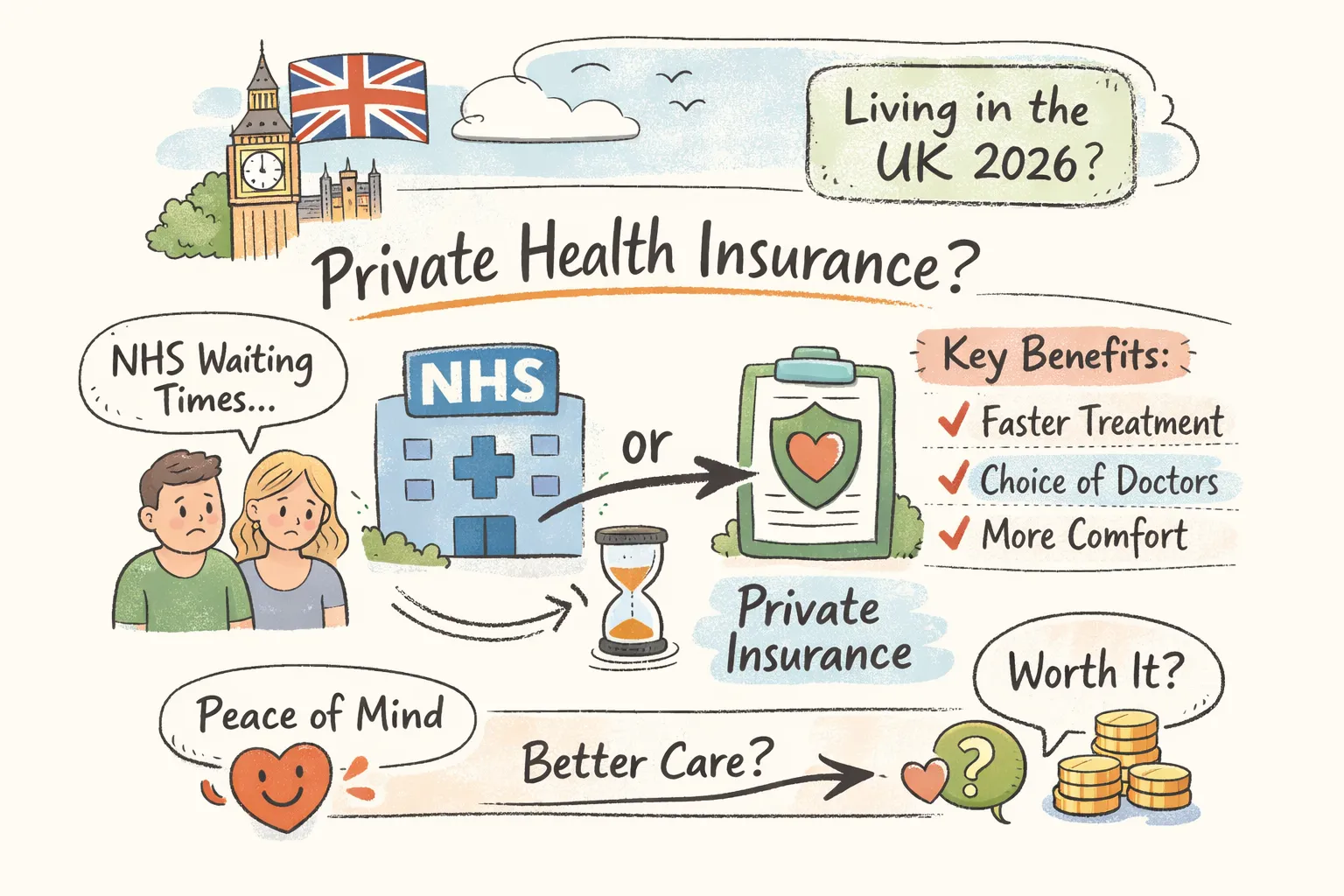
Private and international plans buy three practical things beyond core NHS entitlements: speed, choice and portability.
Speed: private plans typically offer much quicker access to specialists and diagnostics — a private referral can reduce wait times from months to weeks or days. Choice: private cover gives you a choice of consultant, hospital and often private rooms or faster elective surgery scheduling. Portability: international plans extend cover outside the UK, include emergency evacuation and repatriation, and offer 24/7 global assistance lines and second‑opinion services.
Private plans also commonly package outpatient therapy, physiotherapy, dental and optical cover, and value‑added services such as mental‑health programmes, health checks and telemedicine. That said, private policies have limits: they rarely cover purely cosmetic procedures, experimental treatments not widely accepted, or costs beyond authorisation limits. Authorisation processes vary — inpatient admissions usually require pre‑approval and many insurers operate preferred hospital networks for direct billing.
Pre‑existing conditions are the biggest underwriting issue. The NHS does not exclude you from care based on medical history (once eligible), but private insurers often apply moratoriums (temporary exclusions), specific exclusions or price loadings, or they use full medical underwriting with immediate exclusions for declared conditions. If you have significant history, compare moratorium terms carefully or seek insurers offering favourable specialised underwriting.
Hybrid approach: many expats use private services for diagnostics and early specialist reviews to speed diagnosis, then continue treatment on the NHS. This can be an efficient way to get fast answers while avoiding high annual private premiums for long-term care. If you are still weighing the central question of whether to buy a policy, see Do I need private health insurance? for scenario-based guidance.
Who should seriously consider private cover? Practical expat scenarios
Here are short, practical recommendations for common situations and the minimum policy features to look for.
Short‑term visitor / tourist (<6 months) Recommendation: buy travel or short‑term international medical insurance that includes emergency medical care, medical evacuation and repatriation. Minimum features: emergency medical cover, evacuation/repatriation, high hospital limits, and Covid/epidemic cover where relevant. Ask insurers: does it include repatriation? Are pre‑existing conditions accepted or excluded?
Student (IHS‑paid) Recommendation: IHS is usually sufficient for emergencies and general NHS access; consider private or university plans for fast outpatient mental‑health support or specialist referrals. Minimum features: outpatient mental‑health benefit, dental/optical add‑ons if needed, and low excess. Ask insurers: how quickly can I access private mental‑health consultations? Is outpatient counselling included?
Skilled worker with IHS (long stay) Recommendation: rely on the NHS for major care; buy private if faster elective access or continuity for dependants matters. Minimum features: outpatient/physiotherapy options, family cover for dependants, and reasonable authorisation turnaround. Ask insurers: are dependants covered immediately? What are outpatient sub‑limits?
Family with young children Recommendation: consider family‑friendly plans offering paediatric outpatient care, dental and easy GP/paediatrician access. Minimum features: paediatric outpatient limits, dental and vision add‑ons, and a family excess option. Ask insurers: do you have paediatric networks and childcare mental‑health support?
Expat with pre‑existing conditions Recommendation: check NHS coverage first (treatment is typically available); if you need speed or private continuity, prioritize insurers with sympathetic underwriting or pre‑existing cover options. Minimum features: favourable moratorium terms, specialist continuity clauses, and clear exclusions list. Ask insurers: how are my specific conditions treated and what waiting periods apply?
Frequent traveller / globetrotting professional Recommendation: choose international health insurance with worldwide cover and evacuation/repatriation, and ensure continuity across countries. Minimum features: worldwide cover (with appropriate exclusions), medical evacuation, 24/7 assistance. Ask insurers: is evacuation covered worldwide and are there territorial exclusions?
Retiree / US‑bound expat Recommendation: expect higher premiums, especially if you want US cover; many retirees combine NHS use with an international top‑up for evacuation and short US visits. Minimum features: repatriation, travel medical limits, and optional limited US cover. Ask insurers: what is the cost to include the USA and are there limits for travel periods?
Top expat‑friendly insurers in 2026 — a short comparison
| Provider | Best for | Headline benefits | Key exclusions / considerations | What to ask |
|---|---|---|---|---|
| Cigna | Global portability | Flexible global plans, modular benefits (dental, vision, wellness), strong expat focus | Premium pricing for top tiers; US cover raises cost | Does this plan include medical evacuation and second opinions? How are pre‑existing conditions handled? |
| AXA Health / AXA Global Healthcare | UK + international modular plans | Good digital tools, outpatient and mental‑health options, AXA Select hospital network | Can be pricier at higher levels; check network vs open access | Is the plan UK‑centric or worldwide? What outpatient sub‑limits apply? |
| APRIL International | Frequent movers / short terms | Expat‑focused, online claims, flexible short‑term options | May exclude long‑term chronic management in early years | Does this cover short gaps between countries? How are renewals handled? |
| Vitality | Wellness‑focused private cover | Telehealth, wellness incentives, outpatient and mental‑health benefits | Worldwide options limited compared with pure global players | Are telehealth and mental‑health services available internationally? |
| Aviva | UK‑focused private plans | Strong UK network, digital GP and competitive outpatient options | Less emphasis on worldwide portability | Does this plan support direct billing in UK hospitals? What outpatient limits exist? |
| Bupa (Bupa Global) | International reputation, global networks | Worldwide access, strong inpatient/outpatient options, well known for customer service | Premiums reflect brand and global reach | Can I tailor zones (exclude USA) to lower cost? What is your claims turnaround? |
| WPA | Smaller UK‑focused alternatives | Good UK GP and outpatient support, competitive pricing for UK residents | Limited global portability | Is international cover available and on what terms? |
How to read provider quotes: in every quote watch annual limits, outpatient sub‑limits, excess options, network vs open access and the policy currency. Note whether inpatient care requires pre‑authorisation and whether the policy reimburses you or pays hospitals directly. The “USA included” option typically multiplies premiums — if you expect US stays, get explicit pricing for time‑limited US cover.
How to estimate cost and buy the right policy — a step‑by‑step checklist
Inputs you need for realistic quotes: ages and family composition, current residency/visa status and IHS payment, postcode (risk rating), desired geography of cover (UK only / worldwide excl. USA / worldwide incl. USA), outpatient needs, dental/vision add‑ons, preferred excess level and whether you require repatriation or medical evacuation.
2026 indicative benchmarks (illustrative only)
| Profile / Level | Typical annual range (2026 indicative) |
|---|---|
| Young adult, basic UK‑focused | £500 – £2,000 |
| Mid‑tier expat (worldwide excl. USA), single 30s | £2,500 – £5,000 |
| Family (2 adults + 2 children), mid‑tier | £8,000 – £15,000 |
| Comprehensive international (incl. USA) or older age bands | £10,000 – £25,000+ |
Benchmarks vary widely with age, territory and outpatient inclusion; use these only as planning guides.
- Decide your primary need: speed/choice, worldwide portability, or repatriation.
- Gather personal details and recent medical history for accurate quotes.
- Get at least three quotes (direct and via a broker) and ensure you are comparing identical benefit packages.
- Check underwriting style: moratorium (time‑based) versus full medical underwriting (immediate exclusions for declared conditions).
- Review authorisation, claims and customer service reviews for each insurer.
- Confirm cooling‑off period, cancellation terms and refund rules before committing.
- If you arrive before IHS‑eligibility, buy travel/short‑term cover that includes repatriation and medical evacuation.
Worked example — illustrative only A 35‑year‑old professional seeking mid‑tier worldwide (excl. USA) cover might expect an indicative annual premium of ~£2,400 (£200/month). Choosing a £500 excess could reduce that premium by ~10% (to ~£2,160/year or £180/month). Conversely, adding USA cover or insuring dependants typically multiplies the premium significantly. Use actual quotes for budgeting — underwriting and postcode materially change figures.
Final checklist, quick FAQs and where ExpatsUK can help next
- If you’re arriving <6 months, buy travel/short‑term cover with evacuation before you travel.
- Pay the IHS if your visa requires it and save the receipt; missing it risks refusal.
- Register with a GP and get your NHS number — bring passport, BRP/visa and proof of address.
- Decide whether private cover is for speed/choice or international portability.
- Gather three quotes and check underwriting style and outpatient limits.
- Start private cover if needed and store insurer emergency contacts in your phone.
- Keep a printed and digital copy of your policy and the ExpatsUK checklist in your relocation folder.
Quick FAQs
Does private replace the NHS? No. Private insurance supplements the NHS by offering speed, choice and extra services; it does not nullify your NHS entitlements.
Will having private affect my visa? No. Holding private insurance does not replace IHS obligations and does not affect visa decisions. IHS payment (where required) remains a separate legal requirement.
Can I use both NHS and private? Yes. Many expats use a hybrid model: private diagnostics or consultations, then NHS treatment, or private for elective procedures and NHS for emergency care.
What about pre‑existing conditions? The NHS treats pre‑existing conditions once you’re eligible. Private insurers typically apply moratoriums, exclusions or loadings — always ask for the insurer’s exact underwriting stance on your condition.
How ExpatsUK can help
ExpatsUK provides step‑by‑step NHS and IHS how‑tos, insurer write‑ups and a printable buying checklist to guide you through quotes and registrations. We also publish nationality‑specific guidance (US, Australia, Germany and others) and are building local groups and message boards so you can hear real claims and service experiences from neighbours. Download UK Health Insurance for Foreigners: A Friendly Guide from ExpatsUK to compare quotes side‑by‑side and join the community to ask peers about local provider experiences.
One final point: check GOV.UK for the definitive legal information on IHS, S1 registration and visitor charging rules; use insurer FAQs for plan‑specific exclusions. If you’re unsure which route to take, start with a short travel policy on arrival, register with a GP, pay any IHS required for your visa and then get tailored quotes once your residency and family situation is settled.
Key takeaways: if you’re not resident or haven’t paid the IHS, you need travel or short‑term cover. If you are resident/IHS‑paid, the NHS will cover most core care, but private or international insurance is worth serious consideration when you need speed, wider choice or medical evacuation.
Download the printable checklist on ExpatsUK to work through the steps above and join our upcoming local groups to compare insurer experiences with other expats in your area.