
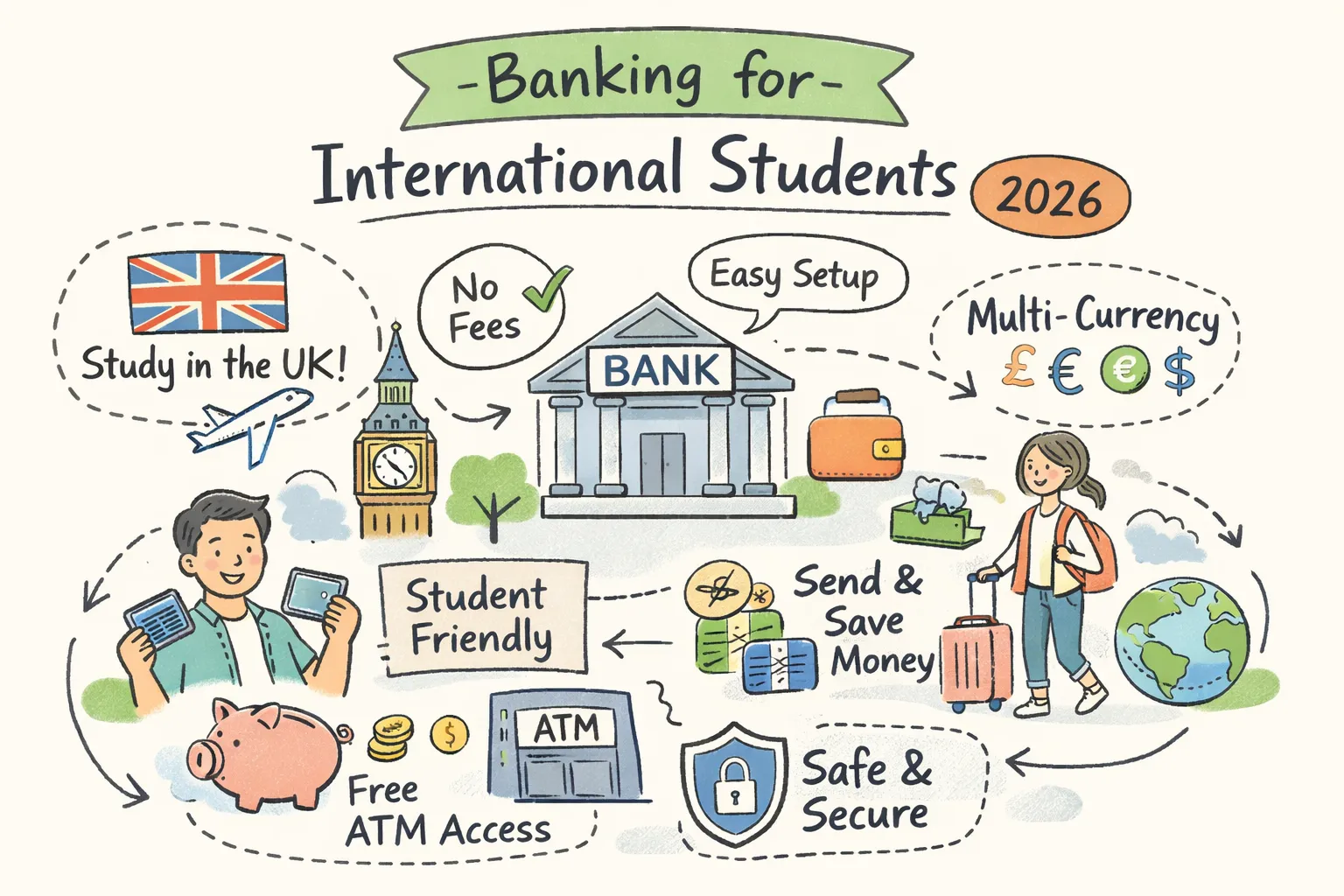
Opening a UK bank account is one of the first—and most useful—tasks you’ll do when you arrive to study. Get it right and paying rent, receiving family support and spending abroad become painless. Get it wrong and you’ll waste time or miss out on student perks. This guide strips away the confusion and gives clear picks from ExpatsUK, a compact high‑street vs fintech comparison, the exact documents to prepare, remote vs in‑branch flows and a practical decision checklist you can use on arrival.
Read time: ≈ 8–10 minutes. Tip: download the ExpatsUK student banking checklist at the end to print or save on your phone.
Quick picks from ExpatsUK: choose a bank by what matters to you
If you want one quick answer, pick the option that matches your top two needs. Below are short, actionable starting points so you can stop scrolling and start applying.
Best for overdrafts & student perks
Santander Edge Student and NatWest Student accounts typically offer the largest interest‑free overdrafts and clear student perks (railcards, vouchers and small cash bonuses). If an overdraft will be important during your first term, start here—but confirm international eligibility before applying.
Best for low FX and family transfers
Wise, Revolut and (for everyday banking) Monzo or Starling. Use a fintech account to receive family payments and pay tuition with much lower cost than traditional banks. Combine with a high‑street account if you need tenancy references or branch services.
Best for landlord/employer/branch support
HSBC, Barclays and Lloyds/Halifax have large branch networks and are generally easier for in‑person ID checks and landlord or employer ID requests. Choose these when you expect in‑branch needs or your landlord explicitly requires a “UK bank account.”
Best pre‑arrival options
Monzo, Starling and Wise let you start the signup before you arrive. HSBC and Santander sometimes offer international student pre‑opening in specific countries—check their country pages. If you need an account active on day one, start a fintech flow and, if available, open your high‑street account via your university partnership once you land.
Two recommended combos
1) High‑street primary + fintech secondary: Use a Santander or NatWest current account for official paperwork, tenancy and loans, and a Wise or Revolut account for inbound transfers and travel FX.
2) Fintech primary + high‑street backup: If you’re on a short course or arriving with limited UK history, use Monzo or Starling as your day‑to‑day account and open a high‑street account later if a landlord or employer asks for it.
Note: Overdrafts are not guaranteed and depend on credit, residency and the bank’s policies. Use these quick picks as starting guidance, not legal or financial advice.
High‑street student accounts: what the big banks actually offer
Below is a compact comparison to help you scan core differences at a glance. Figures are typical 2026 offers and approximate—always check the bank’s terms before applying.
| Bank | Eligibility for internationals | Overdraft (yr1 → yr3) | Fees | ATM / abroad | Pre‑arrival | Best for |
|---|---|---|---|---|---|---|
| Santander Edge Student | Usually accepted; needs UK address | Up to ~£1,500 → £1,800–£2,000 | No monthly fee for student account | Free UK ATMs; abroad fees vary | Some countries—check local HSBC network | Large overdrafts & student perks (railcard) |
| NatWest Student | Available to internationals but terms vary | ~£500 (term) → £2,000 → £3,250 | No monthly fee; modest sign‑up bonus sometimes | UK ATMs free; abroad charges apply | Usually in‑branch after arrival | Graduated overdraft ladder and student offers |
| HSBC (International student) | Designed for international students; global network | Varies; overdraft not always immediate | No monthly fee for student options | Wide global access; abroad fees depend on product | Pre‑arrival options in some markets | Best for students arriving from overseas with existing HSBC relationships |
| Barclays | Open to internationals; branch support | ~£1,000 → £1,500 | No monthly fee (student accounts) | UK ATMs free; overseas fees vary | Usually requires in‑branch ID | Branch access, landlord/employer checks |
| Lloyds / Halifax | Open to internationals; proof of student status required | Smaller typical overdrafts vs Santander/NatWest | No monthly fee | Standard UK ATM rules | In‑branch verification typical | Good branch coverage in many towns |
| Nationwide (FlexStudent) | Available but some offers require longer UK history | Up to ~£3,000 by year three (product dependent) | No monthly fee; sign‑up incentives | UK ATMs free | Usually in‑branch | Competitive overdraft for qualifying students |
For a concise cross‑comparison aimed at expats, see the UK Bank Accounts for Expats: Quick Compare & How to Open guide.
What the banks want (short summaries)
Santander Edge Student: Big first‑term overdrafts for successful applicants, a 16–25 railcard perk and partner offers. Eligibility often requires a UK address and some regular payments into the account.
NatWest Student Account: Graduated overdraft ladder and occasional sign‑on bonuses. Some student offers assume prior UK residency—if you’re new to the UK ask what proof they need.
HSBC (international options): Designed for arriving international students in some countries. Useful if you already bank with HSBC at home because transfers inside HSBC are easier and pre‑arrival onboarding is sometimes available.
Barclays, Lloyds/Halifax, Nationwide: Strong branch support and local acceptance. Overdraft amounts vary; perks tend toward vouchers and student offers rather than huge overdrafts for new arrivals.
Reader takeaways: HSBC, Barclays and Lloyds often accept international students more readily at branch because they have flexible ID procedures. Santander and NatWest commonly lead on overdraft size and student perks—useful if you need short‑term credit. If cost of international transfers and FX matters more than an overdraft, a fintech account will usually save you more than bank perks are worth.
Pro tips: Check whether your university has an official banking partner (many publish step‑by‑step guides). Bring original documents to the branch (not photocopies) and ask the teller to confirm which documents they logged for your file. Always ask for overdraft terms in writing, including whether it is interest‑free and for how long.
Digital challengers & fintechs: Monzo, Starling, Revolut, Wise — when to use them
Fintechs matter because they reduce fees and friction: fast remote opening, transparent FX at or near mid‑market rates, instant notifications and well‑designed apps. They do have limits—some landlords and employers still expect a traditional UK current account, and student loan providers occasionally require a branch account. Use fintechs where speed, FX and travel are priorities.
Monzo
App signup is straightforward: passport + selfie. You’ll need a UK address for card delivery and most account features. Monzo offers fee‑free card spending abroad and cash withdrawals within a free allowance on the standard plan (allowances vary by plan). Delivery is usually a few days after verification.
Starling
Starling provides a full UK current account with no monthly fees and strong overseas spending rules (no FX markup on card payments). Remote signup via passport and selfie is quick; Starling behaves like a high‑feature bank but without branches.
Revolut
Revolut is multi‑currency by design: hold balances in many currencies, convert at competitive rates and receive quick parent transfers. Watch out for small weekend or off‑hours markups on some currencies and monthly free allowances depending on your plan.
Wise
Wise is the best choice for receiving international transfers and converting currency cheaply. It offers multi‑currency balances, mid‑market FX and transparent flat fees. Use Wise as the inbound transfer account and combine it with a local debit card account for everyday UK acceptance.
Practical guidance: Fintech accounts are often accepted by universities and many landlords, but always confirm. Use a fintech for inbound family payments (cheaper FX) and travel spending, and keep a high‑street account if you need a BRP‑linked payroll account or a landlord specifically requests a UK bank branch reference.
Common downsides and fixes: No branches, occasional acceptance issues, and many require a UK phone number. Fixes: get a cheap UK mobile plan on arrival; keep a screenshot of your fintech account details and transaction IDs; if a landlord refuses fintech, show them the account statement and ask whether the tenant reference can be provided in writing.
Exactly what you’ll need: documents, university letters and acceptable alternatives
Bring originals for any in‑branch visit. Scan copies and save them to your phone—apps and fintech flows will often ask for uploads.
- Passport (original)
- UK student visa or Biometric Residence Permit (BRP) — or eVisa share code if your bank accepts digital verification
- Proof of student status: CAS, unconditional offer letter, or university enrolment/bank letter
- Proof of UK address: tenancy agreement, university accommodation letter, utility bill or an official university bank letter
- Recent home bank statement (some banks ask for 3 months) or proof of overseas address
Bank‑specific variations: Some banks accept a university “banking letter” as proof of address—ask student services how to request one. NatWest and others may accept HMRC letters, a non‑UK bank statement addressed to your UK address, or a provisional UK driving licence as alternatives. HSBC and Santander sometimes allow pre‑arrival applications in certain countries; check local pages. For a step‑by‑step list of documents and guidance for foreigners, see Open a UK Bank Account as a Foreigner — Steps & Docs.
Sample email to student services (copy‑paste)
Subject: Request for bank letter to open a UK bank account

Hello [Name],

I am an incoming international student on course [Course name] starting [date]. Could you please issue a university bank letter confirming my name, student status and on‑campus/off‑campus accommodation address? I need this to open a UK bank account.

Thank you,
[Your full name] | UCAS ID / Student number
Short branch script
"Good morning. I'm an international student and I'd like to open a student/current account. Here is my passport, visa/BRP, my offer/CAS and my university accommodation letter. Could you confirm which account and overdraft options are available to me, and what proof you'll log today?"Edge cases: If you arrive before your tenancy is signed, use your university accommodation letter or ask your landlord for a welcome letter confirming your move‑in date. Under‑18 applicants may need a parent/guardian present or a junior account—check the bank first.
How to open an account: three flows (pre‑arrival, online fintech, and in‑branch)
- Pre‑arrival options Monzo, Starling and Wise allow much of the signup from overseas: start the app, upload passport/selfie and provide a UK address (your university accommodation or a friend). HSBC and Santander sometimes offer pre‑arrival onboarding in selected countries; if your home country has an HSBC branch, ask about the International Student Account.For broader context on expat banking, see the Guide to Expat Banking in the UK.
- Online fintech flow — typical 6 steps Timing: app activation can be instant or within 24–72 hours; card delivery varies by provider.
- Download the app (Monzo/Starling/Revolut/Wise).
- Start identity verification: photograph passport and take a selfie/video.
- Enter personal details and your UK address (use university accommodation if needed).
- Complete any small initial top‑up if required for activation.
- Wait for verification (often instant to 72 hours).
- Card mailed to UK address (usually 3–7 business days); you can use instant virtual card features in some apps.
- In‑branch flow — typical 6 steps What to expect: many banks perform soft credit checks for overdrafts; ask whether the bank needs to see your BRP or whether a CAS plus passport will do for now.
- Book an appointment if the branch allows bookings.
- Bring originals (passport, BRP/visa, CAS/offer, proof of address).
- Ask specifically for a student/current account and for details on the overdraft offer.
- Complete forms and any online steps at the counter.
- Receive online banking login details during or shortly after the visit.
- Debit card posted to your UK address (3–10 days).
If you’re refused: Ask the teller for the reason and whether a basic current account is available. Request a list of missing documents and whether a university bank letter would help. Open a fintech account while you resolve documentation—most fintechs will get you transacting within hours.
Receiving money, FX and inbound transfers: smart strategies
Universities usually publish beneficiary details (account name, IBAN, SWIFT/BIC). If you’re receiving tuition or family support, the total cost depends on transfer fees and FX markups. Traditional banks often add a hidden FX markup (3–6%) plus fixed fees; fintechs show the mid‑market rate and a transparent small fee.
Example illustration (typical, illustrative): sending £1,000 from abroad. A traditional bank could charge a flat fee plus a 2–4% FX margin, costing £30–£80 extra. Wise or Remitly would usually charge a small fixed fee plus a tiny percentage, often saving 90% of the FX margin compared with big banks. For precise numbers check the app before sending.
Practical tips
Ask the sender to use Wise, Revolut or OFX and to select “sender pays fees” if possible. If you must use a SWIFT wire from a bank, ask the sender to use OUR fees (so the sender covers intermediary fees) or confirm who pays intermediary charges. Use Wise’s multi‑currency balance to hold funds until rates are favourable and always include your full name and student ID/reference so the university can reconcile tuition payments quickly.
Long‑term set‑up — Use a high‑street account for payroll, tenancy deposits and any official UK receipts. Use a fintech for inbound family transfers and travel spending. That combination minimises fees while keeping a bank that satisfies landlords and employers.
How to decide — short checklist, sample combinations and next steps
Answer these quickly and you’ll know which route to pick.
- Do you need a UK branch account for tuition, rent or employer checks?
- Will you receive frequent transfers from abroad?
- Do you want an interest‑free overdraft?
- Will you need branch support close to campus?
- Are you arriving pre‑arrival and need remote opening?
- Do you travel often and want fee‑free FX?
- Can you supply a UK address on arrival?
- Is landlord/university acceptance critical?
- Will you work and need payroll deposited?
- Do you prefer a low‑cost fintech or a traditional account for the long term?
Sample combinations
Overdraft + local acceptance: NatWest or Santander as your main account, plus Wise for transfers.
Pre‑arrival + travel: Open Monzo or Starling before travel, add Wise for family transfers and Revolut for multi‑currency if you want card flexibility.
Minimal fuss short course: Use Revolut or Wise as your primary account; open a high‑street account later if required for tenancy or formal checks.
Simple week 0–2 timeline
Day 0 (arrival): Have passport, CAS and accommodation letter with you. Start fintech app flows before landing.
Days 1–3: If you need in‑branch verification, book a bank appointment or visit the student banking desk at orientation. Open fintech account immediately.
Week 1: Confirm card arrival, set up direct debits for phone/streaming and add your employer/university payroll details if you’ll work.
Week 2: Test a small inbound transfer from home, confirm university receipt of tuition if relevant, and finalise any landlord bank acceptance.
Downloadable help: Grab the ExpatsUK printable student banking checklist (includes required docs, a script and a sample email) to take with you to the bank or student services. For curated account picks and a ranked list, see Best UK Student Bank Accounts for Internationals. Also check ExpatsUK community boards to ask students in your city about specific branch experiences.
Short FAQ
Can I open an account before I arrive? Yes—Monzo, Starling and Wise let you start remotely; HSBC and Santander may offer pre‑arrival accounts in selected countries. Most traditional accounts still require in‑branch verification at some point. For step‑by‑step guidance see How do I open a UK bank account?
Do student loans go into fintech accounts? Sometimes. Universities and student finance services prefer a UK current account; check with your loan provider. If they require a branch account, use your high‑street account for the loan and fintech for personal spending.
What if I don’t have a tenancy agreement? Use your university accommodation letter or ask your landlord for a signed welcome letter. Many banks accept these for first‑time student account openings.
Conclusion — two simple rules and next steps
Rule 1: Pick the account that matches your top two needs — overdraft and branch access, or low FX and fast transfers. Rule 2: Pair a fintech with a high‑street account if you’re unsure. Start the fintech flow before you arrive, bring original documents for any branch appointment, and confirm overdraft terms in writing.
Download the ExpatsUK student banking checklist to get the exact document list, the email template and the branch script. Want local tips? Join the ExpatsUK community boards to ask students near your university about the friendliest branch and the landlord‑friendly accounts in your town.