
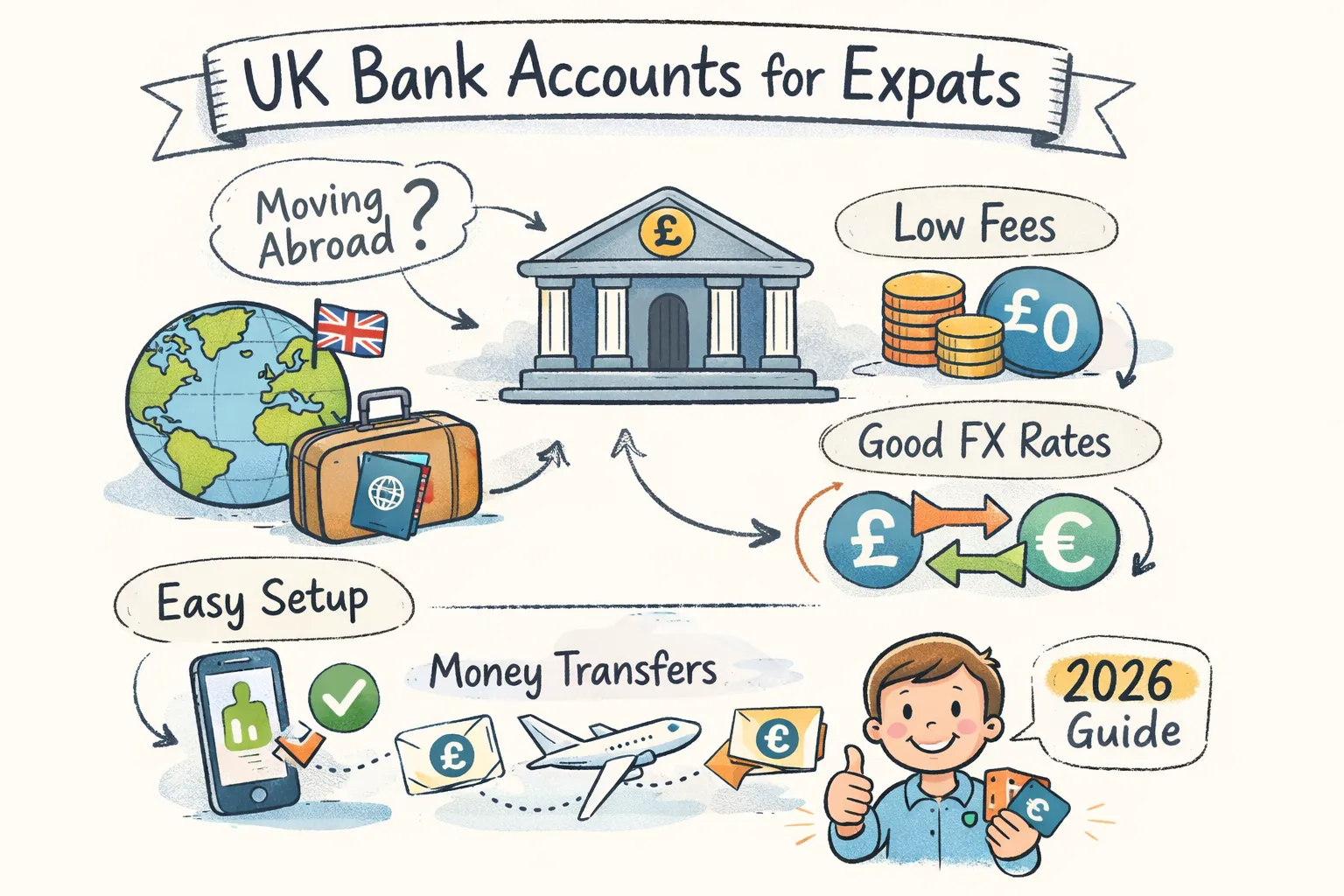
Moving money is one of those background headaches that becomes very loud when you need to pay a deposit, transfer a salary or buy property overseas. Pick the wrong account and fees, poor exchange rates or jurisdictional surprises will quietly erode your cash. Pick the right one and you’ll save hundreds — sometimes thousands — a year.
Read on and you’ll be able to compare the leading UK-friendly expat accounts by fees, multicurrency features and deposit protection, and follow a simple checklist to apply from abroad. If you want to skip ahead, ExpatsUK has this condensed into a downloadable one‑page checklist to speed the process.
1. A three‑minute decision filter: how to choose the right account
Run through these five quick filters in order — they will narrow your options fast.
- Residency: Are you UK-resident or non-resident? FSCS protection and product eligibility depend on this.
- Multicurrency needs: Do you need to hold EUR/USD/other balances or just GBP? Some providers give true multicurrency wallets and local IBANs; others do not.
- Transfer frequency & size:Small, regular transfers favour fintechs; occasional large transfers often justify an FX specialist or bank relationship.
- Branch/mortgage support: Want UK mortgage options or in-branch service? Some international banks link to mortgages; fintechs rarely do.
- Risk appetite for offshore banking: Offshore accounts (Jersey/IoM) may offer features but usually sit outside FSCS protection.
Simple if/then shortlist to self-select:
- If you move more than £10k occasionally → consider Moneycorp or HSBC Expat (get quotes first).
- If you send small, regular payments and want low FX cost → Wise or Revolut.
- If you need UK mortgage support or long-term UK banking ties → Barclays International or NatWest International.
- If you want everyday UK access with simple UX → Monzo, Lloyds or NatWest.
2. Top 8 expat-friendly accounts — 2026 snapshot
Below are the leading options I see for Brits and internationals moving money to and from the UK. Each entry is a short elevator pitch, headline features and a fees/eligibility note.
HSBC Expat
Offshore multi‑currency account in GBP/EUR/USD with fixed‑term deposits and a dedicated relationship manager. Suits high‑balance savers and overseas property buyers. Eligibility requires significant relationship balances or salary (e.g., ~£75k relationship or £120k salary); accounts often sit under HSBC Jersey — check which jurisdiction holds your funds and compensation cover.
Barclays International
Multi‑currency capabilities and continuity for customers with UK property needs. Good where mortgage continuity and long-term UK ties matter. Minimums and mortgage support tend to be higher; verify current thresholds for international applicants.
NatWest International
Tiered international accounts (Select, Cash Management, Premier) offering multicurrency tools and mobile banking. Suits families who want UK banking links plus modest international features; some tiers carry monthly fees (e.g., International Select ~£8/month).
Lloyds International
Simple GBP/EUR/USD options and a user-friendly current account experience. Useful for UK-facing expats who prefer a straightforward bank; modest monthly fee may apply depending on the product.
Wise (multi‑currency)
A true mid‑market FX service with multiple currency balances and local receiving details (IBANs). Best for low‑cost transfers and everyday multicurrency use; transparent low fees and quick onboarding.
Revolut
App-first multicurrency wallet with real‑time conversion and travel-friendly cards. Great for digital nomads and frequent travellers; watch weekend FX rules and tiered conversion allowances depending on plan.
Monzo
Mobile-first UK current account with simple UX and international transfers powered by partners. Good for day‑to‑day banking and short-term residents—confirm non‑resident acceptance rules for your nationality.
Moneycorp
FX specialist that offers multi‑currency accounts and negotiated rates for large transfers. Best when you need one-off large transfers (property, salaries) or currency risk management; fees are volume-sensitive — request a live quote.
Provider rules change frequently — always verify eligibility in your country and for your nationality before applying.
3. Fees, FX and real‑world costs — how to compare like‑for‑like
When you compare providers look at these cost components: the flat transfer fee, the FX margin (difference from the mid‑market rate), any correspondent/intermediary charges, card foreign‑transaction fees and ATM withdrawal charges. The FX margin is usually the biggest invisible cost.
Here’s a worked example on a £1,000 transfer (typical ranges in 2026):
| Provider type | Approx. total cost on £1,000 | Typical % range |
|---|---|---|
| Traditional bank (large UK bank) | £80–£100 | 3–10% |
| Fintech (Wise / Revolut) | £0–£20 | 0–2% |
| FX specialist / expat bank (Moneycorp / HSBC Expat) | £5–£25 (size-dependent) | 0–2% (better on large sums) |
How to measure cost yourself: get the provider quote, find the mid‑market rate (Google “mid‑market rate GBP to …”), subtract to see the FX margin, then add any flat fee. Ask if recipient/intermediary banks might levy additional charges.
Quick rule: frequent small transfers → fintechs. Very large, occasional transfers → request quotes from FX specialists (Moneycorp, OFX) and ask about forward contracts or limit orders to manage currency risk.
4. Deposit protection, offshore risks and tax basics
Protection matters. UK‑authorised deposits are covered by the FSCS up to £120,000 per eligible person per authorised firm (updated from Dec 2025). Temporary high‑balance protection exists for certain incoming funds for a limited time — always ask the FSCS or your bank for details.
Offshore nuance: accounts held in Jersey, Guernsey or the Isle of Man are not covered by FSCS; they sit under local schemes with smaller limits (for example, Jersey’s scheme has a lower cap). HSBC Expat commonly holds accounts in Jersey — confirm the legal entity and which compensation scheme applies before you transfer large sums.
Tax/reporting: banks report under CRS and FATCA where relevant. US citizens often face extra paperwork and some providers decline US taxpayers — treat that as an early red flag. Practical safeguard: if you will hold more than £120,000, split balances across separate UK‑authorised institutions to preserve FSCS coverage.
5. How to apply from abroad — step‑by‑step
Two concise application flows, with timelines and the documents you’ll need. If you want a longer list of options and practical routes, see our guide on how to open a UK bank account from overseas — 7 ways.
Fintech flow (Wise / Revolut / Monzo)
- Download the app and register.
- Upload passport and proof of address; complete video ID if requested.
- Link a funding source and make a small test transfer.
Typical timeline: hours to a few days.
Traditional/international bank flow (HSBC Expat / Barclays / NatWest)
- Apply online or arrange a branch appointment. Some banks require notarised or certified copies for non‑resident applicants.
- Provide proof of salary/investments for premium relationships; expect additional KYC checks.
- Wait for account opening — typically 1–3 weeks if documents are in order.
Required documents (have scans ready): valid passport, secondary ID (driver’s licence), recent proof of address (utility bill or bank statement), tax ID (TIN/SSN/ITIN where required) and proof of funds or employment for premium accounts. For a full checklist of the steps and documents, see our guide on how to open a UK bank account as a foreigner — steps & docs.
Common pitfalls: expired IDs, address mismatches, not declaring US citizenship (FATCA delays) and expecting immediate IBANs for offshore accounts. Fixes: scan documents in advance, use consistent address formats and declare tax residency early. In the week before applying, scan documents, verify the bank’s eligible countries list and prepare a small test transfer.
Tip: use ExpatsUK’s one‑page application checklist and our sample cover email to speed verifications with traditional banks.
6. Which account fits you? Quick profiles and next steps
Match your profile to a shortlist and a single next step.
High‑net‑worth saver or frequent large transfers: HSBC Expat — next step: verify jurisdiction/FSCS-equivalent and request a relationship manager quote.
Frequent small international payments / digital nomad: Wise or Revolut — next step: sign up and verify, set up multicurrency balances and test a small transfer.
Need UK mortgage / long‑term UK ties: Barclays International or NatWest International — next step: speak to an international mortgages specialist and confirm minimums.
Day‑to‑day UK access and family banking: Monzo, NatWest or Lloyds — next step: confirm branch/phone support for your country and open a primary current account.
Large property purchase / big forex exposure: Moneycorp or other FX specialist — next step: request a tailored quote and ask about forward contracts or limit orders.
Download ExpatsUK’s comparison table and one‑page application checklist to print or email banks directly. If you’re moving from the USA, see our practical guide on moving to the UK from USA — a calm, practical plan. If you’d like local tips, sign up to be notified when ExpatsUK’s message boards and city groups go live — community suggestions make a big difference in processing time and real‑world fees.
Conclusion
Small preparation now saves time and money later. Compare by residency, multicurrency needs and deposit protection; measure FX by the mid‑market rate; and follow a short checklist when applying from abroad. Grab the one‑page checklist on ExpatsUK and start your application this week — then share your situation in the community to get practical, local tips.