
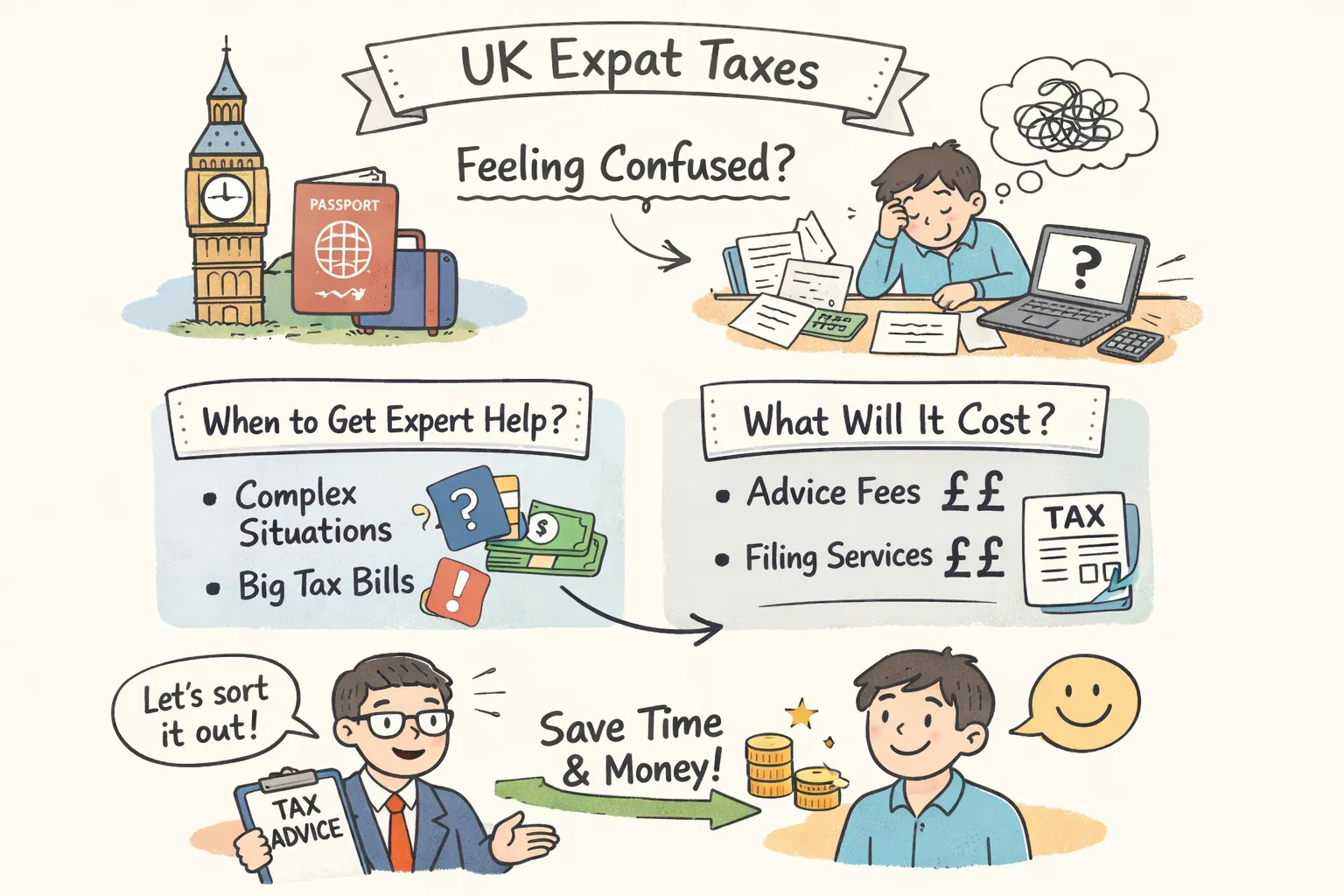
At ExpatsUK we help internationals cut through the UK tax noise. In the next ten minutes you’ll know whether to pick up the phone, how to shortlist qualified advisers, the core cross‑border topics to raise, and exactly what to bring to the first meeting to save time and fees.
If you’re, for example, a US citizen with UK rental income and foreign pensions, keep reading. If you prefer, download ExpatsUK’s checklist to prepare your documents before you call — it will shave hours off the first meeting.
Do you need an expat tax adviser? A quick triage
Decide in minutes with three rules of thumb.
Simple cases — usually manageable without a specialist: one UK PAYE job, no foreign income or UK property, short stays in the UK and straightforward pension income. HMRC guidance and a basic Self Assessment can often handle this.
Cases that usually need specialist help: complex foreign income (pensions, dividends, rental income abroad), trusts, sales of UK or foreign property, emigration or returning to the UK, and US citizenship (because of Form 1040/FBAR/FATCA). These involve multiple treaties (see our U.S.–U.K. Tax Treaty Explained: A Practical Guide for Expats), reporting forms and timing traps.
Borderline situations worth a short paid consult: unclear residency under the Statutory Residence Test (SRT), split‑year treatment, significant foreign bank accounts, or mixed UK/foreign employer arrangements. Day‑count and split‑year questions alone are a common reason to hire an adviser.
If two or more of the above triggers apply, book a consult — it’s cheaper than fixing an avoidable error later.
The core cross‑border issues to surface in conversation
Before you call, be literate enough to judge competence. Start with the SRT: residency is determined year‑by‑year by automatic overseas/UK tests and, if needed, the sufficient‑ties test. The simple rule to remember is 183 days, but the automatic tests and ties (family, accommodation, work, 90‑day tie) decide many borderline cases. Keep a travel diary — day counts matter. For an accessible overview see our UK Taxes for Expats: Residency, Reliefs & Filing Guide, and for the official statutory detail consult the Statutory Residence Test guidance.
Important recent change: from 6 April 2025 the UK moved to a residence‑based tax system and abolished the remittance basis. That means residents are generally taxed on worldwide income as it arises. A practical transitional concession: people who return to UK residence after at least 10 years abroad may qualify for a four‑year foreign income and gains relief — ask whether you qualify (see our Moving from the USA to the UK: Your Practical 10‑Step Plan). For official notes on the broader residence rules and timing see the government residence guidance and the deemed domicile rules.
Domicile used to drive IHT and remittance planning; the landscape has shifted, but inheritance tax and estate planning remain specialist areas. For US citizens, expect dual obligations: Form 1040 (worldwide income), FBAR (FinCEN 114) if foreign accounts exceed US$10,000 aggregate, and Form 8938 where thresholds apply — see the IRS comparison of Form 8938 and FBAR requirements. Use Form 2555 (FEIE) or Form 1116 (foreign tax credit) as relevant to avoid double taxation — an adviser who understands both UK and US reporting is essential for these clients.
Common traps: unreported foreign accounts/FBAR, late Self Assessment filings, incorrect split‑year claims, and assuming domicile rules still allow pre‑2025 remittance planning. Listing these early gives you a way to test an adviser’s competence.
How to shortlist and vet advisers: credentials, experience and red flags
Build a list of 3–5 prospects. Prioritise advisers with nationally recognised tax qualifications: Chartered Tax Adviser (CTA) is the gold standard in the UK; ATT and chartered accountant qualifications (ACA/ACCA) are strong indicators of competence. If you’re a US citizen, look for a US CPA or a dual‑qualified adviser who handles both UK and US filings.
Verify qualifications via professional registers — CIOT’s “Find a Member” for CTAs and the ATT site for ATT members. Ask for recent case studies or references involving UK–US cross‑border issues or HMRC enquiries. Practical experience with returns, treaty claims and FBAR/8938 filings matters more than marketing copy.
Use a simple scorecard to compare prospects: rate each on expertise, cross‑border experience, clarity of fees and responsiveness. Ask for two client references and sample engagement letters where possible. Watch for red flags: no listed qualifications, reluctance to provide a written engagement letter, evasive fee estimates, or promises of guaranteed tax savings. For peer feedback, check ExpatsUK’s adviser checklist and the upcoming local message boards to see what other expats say.
What advisers charge — typical fee structures and how to get transparent quotes
Advisers bill hourly, by fixed fee for defined tasks, by retainer or a bundled annual service. Expect a range depending on complexity: short initial calls typically cost in the low hundreds (roughly £190–£500); straightforward Self Assessment returns start in the mid‑hundreds to low‑thousands (£595–£850+VAT in many cases); complex or part‑year returns, cross‑border filings and onboarding can push fees above £1,200, with comprehensive ongoing packages commonly £750–£2,000+ per year. US filing work is usually quoted separately.
VAT (20% for most UK firms) and AML onboarding checks can add modest fees; good advisers present itemised quotes. When you request a quote, ask for a defined scope and deliverables, who will do the work (partner vs junior), key milestones and timelines, hourly rates for extra work, and cancellation or dispute terms. Negotiate fixed fees for clearly scoped tasks (e.g., UK Self Assessment + FBAR + Form 8938), and insist on a written engagement letter before any substantive work begins.
What to bring and the questions that save time (and fees)
Bring these documents to the first meeting — they let an adviser quote accurately and avoid needless follow‑ups:
- Passport/ID and a travel diary with arrival/departure dates (for SRT day counts).
- P60/P45 or payslips; pension statements (UK & foreign); UK and foreign bank and investment statements.
- Property deeds or rental contracts (UK and abroad); prior UK and US tax returns (last 2–3 years); FBAR/FinCEN details if filing required.
- Trust or company documents and any HMRC correspondence.
Ask these high‑value questions in your first call — they clarify scope immediately:
- Have you handled cases like mine, including UK–US filings if relevant?
- Will you prepare US returns/FBAR or refer to a US CPA (and what are the extra costs)?
- What’s the likely outcome and timeline for my core issues?
- Exactly what is included in the fee and who will do the work? How will we communicate?
Prepare a one‑page factsheet for the adviser: nationality, key dates of moves, summary of incomes and assets, brief residency history and top two concerns. That one page often saves hours of billed time.
Next steps: booking a consult, a simple briefing email and the decision checklist
Use this short template when contacting shortlisted advisers — paste, edit and send:
Hello [Name], I’m a [nationality] who moved to/left the UK on [date]. I have [list high‑level facts: e.g., UK rental income, foreign pensions, US citizenship] and I need advice on residency, UK Self Assessment and US filings. Can we arrange a 30‑minute paid consult to discuss scope and a fixed quote? I can send a one‑page factsheet on request. — [Your name, phone, availability]
Compare proposals using your scorecard: price versus scope, demonstrable cross‑border experience, clarity of fees and references, and responsiveness. The engagement letter should spell scope, fees, AML checks and data handling. Choose the adviser who combines technical competence with transparent pricing and clear communication — both matter.
Book a consult, bring the one‑page factsheet and your documents, and expect most issues to be manageable with the right specialist. For a head start, download ExpatsUK’s checklist from our Moving to London as an Expat: Visas, Costs & Checklist and keep an eye out for our local message boards to crowdsource peer feedback on advisers in your area.
In short
Two takeaways: if you have complex foreign income, UK property, trust/exported assets or US filing obligations, get a cross‑border adviser. Prepare a one‑page factsheet and the documents above to get a reliable, fixed quote. When in doubt, book a short paid consult — it’s an investment that often pays for itself.
Ready? Book that consult and use ExpatsUK’s checklist to arrive prepared — and for US‑specific pre‑departure and settlement tips see our US Citizens in the UK: A Practical Move & Settlement Guide.