
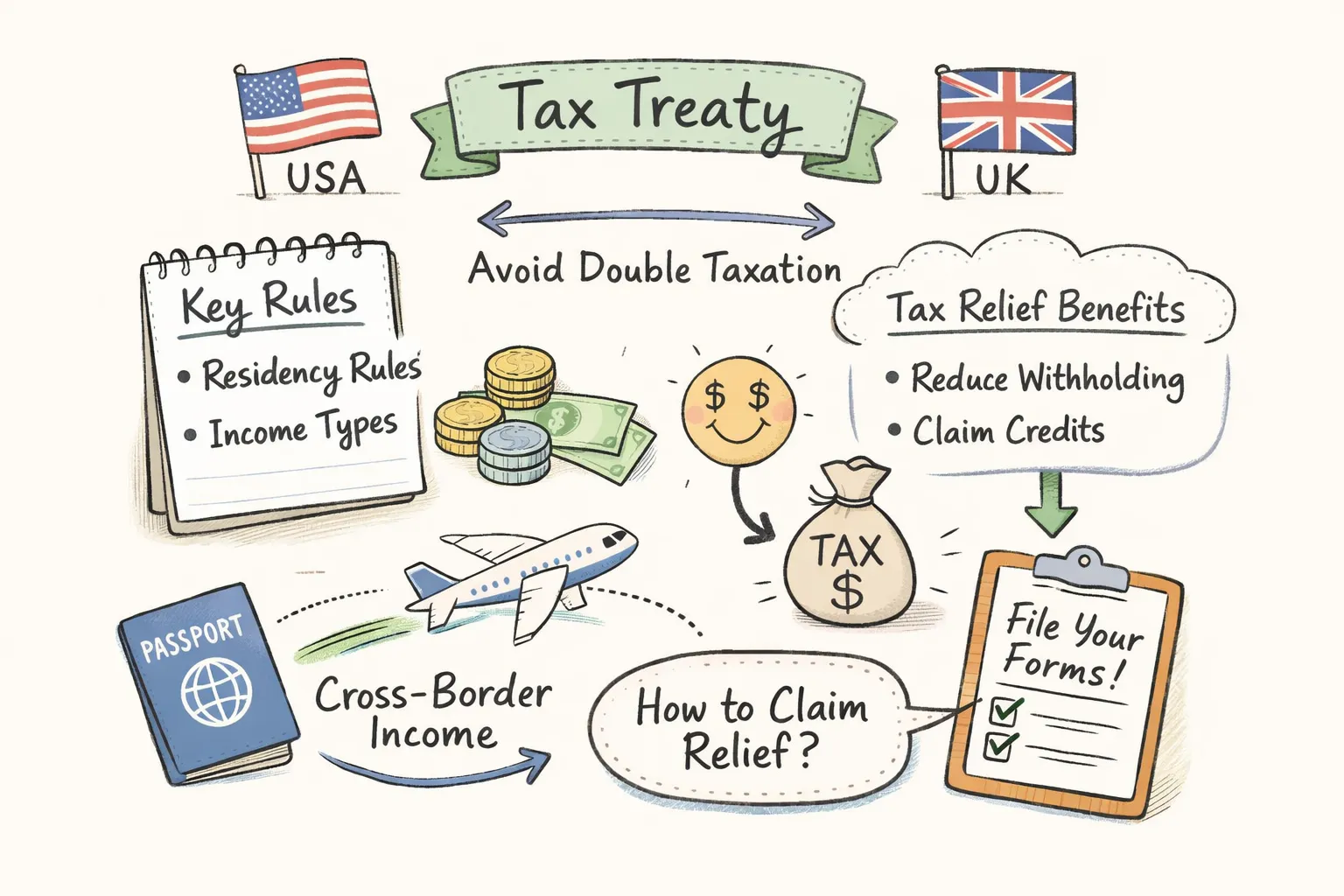
If you live, work or invest across the United States and the United Kingdom, the US–UK income tax convention is your first and best defence against being taxed twice. It reallocates taxing rights, reduces withholding at source for many payments, and gives you clear steps to claim relief — but only if you understand residency rules, the right treaty articles and the exact forms to file. This guide walks you through those steps with practical checklists, sample numbers and next actions you can take today. If you need local help, ExpatsUK’s finance guides and community pages list trusted advisers and downloadable checklists to speed the process.
- Official treaty text (U.S. Treasury)and2002 Protocol (technical explanation).
- IRS treaty documents and forms(W‑8 guides, Form 8233/8833 instructions).
- GOV.UK treaty guidanceand HMRC links for claiming foreign tax relief in the UK.
- Treaty entered into force 31 March 2003. Effective dates: US — 1 May 2003 (withholding) / 1 Jan 2004 (other taxes); UK — April/May 2003 (varies by tax).
1) Does the treaty apply to you? Residency, tie‑breakers and the saving clause
The first question is residency. Treaty benefits attach to persons who are residents of one of the Contracting States for treaty purposes. If you’re a dual resident, the treaty contains a standard tie‑breaker to pick a single country of residence for treaty benefits.
How treaty residency is decided (plain English)
Article 4 sets the rules in a step sequence. Think of it as five checkpoints, applied in order:
Permanent home: Do you have a home available in one country but not the other? If so, that country is your treaty residence. Example: your family home and lease are in London, not in New York.
Centre of vital interests: Where are your closest personal and economic ties — family, bank accounts, employment, business ownership? Example: you live in London but your main business, income and spouse remain in the US.
Habitual abode: Which country do you actually spend most of your time in? Example: you spend 9 months a year in the UK and 3 months in the US.
Nationality: If the above don’t decide it, nationality (citizenship) can break the tie.
Mutual agreement procedure: If still unresolved, the competent authorities (IRS and HMRC) negotiate the outcome.
Special note for US citizens and green‑card holders — the saving clause
The treaty contains a “saving clause”: the United States generally reserves the right to tax its citizens and residents as if the treaty didn’t exist, with a few important exceptions. Practically this means a US citizen living in the UK can still have US filing obligations and may need to use the foreign tax credit (FTC) rather than rely on the treaty to eliminate US tax. Pensions, certain government‑service payments and special FTC provisions are common sticking points — read Article 4 and the saving clause text if you are a US citizen or green‑card holder, and consult an adviser for complex pensions or large balances.
For a practical checklist and step‑by‑step guidance tailored to US nationals in Britain, see the U.S. Citizens in the UK: A Practical Tax Playbook Guide.
Quick evidence checklist — documents that support treaty residency
| Document | Why it helps |
|---|---|
| Lease/mortgage and utility bills | Shows a permanent home is available |
| Council tax / electoral roll / BRP | Confirms UK residence and local registration |
| UK payroll records / P60 / payslips | Shows where economic ties and habitual abode lie |
| Bank statements and pension paperwork | Demonstrates where income and savings are based |
| Tax returns (UK self‑assessment, US filings) | Consistent filing patterns strengthen a residency claim |
2) What the treaty actually changes — the key articles you’ll use
Below are the articles people use most. Each entry explains the practical outcome and when it matters to you.
Permanent Establishment (Article 5 — Business profits)
Defines when a business creates a taxable presence in the other country (fixed place of business, dependent agent, construction site >12 months). If you have a PE, profits attributable to it may be taxed by the host state. When this matters: UK consultants on US assignments, companies sending staff to the other country.
Dividends (Article 10)
Reduces source withholding on dividends to 0%, 5% or 15% depending on recipient type and ownership tests. When this matters: investors holding US shares through brokers or receiving corporate income.
Interest (Article 11)
Most interest payments are exempt from source withholding (0%), though profit‑linked or contingent interest can be treated differently. When this matters: banks, bondholders and portfolio investors.
Royalties (Article 12)
Royalties paid across borders are generally exempt from source withholding (0%) under the treaty. When this matters: software licensors, patent/license income.
Pensions and social security (Article 18 and related)
Pensions from past employment are generally taxable only in the State of residence, with important exceptions for government service and for US nationals under the saving clause. When this matters: expat pensioners and those with multi‑jurisdictional pension accruals.
Capital gains (Article 13)
Capital gains are usually taxable only in the seller’s residence State, except for gains from immovable property, gains attributable to a PE, or sales of shares deriving most value from immovable property. When this matters: property sales, corporate disposals and cross‑border M&A.
3) Withholding at a glance: rates, ownership tests and common traps
Headline withholding rates (practical summary)
For US‑source payments to UK residents (and vice versa in terms of treaty effect):
Dividends: reduced to 0%, 5% or 15% depending on whether the recipient is a qualifying pension, a qualifying corporate owner (ownership thresholds vary by clause) or another investor. Check Article 10 and your broker for the exact ownership test that applies to your case.
Interest: generally 0% — most portfolio and bank interest is exempt from US withholding under the treaty, though exceptions exist for contingent or profit‑sharing interest.
Royalties: generally 0% at source under Article 12.
How reductions are claimed at payer/broker level
To get the treaty rate applied at source you give the withholding agent a completed W‑8 form:
– Individuals: Form W‑8BEN . Entities: W‑8BEN‑E. Intermediaries or funds: W‑8IMY. These documents are provided to the payer or broker — do not send W‑8s to the IRS. A correctly submitted W‑8 lets the payer apply the treaty rate immediately; otherwise the payer may withhold the full statutory rate and you will need to reclaim it later.
What “beneficial owner” means (common sense)
The beneficial owner is the person or entity that ultimately receives and is entitled to the income, not an intermediary routing the funds. If you’re the ultimate recipient and not a conduit, you are normally the beneficial owner for treaty purposes.
When a payer refuses a W‑8 or applies full withholding — quick steps
1) Ask the payer in writing for the reason and request details of the withholding (Form 1042‑S or similar).
2) Confirm and resubmit the correct W‑8 (check names, tax IDs and beneficial owner box).
3) If still refused, request a refund procedure from the payer and, if necessary, prepare a US refund claim (Form 1040‑NR) or a protective claim through your broker.
| Example | Statutory 30% | Treaty 15% | Immediate cashflow difference |
|---|---|---|---|
| US dividend, gross $1,000 | $300 withheld, net $700 | $150 withheld, net $850 | $150 more cash now with treaty form |
4) Exactly which forms to use — W‑8s, Form 8233, 8833 and HMRC steps
Who submits what and when is often the practical difference between immediate relief and months of chasing refunds. The table below is a compact map.
| Form | Use | Where/when |
|---|---|---|
| W‑8BEN | Individuals claim treaty status and beneficial ownership | Give to US payer/broker before payment (valid up to 3 years) |
| W‑8BEN‑E | Entities claim treaty benefits; includes LOB and chapter 4 status | Provide to withholding agent; include LOB documentation where required |
| W‑8IMY | Intermediaries / flow‑through entities | Provided to payer when payments route through funds or brokers |
| Form 8233 | Claim exemption from withholding on compensation for personal services under a treaty | File with the withholding agent (employer); SSN/ITIN often required |
| Form 8833 | Disclose treaty-based return position that overrides US tax rules | Attach to US tax return when required (non‑disclosure can attract penalties) |
| Form 1040‑NR | Nonresident US return; use to claim refunds for over‑withholding | File with IRS to reclaim excess withheld at source |
| Form 1116 | Claim foreign tax credit on a US return | Attached to Form 1040 when claiming FTC |
Immediate scenario form checklist (fill‑in)
| Scenario | Immediate form/action |
|---|---|
| Individual investor receiving US dividends | Provide W‑8BEN to broker before ex‑date |
| Contractor paid by US payer for services in the US | Assess whether Form 8233 applies (personal services) or provide W‑8BEN and prepare Form 1040‑NR if needed |
| Company receiving US payments | Submit W‑8BEN‑E and LOB evidence to payer |
5) Treaty relief vs foreign tax credit — how to choose (practical framework)
Treaty relief and the foreign tax credit (FTC) solve double‑taxation in different ways. Treaty relief changes source‑country withholding or re‑sources income; FTC is a domestic mechanism that credits foreign tax against your US tax liability.
Use this decision framework in plain terms:
– If the treaty re‑sources the income to the country where you’re resident (for example, a pension treated as UK‑sourced), treaty relief is often necessary to get the right sourcing and to preserve FTC baskets.
– If the UK tax on the item is higher than the US tax, the FTC normally prevents extra US tax — meaning you pay the UK tax and use Form 1116 to claim a credit on your US return.
– If you’re a US citizen or green‑card holder, remember the saving clause: you may still need to use the FTC and file US returns even if the treaty would otherwise assign taxing rights to the UK.
Mini‑calculator — cashflow and paperwork trade‑off
Example: US dividend $1,000. With no W‑8 you suffer 30% withholding ($300). With a timely W‑8BEN the payer applies the treaty 15% rate ($150). If you don’t provide W‑8, you can reclaim the excess by filing Form 1040‑NR, but that takes time and paperwork. For many expats, the immediate cashflow improvement of filing W‑8 is decisive.
Timing mismatch: UK tax year runs 6 April–5 April; US tax year is calendar year. If UK tax falls after the US filing year, you can hit FTC limits; common fixes are prepayments, carrybacks/carryforwards or professional timing strategies.
Rule of thumb: favour treaty relief at source when possible for cashflow. Use FTC to clean up residual US liability, especially for US citizens who must still file in the US.
6) Common pitfalls, LOB problems and dispute routes
Limitation on Benefits (LOB)
Entities often find their treaty benefits blocked by the LOB article if they don’t meet ownership or substance tests. Expect requests for ownership charts, shareholder information and proof of public listing or active trade. If you run a fund, trust or holding company, get LOB analysis early.
Beneficial ownership and conduit payments
Payments routed through intermediaries may be treated as conduit transactions. Keep contracts and payment flows clear: if you are the ultimate recipient, document it. If you’re an intermediary, complete W‑8IMY and attach supporting documentation for your beneficial owners.
Saving clause surprises
US citizens and green‑card holders should check whether treaty language actually provides relief in their case — many pension and government service items are caught by exceptions. When in doubt, consult an adviser and plan for FTC work on the US return.
Employer or broker resistance
If a broker refuses to accept a W‑8 and applies full withholding, ask for the reason in writing, resubmit corrected forms and, if necessary, escalate to the payer’s compliance team. If you can’t get immediate relief, gather Form 1042‑S and file Form 1040‑NR for a refund.
Disputes and MAP (Mutual Agreement Procedure)
If you and the tax authority disagree on treaty interpretation or you receive double taxation despite following the rules, you can ask the competent authorities (IRS and HMRC) to resolve the issue under the treaty’s Mutual Agreement Procedure. MAP is a last resort after exhausting domestic remedies and can take months — keep thorough records and seek professional help before starting MAP.
Document retention: keep supporting records for at least 3–7 years depending on the tax authority, including W‑8 copies, correspondence with payers, contract terms, proof of payments and Form 1042‑S/1099s.
7) Worked examples — three real‑world scenarios
Scenario A — UK resident investor with shares in a US company (via a US broker)
Facts: You are UK tax resident, own shares in a US company through a US broker, ownership under 10% (retail investor).
Treatment and steps: Provide a completed W‑8BEN to your broker before the ex‑dividend date certifying that you are a UK resident and the beneficial owner. The broker should apply the treaty dividend rate (typically 15% for most retail holders). If the broker withholds at 30%, ask for the broker’s explanation and Form 1042‑S and then file a US refund claim (Form 1040‑NR) if necessary. For UK tax, declare the gross dividend and claim any foreign tax credit under UK rules.
| What to do today | Form |
|---|---|
| Submit W‑8BEN to broker | W‑8BEN |
| If over‑withheld, request Form 1042‑S | Request from broker |
| File Form 1040‑NR to claim refund (if broker unable/unwilling) | 1040‑NR |
Scenario B — US citizen living in the UK with a UK pension
Facts: You are a US citizen resident in the UK receiving a UK pension.
Treatment and steps: The treaty treats pensions as taxable in the country of residence, but the US saving clause means you may still have US tax obligations. In practice you typically pay UK tax on the pension and then claim a foreign tax credit on your US Form 1040 using Form 1116. If you assert a treaty position that changes US tax results, you may need to attach Form 8833 to disclose the treaty claim. Because of the saving clause and pension complexities, get a professional review.
| What to do today | Form |
|---|---|
| Confirm treaty residency and collect pension statements | Records |
| Pay UK tax and obtain tax computation | UK self‑assessment |
| File US return, claim FTC with Form 1116 (and attach Form 8833 if treaty used) | Form 1116 / 8833 |
Scenario C — Small UK consultancy sends a team to the US for a 10‑week contract
Facts: Short client engagement (10 weeks), staff perform services in the US; no fixed office.
Treatment and steps: A construction/project PE usually requires activity >12 months, so a 10‑week job typically won’t create a PE on that test. However, PE can arise if a dependent agent habitually concludes contracts in the US on your behalf. Limit agent authority, structure contracts to avoid US‑situs performance triggers, and keep contemporaneous records. If the US client treats your firm as having a PE or withholds tax, ask for the legal basis and review with a cross‑border adviser. If a PE exists, you will be taxable on profits attributable to it and need to file appropriate US returns.
| What to do today | Form/Document |
|---|---|
| Review contracts to limit authority of local agents | Engagement letters |
| Document days in country and nature of activities | Timesheets / travel records |
| Consult a transfer pricing / PE specialist before sending future teams | Professional advice |
8) Your checklist, official links and next steps (including how ExpatsUK can help)
Use this concise action checklist as your immediate to‑do list. The goal: establish residency, classify income, and provide the right form to the payer before the next payment.
| Action | Why / Where |
|---|---|
| Confirm your treaty residency and collect supporting documents | Article 4; residency evidence |
| Identify income types (dividends, interest, royalties, pensions, employment, capital gains) | Different articles and relief apply |
| Gather ownership and beneficial‑owner documents for entities | LOB and beneficial ownership checks |
| Choose and complete the right W‑8 (BEN / BEN‑E / IMY) or Form 8233 and send to the payer before payment | Apply relief at source |
| Keep originals and copies on file; note renewal dates (W‑8 validity: generally 3 years) | Audit readiness |
| If over‑withheld, request Form 1042‑S and pursue payer refund or file Form 1040‑NR | Reclaim excess US withholding |
| Decide treaty relief vs FTC and prepare Forms 8833 and 1116 as needed | US return strategy and disclosure |
| Consider MAP only after domestic appeals are exhausted | International dispute resolution |
Official resources (start here)
- U.S. Treasury — Treaty text (2001)
- Treasury — Protocol technical explanation (2002)
- IRS — UK tax treaty documents and W‑8 instructions
- GOV.UK — USA tax treaties and HMRC guidance
- IRS Forms (W‑8BEN, W‑8BEN‑E, 8233, 8833, 1040‑NR, 1116)
How ExpatsUK can help
ExpatsUK publishes nationality‑specific finance guides that walk you through forms and local quirks, and our community pages are a place to ask one focused question and find peer‑recommended advisers in your city. See our American Expat in the UK: Your No‑Nonsense 90‑Day Guide if you just arrived, and our UK Taxes for Expats: Residency, Reliefs & Filing Guide for filing and residency detail. Look for our downloadable treaty checklists and upcoming local groups/message boards where members swap contact details for trusted tax advisers.
Conclusion
The US‑UK treaty exists to prevent double taxation and to make cross‑border income predictable — but it only helps if you apply the right tests and present the right paperwork. Start by confirming your treaty residency, gather the documents in the residency checklist, submit the correct W‑8 or Form 8233 to the payer before payment, and then use FTC or refund procedures where needed. Keep treaty texts and forms handy (links above), use the action checklist, and reach out to ExpatsUK’s community or a specialist for unusual or high‑value cases.
Next step: download the checklist on ExpatsUK, gather your residency documents and submit the correct W‑8 to your payer before the next payment to preserve immediate treaty relief. If you have non‑dom status or think the 2025 changes affect you, read UK Non‑Dom Ends: 2025 Changes and 6 Practical Steps for practical next actions.
For a short FAQ that answers whether tax treaties can prevent double taxation in common scenarios, see our article Are there tax treaties to avoid double taxation?