
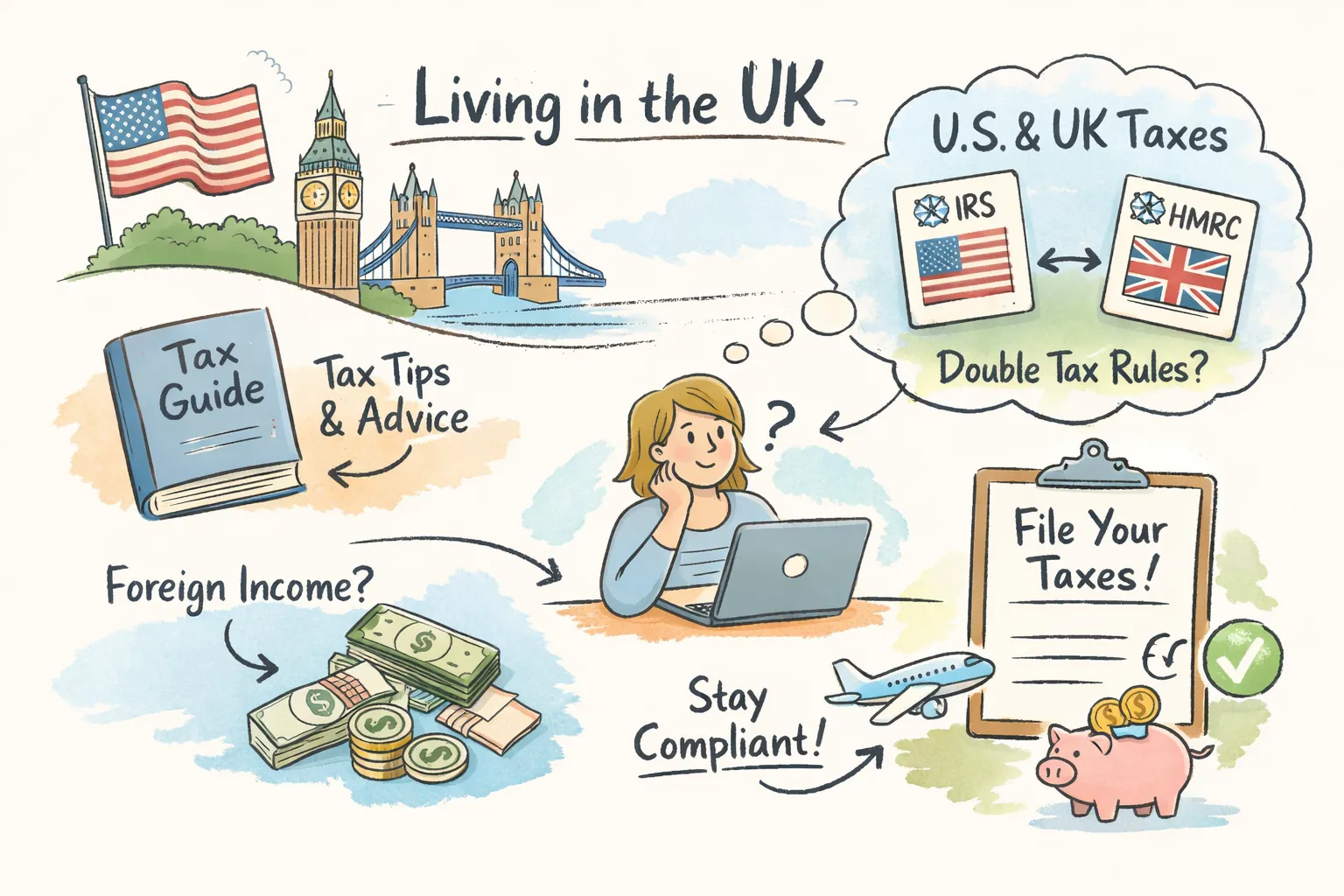
Three urgent things every American in the UK should do right now
If you’re a U.S. citizen living in the UK, you still file to the IRS — but there are ways to avoid double tax and stay compliant. The three most urgent takeaways are simple: first, determine your UK residency under the Statutory Residence Test (SRT) and register with HMRC if required; second, run a side‑by‑side FEIE versus Foreign Tax Credit (FTC) calculation before you file; and third, don’t ignore FBAR and FATCA thresholds — reporting can be required even when no U.S. tax is due.
ExpatsUK is a practical home for nationality‑aware checklists and a growing peer community. If you want to follow along, download our SRT day‑counter and tax checklist at ExpatsUK to record your days, ties and account balances as you read.
By the end of this guide you’ll understand your filing obligations in both countries, the forms and deadlines that matter, how to compare FEIE and FTC using concrete examples, and a dated, step‑by‑step checklist you can use this tax year.
Residency first: how the UK Statutory Residence Test drives your UK filing
Residency in the UK, not nationality, dictates whether your worldwide income is taxed there. The Statutory Residence Test (SRT) is a strict, ordered set of rules: if you meet an automatic UK test you are resident; if you meet an automatic overseas test you are non‑resident; otherwise the sufficient‑ties test decides your status.
The SRT in plain language
Automatic UK tests include spending 183 days or more in the tax year in the UK; having a UK home available for more than 90 consecutive days and being present there for at least 30 of those days; or working full‑time in the UK. Automatic overseas tests cover very short UK stays (e.g., under 16 or 46 days depending on prior residency) and full‑time work abroad with limited UK days.
If neither automatic rule applies you fall to the sufficient‑ties test: the UK counts how many ties you have (family in the UK, available accommodation, work days, a 90‑day prior‑period tie and whether the UK is the country where you spent the most days). Fewer days plus fewer ties usually means non‑resident; more days and more ties means resident.
Quick examples that clarify
Example one: you spend 160 UK days and your spouse lives in the UK — that family tie plus the days makes residency likely. Example two: you spend 120 UK days and have no UK ties — you are possibly non‑resident, but check the sufficient‑ties table carefully and keep records.
When you move mid‑year you may qualify for split‑year treatment, which separates the tax year into UK and non‑UK parts. That can simplify where income is taxed, but it doesn’t remove filing obligations in the U.S.
Practical actions (immediately)
Start a trustworthy day log and record every overnight stay: the UK counts a “UK day” if you are present at midnight (transit exceptions apply). Save passport entry/exit pages, tenancy agreements, utility bills, P60s/P45s and pay slips as evidence. If you become liable for UK Self Assessment, register with HMRC by 5 October following the tax year to get your UTR number. Use ExpatsUK’s SRT day‑counter to keep an auditable log and follow our short checklist to know when to register (see American Expat in the UK: Your No‑Nonsense 90‑Day Guide).
U.S. filing essentials: which forms, deadlines and penalties matter
U.S. citizens file Form 1040 on worldwide income if income exceeds IRS thresholds. Beyond Form 1040 there are a handful of forms that typically matter for Americans living in the UK:
- Form 1040 — report worldwide income to the IRS.
- Form 2555 — claim the Foreign Earned Income Exclusion (FEIE) and housing exclusion if you qualify by physical presence or bona fide residence.
- Form 1116 — claim the Foreign Tax Credit (FTC) for UK income taxes paid.
- Form 8938 — FATCA report of specified foreign financial assets when thresholds are met.
- FinCEN Form 114 (FBAR) — report foreign financial accounts to FinCEN if aggregate balances exceed $10,000 at any time in the year.
Other forms — Form 3520/3520‑A for trusts, Form 8833 for treaty positions, and specific disclosures — apply in special situations.
Deadlines you must keep
April 15 is the standard U.S. filing and payment deadline; U.S. citizens abroad get an automatic filing extension to June 15 (but tax payments are still due April 15 unless you pay or file an extension). You can use Form 4868 for an extension to October 15. FBAR is filed separately to FinCEN via BSA E‑File with an April 15 due date and an automatic extension to October 15. Form 8938 is filed with your Form 1040 and follows the tax‑return timing.
Penalties worth noting
Late Form 1040 filings bring failure‑to‑file penalties and interest. FBAR penalties are severe: non‑willful violations start around the low‑five figures (recently adjusted for inflation) and willful violations can be much larger (up to a percentage of account balances or into six figures). Form 8938 failures carry an initial $10,000 penalty and larger amounts for continued non‑compliance. Crucially, these information filings can be required even when no U.S. tax is due.
Finally, check whether your last U.S. state of residence still wants a return — some states (notably California) base tax on domicile, not just physical presence.
FEIE vs. Foreign Tax Credit — a practical comparison with worked examples
FEIE and FTC are the two main tools Americans use to avoid double taxation. FEIE excludes a portion of foreign earned income (Form 2555); FTC credits U.S. tax for income taxes paid to the UK (Form 1116). Which wins depends on your income, UK tax rates on that income, and whether you’re self‑employed.
How they differ, simply
FEIE excludes earned income (up to the annual limit: $130,000 for 2025, rising to $132,900 for 2026) if you meet the physical presence (330 full days) or bona fide residence tests. There’s also a housing exclusion that can further reduce taxable income. FEIE does not reduce self‑employment tax.
FTC gives a dollar‑for‑dollar credit against U.S. income tax for foreign income taxes you paid. It applies to earned and passive income alike and can often fully offset U.S. tax when UK taxes are higher than U.S. tax on the same income.
A practical 4‑step test to compare them
1) Compute your U.S. tax on worldwide income (baseline). 2) FEIE scenario: subtract allowable FEIE and housing exclusion, then compute U.S. tax; remember self‑employment tax still applies. 3) FTC scenario: compute U.S. tax on full income, compute allowable FTC (the lesser of U.S. tax attributable to foreign income or UK tax paid), subtract the credit. 4) Compare net U.S. tax; consider secondary effects such as FTC carryforwards, interaction with state taxes, and how FEIE affects other deductions and credits.
Worked examples (illustrative)
Low‑tax example: a single expat earning £60,000 (≈$80,000) with modest UK tax. If you qualify for FEIE, the $130k exclusion covers the whole salary and reduces U.S. taxable income to near zero — FEIE typically wins here. If you instead used FTC, the small UK tax credit might not eliminate U.S. tax as cleanly.
High‑tax example: a senior engineer earning £110,000 (≈$150,000) facing an effective UK tax bill of around 30% (~$45,000). U.S. tax on that income might be roughly $28,000 before credits; the FTC can fully offset the U.S. liability because UK tax paid exceeds U.S. tax — FTC typically wins for higher UK tax rates.
Self‑employed / London housing case: suppose $150,000 net self‑employment income and high London rent. FEIE plus the housing exclusion can shelter most or all earned income from U.S. income tax, but self‑employment tax (about 15.3% on net earnings unless totalisation rules apply) still applies. FTC can offset U.S. income tax but not SE tax. In practice you must compute both scenarios: FEIE may reduce income tax to zero but leave SE tax owed; FTC may zero income tax and leave SE tax unchanged. The right choice depends on which liability dominates.
Rule of thumb: if your effective UK tax rate on the income exceeds your U.S. tax rate for that income, FTC often gives the better outcome; use FEIE when UK tax is low relative to U.S. tax or when housing exclusion materially increases the excluded amount. Always run both calculations before you file.
Foreign‑account reporting: FBAR and FATCA (Form 8938) — thresholds, timing and traps
FBAR (FinCEN Form 114) and FATCA (Form 8938) are separate regimes with different thresholds, filing channels and penalties. Treat them independently.
FBAR: file if the aggregate maximum value of all your foreign financial accounts exceeds $10,000 at any time in the calendar year. File electronically through the BSA E‑Filing system. Recent penalties for non‑willful failures have been adjusted into the mid‑five‑figure range per violation; willful failures can reach six figures or a percentage of the account balance.
Form 8938: FATCA thresholds are higher for Americans living abroad — for single filers the trigger is $200,000 on the last day of the year or $300,000 at any time; for married filing jointly it’s $400,000/$600,000. Form 8938 is attached to Form 1040 and has its own $10,000+ penalties for non‑filing.
Common traps and recordkeeping
Watch for joint accounts (you generally report your full share), foreign pensions and trusts (which may require Forms 3520/3520‑A), and digital asset custodial accounts. Use the correct Treasury/IRS exchange rate for converting balances. Keep bank statements, year‑end balances and conversion calculations, FBAR/8938 confirmation receipts and any FinCEN authorisations for at least five years. FBAR penalties can be assessed retroactively, so maintaining tidy records is critical. If you’re still choosing a UK bank, consult our Best UK Bank Accounts for Expats to pick an account that simplifies reporting.
The U.S.–UK treaty, pensions and social security — what changes and how to claim it
The U.S.–UK tax treaty resolves many cross‑border frictions. Its tie‑breaker rules determine which country you’re treated as resident of for treaty purposes (permanent home, centre of vital interests, habitual abode, nationality). For dual residents the treaty tie‑breaker matters because it shapes where income is taxed under treaty articles.
On pensions and social security, the treaty and the U.S.–UK Totalization Agreement are the main tools. Private pensions are usually taxable in the country of residence; government pensions may be taxed in the paying state. U.S. Social Security benefits remain taxable in the U.S., while the UK State Pension is generally taxed in the UK. The totalisation agreement prevents double Social Security contributions and decides where NI/US contributions should be made for workers temporarily assigned across borders.
How to claim treaty relief
On your U.S. return you always report worldwide income on Form 1040. Attach Form 8833 only when you take a treaty position that changes how U.S. tax law applies to you (for example, a tie‑breaker residency position). Claim FTC on Form 1116 or FEIE on Form 2555 as normal; treaty benefits often operate through those provisions or by allocating taxing rights. In the UK, claim treaty relief or credits on your Self Assessment return and retain documentation of your U.S. filings. Treaty relief rarely eliminates filing duties — it reallocates taxing rights or provides credits. If you have non‑dom considerations or planning questions related to recent rule changes, review UK Non‑Dom Ends: 2025 Changes and 6 Practical Steps.
A clear, dated compliance checklist you can follow this tax year
Immediate / before year‑end: start your SRT day log and save passport stamps. Gather proof of residence (leases, utility bills), collect pay slips and P60/P45s, and list all foreign accounts with their peak values for the year. If you have foreign gifts, trusts, or large pensions, note these now.
By 5 October following the UK tax year: if you’re UK resident and have untaxed UK income (self‑employment, rental, foreign income not taxed at source), register for HMRC Self Assessment to receive your UTR number.
UK filing and payment: paper returns are due 31 October; online returns are due 31 January. Payments on account for UK Self Assessment fall on 31 January and 31 July; missing these triggers interest and penalties.
U.S. calendar deadlines: U.S. tax payment is due 15 April (even if overseas). You receive an automatic filing extension to 15 June; file Form 4868 to extend to 15 October if needed. FBAR to FinCEN is due 15 April with an automatic extension to 15 October. File Form 8938 with your Form 1040 if you meet the thresholds.
If you’ve missed filings: don’t ignore the problem. The Streamlined Filing Compliance Procedures exist for many non‑willful delinquencies; for willful non‑filings you must speak to a specialist. Document checklist to keep on file: passport pages, tenancy agreements, pay slips/P60s, UK tax computations, bank statements showing peak balances, copies of any previously filed FBAR or Form 8938.
What to do this week (micro actions): open a single folder (digital or paper) and add passport pages and last three months of bank statements; run a quick tally of account peak balances; note how many UK days you’ve spent this tax year in your SRT log. If you prefer, download the combined tax checklist and FEIE vs FTC spreadsheet from UK Taxes for Expats: Residency, Reliefs & Filing Made Simple and plug in your numbers — it will save you hours of guesswork. If you need an account, compare options in Best UK Expat Bank Accounts 2026 — Compare & Apply.
Real scenarios, short calculations and a mini “what if” idea
Scenario A — Salary £60k (≈$80k). You qualify for FEIE via bona fide residence or the physical presence test. FEIE ($130k for 2025) fully excludes the salary from U.S. income tax; your U.S. income tax liability on earned income drops to near zero. Forms required: Form 1040 with Form 2555 (if claiming FEIE), Form 8938 if asset thresholds met, FBAR if combined accounts >$10k. HMRC: likely resident, so register for Self Assessment if you have untaxed UK income.
Scenario B — Senior engineer £110k (≈$150k). UK tax at effective ~30% produces a large UK tax bill (~$45k). FTC often outperforms FEIE here: claim Form 1116 to credit the U.S. tax (example U.S. tax ~$28k) and reduce U.S. tax to zero. Forms required: Form 1040 and Form 1116; FBAR/8938 as thresholds dictate. HMRC: almost certainly a UK taxpayer; comply with Self Assessment timings.
Scenario C — Self‑employed in London, $150k net with high rent. FEIE plus the housing exclusion may eliminate U.S. income tax on earned income, but self‑employment tax (≈15.3%) still applies on net earnings. FTC can offset income tax but not SE tax. Forms required: Form 1040, Schedule C, Schedule SE, Form 2555 or Form 1116 depending on chosen relief; FBAR/8938 if thresholds met. This is the classic case where precise arithmetic — including SE tax — determines the winner.
Mini calculator idea: plug your gross income, UK taxes paid, FEIE eligibility, housing costs and self‑employment tax into a two‑scenario spreadsheet — one sheet for FEIE, one for FTC — then compare net U.S. tax. ExpatsUK hosts a downloadable spreadsheet that performs this comparison and shows where thresholds and SE tax change the outcome; try both scenarios before you click “file.”
When to bring in a pro — choosing a cross‑border tax adviser (and ExpatsUK resources)
Call a specialist now if you have large foreign account balances (FBAR exposure), trusts or foreign estates, significant pensions or lump‑sum distributions, RSUs and complex equity compensation, missed FBAR/8938 filings, or any hint of willful non‑compliance. These are red flags where DIY risk is real.
Look for the right credentials: a U.S. CPA with expat experience, an Enrolled Agent (EA) who handles international returns, or a UK Chartered Accountant (ACA/ACCA) with cross‑border expertise. Ask about cross‑border casework, whether they represent clients in audits, and how they charge (fixed fee vs hourly vs retainer).
- Seven essential questions to ask a prospective adviser: Do you prepare U.S. returns for expats and file FBAR/8938? Do you have experience with FEIE/FTC comparisons and self‑employment issues? Have you handled FBAR or 8938 audits? Who prepares the returns and who is my day‑to‑day contact? How do you bill and what’s included? Can you provide references? How do you secure client data?
On first contact hand your adviser: your SRT day log, list of foreign accounts with peak balances, the last three years of tax returns (U.S. and UK, if available), details of pensions and stock‑based compensation, and any previous FBAR/8938 filings. ExpatsUK maintains nationality‑aware guides, the FEIE vs FTC spreadsheet and a checklist you can download before meeting an adviser. When community features are available, browse peer recommendations on vetted local adviser listings and message boards to find advisers who specialise in U.S.–UK filings.
Conclusion: three things to do now
Check your UK residency with a reliable SRT day log; run both FEIE and FTC calculations using real numbers; and gather account balances now so you meet FBAR and FATCA deadlines. Start the week by downloading ExpatsUK’s SRT tracker and FEIE vs FTC spreadsheet, collect passport stamps and pay slips into one folder, and decide whether your situation requires a cross‑border CPA or accountant.
Legal disclaimer: this guide is general information, not personalised tax advice. Tax rules change and your situation is unique — consult a qualified cross‑border tax professional for specific guidance.