
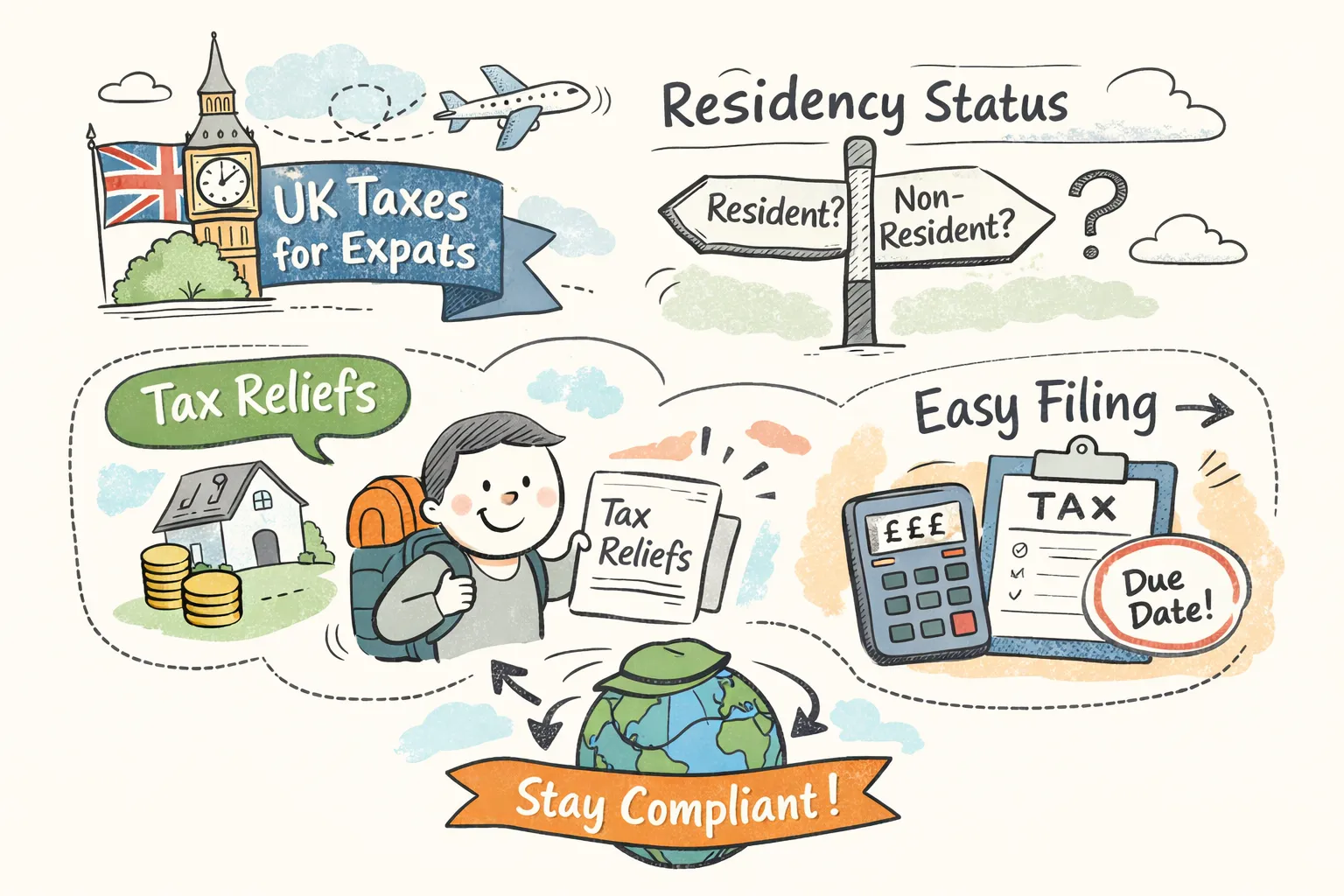
Moving between countries makes tax feel unpredictable. The good news: clear tests and a few documented choices decide whether the UK can tax all your income or only the money that touches the UK. This guide gives a short, practical roadmap—how to run the Statutory Residence Test, what income you must report, which reliefs can change the math, the split‑year rules, and exactly how to file from abroad.
What you’ll learn
- How to run the Statutory Residence Test (SRT) and what it means for your year.
- Which UK and foreign incomes are taxable and when to expect tax liability.
- When reliefs (historical remittance basis, FIG relief, foreign tax credit and DTAs) help—and their trade‑offs.
- Self Assessment steps, deadlines and when to call a specialist.
Are you UK tax resident? Run the Statutory Residence Test
The Statutory Residence Test is sequential: automatic UK tests first, then automatic overseas tests, then the sufficient‑ties test if neither automatic test applies. Stop as soon as a test applies—only one outcome is needed.
Automatic UK residence tests
- 183‑day test: You are resident if you spend 183 or more days in the UK in the tax year (midnight‑to‑midnight counting).
- Home test: You have a UK home available for a 91‑day period, you spend at least 30 days there in the tax year, and you have no overseas home where you spend 30+ days.
- Full‑time work test: You work full‑time in the UK (on average ≥3 hours/day and ≥75% of working days across a 365‑day period that includes at least one day in the tax year).
If none of those apply, the automatic overseas tests can give non‑resident status—examples include being a recent UK resident spending under 16 days in the year, being a long‑term non‑resident spending under 46 days, or working full‑time overseas (average ≥35 hrs/week with limited UK days).
If neither automatic set applies you move to the sufficient‑ties test. The SRT counts five main ties—family (spouse/partner or dependent child in the UK for 61+ days), accommodation (a UK place available for 91+ consecutive days), a work tie (40+ UK working days), a 90‑day tie (90+ UK days in either of the previous two tax years), and the country tie (UK is the country where you spent most days). How many ties make you resident depends on whether you were resident in the prior three years; the fewer years you were resident, the more days/ties are required.
Short examples that map to real life
Leaving for a full‑time overseas job and working ≥35 hours/week with under 91 UK days usually meets the overseas work test → non‑resident. Returning gradually but keeping UK family and accommodation (two ties) while spending 50 UK days commonly becomes resident under the sufficient‑ties test. Keeping a UK home that meets the home test can make you resident even if you plan to move—track dates carefully.
Actionable tip: keep a day‑count log (midnights count), boarding passes, tenancy end dates and employment start/stop dates. ExpatsUK has a simple day‑count checklist you can use to avoid surprises.
What the UK taxes — residents vs non‑residents and the money you must report
Core rule: UK tax residents are taxed on worldwide income; non‑residents are taxed only on UK‑sourced income (unless a specific relief or election applies). That distinction determines whether overseas salary, foreign dividends, or capital gains are reportable in the UK.
Typical income categories you’ll map: UK employment income and PAYE, overseas employment and foreign PAYE, UK and foreign pensions, UK and overseas rental profits, dividends and interest, and capital gains on disposals. For each item, identify where it arose, whether it was taxed abroad, and whether you brought the funds into the UK.
| 2026/27 headline bands (England, Wales & N. Ireland) | |
| Personal allowance | Up to £12,570 (0%) |
| Basic rate | £12,571–£50,270 at 20% |
| Higher rate | £50,271–£125,140 at 40% |
| Additional rate | Over £125,140 at 45% |
Note: Scotland uses different bands and rates. Non‑resident entitlement to the personal allowance can depend on nationality and treaties—if you think you qualify, check HMRC guidance (or the historical R43 process) and record treaty evidence.
National Insurance (NI) is separate from income tax and affects benefits and UK state pension. Check any bilateral social security agreement if you split employment between countries.
Actionable step: gather payslips, P60/P45, pension statements, rental accounts and overseas tax certificates before you make residency or filing decisions. For practical cost‑saving ideas that many expats miss, see Saving Money in the UK: Tips Most Expats Miss.
Reliefs that change the math: remittance basis, foreign tax credits and DTAs
Reliefs can materially change whether and when the UK taxes foreign income. Two big themes: historically the remittance basis for non‑domiciled residents, and the modern mechanisms—foreign tax credits and double taxation agreements (DTAs).
Important update: the formal remittance basis that many non‑domiciled residents used was abolished for new claims from 6 April 2025. It has been largely replaced by the Foreign Income & Gains (FIG) relief for qualifying new residents (a temporary option for a limited number of years), and there is a Temporary Repatriation Facility to handle certain pre‑2025 untaxed amounts. If you previously claimed the remittance basis, the legacy rules and transitional measures may still affect you—get specialist advice.
Before 2025 the remittance basis meant foreign income was taxed only if brought to the UK; trade‑offs included loss of the personal allowance and potential remittance basis charges for long‑term residents. Under current practice, foreign tax paid is usually creditable against UK tax on the same income: report the foreign income on SA106, show foreign tax paid, and claim credit to avoid double taxation. DTAs (for example the UK‑US treaty) allocate taxing rights and often reduce withholding or permit credits—US citizens face additional US filing obligations because the US taxes citizens on worldwide income.
Worked illustration (simple): imagine £10,000 foreign income taxed abroad at 20% (£2,000). UK tax on that income at 20% would also be £2,000; you claim a foreign tax credit for £2,000 so no extra UK tax is due on that item. If the UK rate is higher than the foreign rate, you may pay the difference in the UK but get credit for the foreign tax paid.
Practical how‑to: keep foreign tax receipts, bank remittance records and clear tracing of fund sources (clean capital vs income). Use SA106 for foreign income entries and keep documentation for 5+ years.
Split‑year treatment and everyday expat scenarios you can copy
Split‑year treatment applies when you arrive in or leave the UK part‑way through a tax year and meet the detailed conditions: the tax year splits into a UK resident part and an overseas part so only the UK part is taxed on worldwide income. Typical triggers include starting full‑time UK work, leaving for full‑time overseas work, or acquiring/ceasing to have a UK home.
Scenarios: leaving for a multi‑year overseas job normally gives an overseas part after your departure date; returning mid‑year with a new UK contract normally makes the UK part taxable from your start date; keeping a UK home while mainly abroad can negate split‑year relief unless you genuinely end ties. HMRC expects employment contracts, lease termination or start dates, flight/immigration stamps, utility bills and school enrolment records as evidence.
Filing from abroad: Self Assessment, forms, deadlines and penalties
Who must file: untaxed income, self‑employment, foreign income while resident, UK rental, some pensions, capital gains and other Self Assessment triggers. If you meet any of these you need to register for Self Assessment and file the relevant pages.
Key forms: SA100 is the main return; SA106 is the foreign income supplementary page; SA109 is used for residence/non‑residence claims.
| Practical calendar (watch these dates) | |
| Register for Self Assessment | By 5 October 2026 (if newly required) |
| Paper return deadline | 31 October 2026 |
| Online return & tax payment deadline | 31 January 2027 |
Filing from abroad: true non‑residents may not be able to use HMRC’s standard online services for certain claims—options include posting SA109, using commercial Self Assessment software that supports non‑resident returns, or appointing a UK agent. Pay from overseas by bank transfer/CHAPS or online card payments; note HMRC charges interest on late payments and penalties for late filing—meeting 31 January is important. If you need a UK bank account for payments, see our Best UK Bank Accounts for Expats, expatsuk.net.
Assemble your UTR, National Insurance number, P60/P45, employment contracts, bank statements showing remittances, foreign tax paid receipts and any trust documents before you file. If you’re opening an account from abroad, our UK Bank Accounts for Expats: Quick Compare & How to Open article explains practical steps and options.
A compact checklist and when to call a specialist (plus how ExpatsUK can help)
- Run the SRT and save day‑count evidence (midnights count).
- Map all income to categories: UK‑sourced vs foreign‑sourced and note foreign tax paid.
- Decide whether historic remittance basis/FIG relief applies and weigh loss of allowances.
- Check DTAs and foreign tax credit positions for double‑tax situations.
- Register for Self Assessment (get your UTR) if required and note the 31 Jan online filing deadline.
- File, pay and keep records for at least five years (preferably longer for cross‑border cases).
Red flags to get help now: you are planning to rely on historic remittance arrangements or FIG claims, you have complex trusts or offshore structures, significant foreign income or a major capital gain, you are a US citizen/green‑card holder, or you have a domicile dispute or long‑residency history. These situations often justify paid specialist advice that saves more than it costs.
How ExpatsUK can help: our practical checklists and clear explainers walk you through the SRT, forms and document lists; our upcoming local groups and message boards are a place where members swap peer‑recommended tax advisers in their city. Start with The Ultimate Guide to Moving to the UK as an Expat, expatsuk.net and the practical tips in Things I Wish I Knew Before Moving to the UK, expatsuk.net. Use our day‑count checklist to get started, and if you spot a red flag, seek a specialist review.
Conclusion — two quick takeaways
1) Residency drives the result: run the SRT and keep documentary day counts. 2) Classify income precisely and keep foreign tax receipts—DTAs and foreign tax credits often prevent double tax but require paperwork. Start with the checklist above, consult HMRC pages for SA100/SA106/SA109 details, and book a specialist if any red flags apply.