
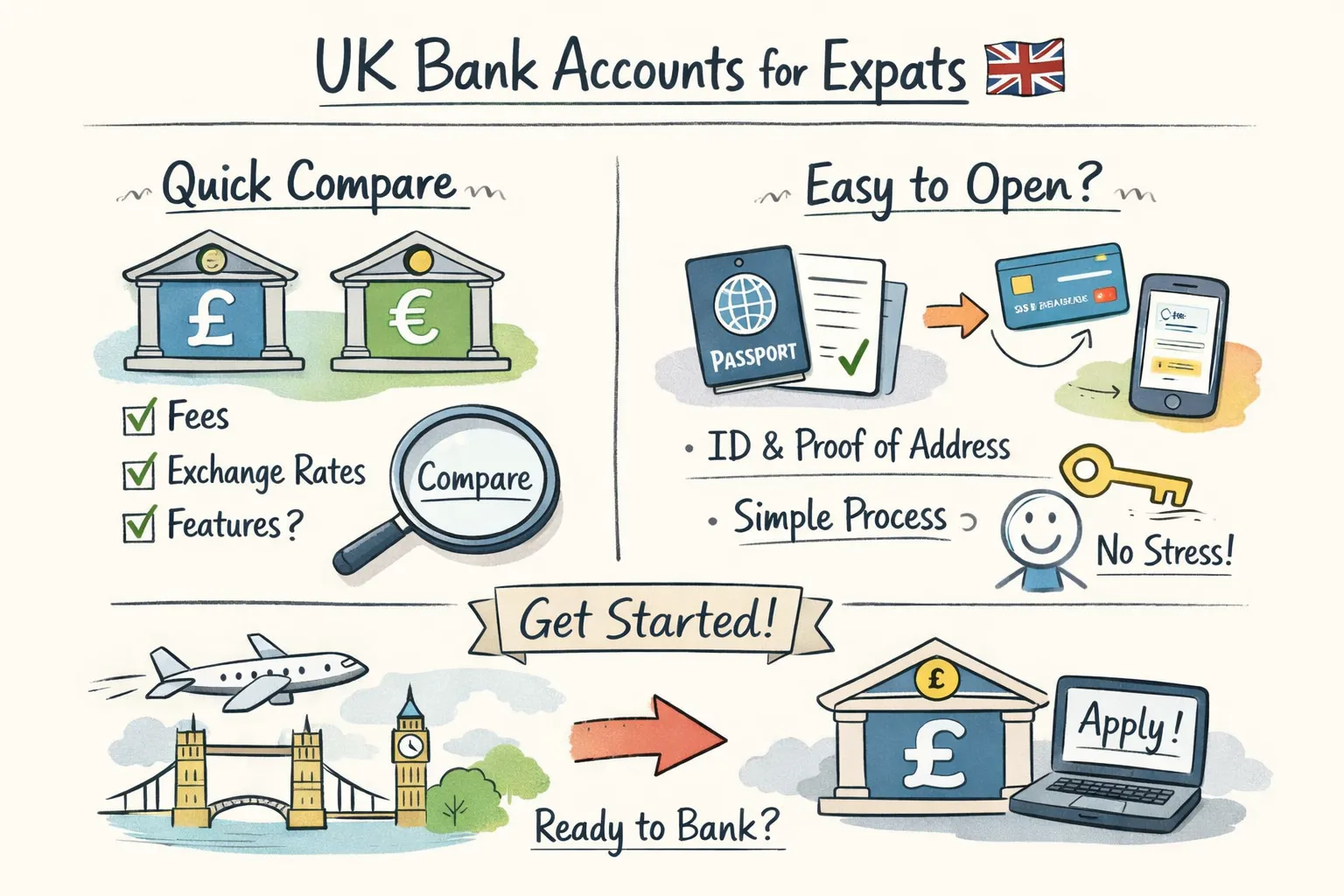
Banking is often the very first practical hurdle when you land or plan to move: without the right account you can’t receive salary, pay rent, or set up Direct Debits. By the end of this guide you’ll be able to choose the account type that matches your situation, compare real costs, gather the exact documents and follow a step‑by‑step checklist to apply from overseas. At ExpatsUK we’ve folded provider terms and member feedback into a simple, step‑by‑step guide and checklist you can use today.
Which UK account fits your situation?
First decide: are you moving permanently, temporarily, or working remotely from abroad? Do you need a UK sort code for payroll and Direct Debits, or are low‑cost international payments the priority? Answering that single question narrows the field quickly.
Full UK current account
What it is: a standard high‑street account with a UK sort code and debit card. Best for salary, paying council tax, registering with a GP and using Direct Debits. Practical trade-offs: excellent local acceptance and FSCS protection when held at an authorised UK bank, but many high‑street banks ask for a UK address and more paperwork.
International / Expat accounts (HSBC Expat, Barclays International)
What it is: accounts built for customers who live overseas. They offer multicurrency features and international support. Practical trade-offs: useful if you keep assets in several countries; sometimes higher eligibility thresholds and different deposit protections depending on the legal entity (e.g., Jersey‑based).
Offshore accounts (Channel Islands / Isle of Man)
What it is: banking through offshore jurisdictions that can provide GBP banking and sort codes. Practical trade-offs: multi‑currency convenience but generally outside UK deposit protection schemes; appropriate only for specific tax, estate or wealth structures.
Fintech multicurrency accounts (Wise, Revolut, Monzo, Starling, Monese)
What it is: app-first accounts with fast onboarding and low foreign exchange costs. Practical trade-offs: quick setup and very competitive FX; limited branch services, some limits on cash/cheque handling and occasional restrictions for business or certain payment types.
ExpatsUK tip: if you’ll be paid in GBP and need recurring bills handled smoothly, prioritise an account with a UK sort code and a debit card that reliably supports Direct Debits. Use fintechs for transfers and short‑term convenience, and add a local current account once you have UK address proof.
Real costs: fees, FX markups and a replicable example
Banks often hide value capture inside the exchange rate: a bank may advertise “no transfer fee” but apply a 2–4% FX margin. Fintechs are typically transparent: they display the mid‑market rate plus a clear fee.
Example calculation you can replicate: assume a £1,000 conversion from EUR to GBP.
Bank example: 3% FX markup + £10 flat fee = 0.03×£1,000 (£30) + £10 = approximately £40 total cost. Banks with higher margins or additional receiver charges can push this figure into the £60–£90 range.
Fintech example (Wise/Revolut): mid‑market rate + transparent fee ≈ £4–£15 total on the same £1,000, depending on route and plan. Always check the “amount the recipient receives” or the in‑app preview rather than the headline fee.
Other cost lines to watch: monthly account fees, card usage fees abroad, ATM withdrawal limits and charges, account‑keeping fees for premium plans, inbound transfer and intermediary SWIFT fees.
Practical rule of thumb: small, frequent transfers → fintech; salary and domestic UK use → UK current account; very large one‑off transfers → specialist FX providers or a negotiated commercial rate with your bank.
Quick numbers to capture when comparing providers:
- Upfront fee and recipient fee
- Exchange rate shown (or margin vs mid‑market)
- Monthly/account keeping cost
- Card/ATM charges and withdrawal limits
- Inbound SWIFT or intermediary fees
Who offers non‑resident or expat accounts (and who they suit)
Short, scan‑friendly notes to match providers with common needs:
- HSBC Expat — long‑term international banking with multi‑currency tools; good for frequent movers and those with overseas assets.
- Barclays International — full service for higher‑balance expats who want branch access when in the UK.
- Lloyds / NatWest / RBS — mainstream UK banking; best if you can provide a UK address and need local services.
- Wise (Borderless) — lowest‑cost multi‑currency transfers and balances; great for sending/receiving internationally.
- Revolut / Monzo / Starling — app‑first everyday banking; low FX costs and strong mobile UX for daily spending.
- Monese — helpful for arrivals without UK utility bills; fast onboarding for newcomers.
Recommended stacks (practical combos): open a Monzo or Starling account for everyday UK spending, and use Wise for cheap international transfers; if you need long‑term global banking, consider HSBC Expat plus a local UK current account once you settle; for business or frequent transfers combine a Revolut/Wise business account with a UK salary account. For a side‑by‑side comparison of options aimed specifically at expats, see the Best UK expat bank accounts.
Offshore accounts have use cases but are typically outside UK FSCS protection — confirm the legal jurisdiction before moving significant sums. For broader context and onboarding strategies, our Guide to Expat Banking in the UK covers practical tips and common pitfalls.
Documents, remote verification and realistic timelines
Key documents you’ll be asked for: a valid passport is the universal ID; proof of address usually requires a recent utility bill, bank statement or council tax bill, but banks commonly accept tenancy agreements, employer/university letters, HMRC/NHS letters or notarised overseas statements for new arrivals. If relevant, have your visa/BRP and proof of income (payslips or foreign bank statements) ready. US citizens should expect to provide SSN/W‑9 details for FATCA reporting.
Remote submission methods: most fintechs accept app uploads, selfie/video KYC and PDF scans (Wise, Revolut, Monese). Traditional banks may allow online starts but sometimes require a branch visit or delivery to a UK address, especially to receive a physical debit card.
Typical timelines in plain terms: fintechs often give usable accounts within 1–7 days; challengers like Monzo/Starling typically take 2–10 days including card delivery; legacy or international bank processes (HSBC Expat, Barclays, Lloyds) commonly run from one week to several weeks for full verification and card arrival.
File tips: scan at ~300 dpi, name files clearly (e.g., Smith_Passport_2026.pdf), translate and notarise non‑English documents, and ensure ID documents are in date.
If you want to check which address documents are commonly accepted when you don’t yet have a UK utility bill, see Do I need a UK address to open an account?
Step‑by‑step checklist to open a UK account from abroad
- Decide your priority (salary/Direct Debits vs transfers vs multicurrency) and shortlist 1–2 providers.
- Gather documents (passport, address evidence alternatives, visa/BRP if applicable, payslips/bank statements) and save two sets: PDF and phone photos.
- Start the online or app application and enter employer/residence fields exactly as on official documents.
- Complete video KYC in a quiet, well‑lit space; show passport open to the photo page if requested.
- If you lack a UK utility bill, upload your tenancy agreement or a university/employer letter early.
- Arrange for card delivery: use mail forwarding, your UK contact’s address (check bank policy), or select digital‑only operation while waiting.
- Make a small initial transfer to confirm source of funds and, where needed, set up a standing order or Direct Debit to verify domestic activity.
- If rejected, call the bank’s international team, ask for the KYC escalation desk and reference the filenames you uploaded; politely request a checklist of missing items.
For a focused walkthrough of remote options and seven practical ways to open an account from overseas, read How to Open a UK Bank Account from Overseas — 7 Ways.
Sample email line to ask a bank about alternatives to a UK utility bill (copy/paste):
Dear [Bank Name] team — I’m applying from abroad and do not yet have a UK utility bill. Could you confirm whether a tenancy agreement, employer letter on headed paper, or a notarised overseas utilities statement would be accepted as proof of address for my application? Kind regards, [Your Name]Common rejections and remedies: mismatched names/addresses (use consistent formatting), expired ID (renew before applying), unexplained large deposits (provide supporting statements).
Safety, tax notes and final recommendations
Deposit protection: accounts held with UK‑authorised banks are typically covered by the Financial Services Compensation Scheme (FSCS) up to the current limit per person per banking group—confirm the amount and that the specific legal entity operating your account is UK‑authorised. Offshore entities (Channel Islands, IoM) use local schemes and may not carry the same protection.
Tax and reporting: US citizens must comply with FBAR and FATCA and will be asked for SSN/W‑9 details; other nationals should consider CRS and home‑country reporting. If you become UK tax resident, interest and some income rules change—keep statement snapshots and consult a tax adviser for cross‑border implications.
Quick profile recommendations: short‑term travellers and digital nomads — start with Wise, Revolut or Monese; workers moving to the UK — prioritise a full UK current account once you have address proof and use fintechs in the interim; large balances or complex needs — get specialist FX quotes and consider an international bank like HSBC Expat alongside a UK account.
Download the ExpatsUK “Open a UK account from abroad” checklist and templates to copy/paste messages, and join our local message boards to ask city‑specific questions and read member threads — visit our Banking for Expats Living in the UK: The Ultimate In‑Depth Guide (2026) to get the downloadable templates and email scripts. Banking is solvable: pick the right two‑account stack (one UK current account, one fintech), follow the checklist and you’ll remove most friction before you move.