
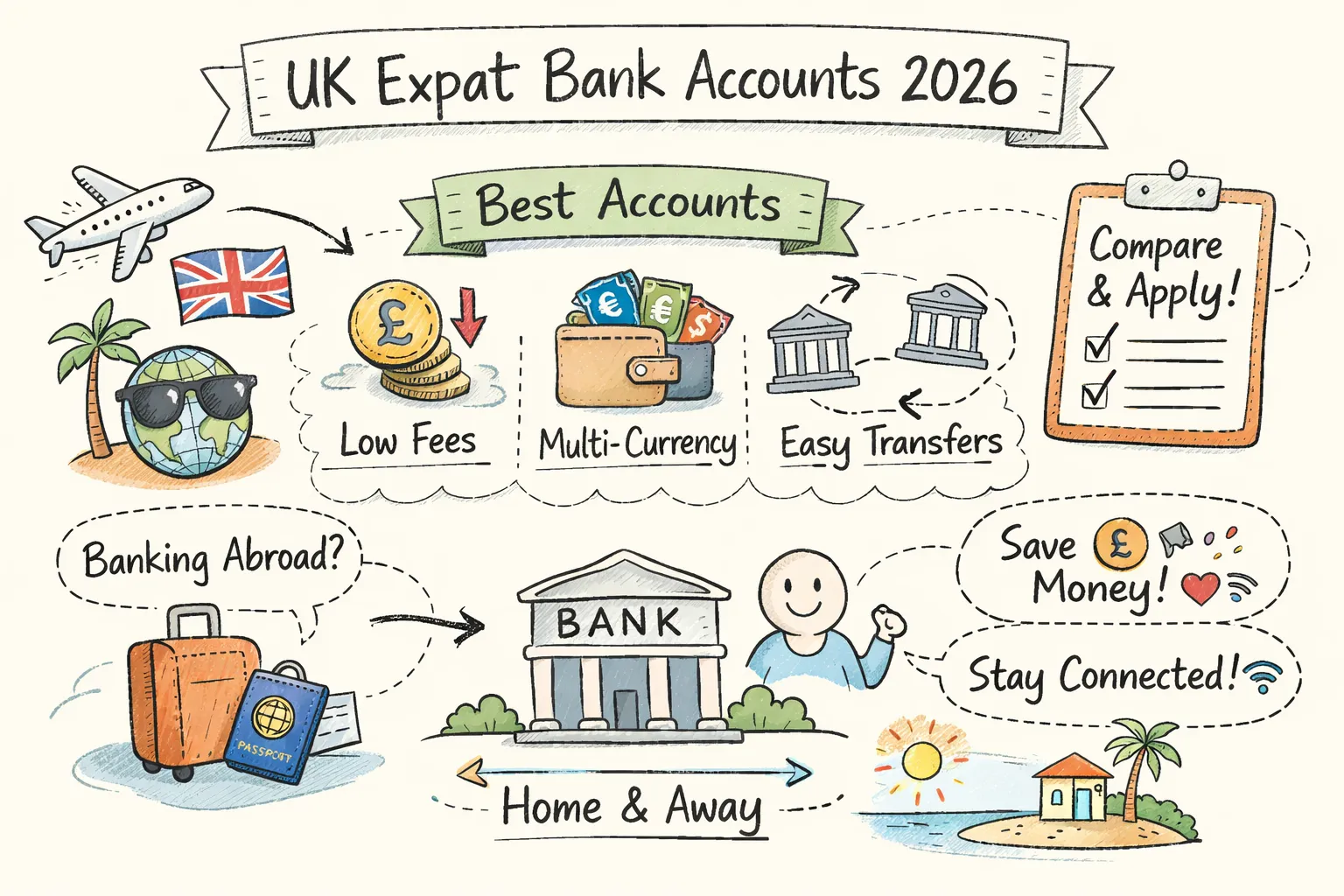
Moving money between countries, keeping multiple currencies and opening a UK-facing account from overseas can feel like a minefield. This short, practical guide cuts through the noise: ExpatsUK’s short guide — tested picks and step‑by‑step advice so you can choose and open the right account remotely. Read on and you’ll be able to pick the best account for your situation, compare real costs and follow a checklist to open it from abroad.
Quick verdict: ExpatsUK’s top picks for 2026
- Wise — Best for low‑cost multi‑currency holding & transfers: mid‑market FX and transparent fees; ideal for frequent senders.
- HSBC Expat (Jersey) — Best for high‑net‑worth expats who want multi‑currency offshore services and relationship support; broad currency set but high minimums.
- Barclays International — Good for serious multi‑currency needs and corporate‑style services (40+ currencies; higher thresholds).
- Santander Current Gold / NatWest International — Useful if you want a familiar high‑street brand with international account options—check thresholds.
- Revolut, Monzo, Starling — Best digital‑first convenience for everyday app workflows; residency rules vary so check availability.
- WorldFirst / specialist FX providers — Best for businesses or customers needing UK sort‑code/local details and fast verification.
How to use this verdict: match the pick to your priority—lowest cost, widest currency set, a UK sort code, or an adviser/relationship service.
What really matters when choosing an account
Fees — they add up faster than you think
Look beyond “no monthly fee.” Compare monthly maintenance, ATM withdrawal charges, card cross‑border fees and per‑transfer fees. Small recurring costs—monthly charges plus ATM/merchant markups—can easily outstrip one big transfer fee if you travel or withdraw often.
Foreign exchange — mid‑market vs a hidden margin
Providers either use the mid‑market rate (fintechs like Wise) or apply a margin to the exchange. That margin is where many banks earn most of their revenue. Simple rule: true transfer cost = explicit fee + (amount × FX margin). Example: if the mid‑market GBP→EUR rate is 1.15, a 2.75% FX margin (HSBC Expat’s published card/ATM adjustment) yields an effective rate ≈1.1184 — £1,000 becomes ≈€1,118. By contrast, mid‑market conversion would give €1,150 before any platform fee, a gap of about €31.6 on that single transfer.
Currencies & features
Decide which currencies you need to hold (GBP/EUR/USD are common). Check whether the account gives multi‑currency balances, IBANs, local UK sort code/account numbers, and whether the debit card works abroad without extra markups.
Eligibility & minimums
Many international accounts require minimum relationship balances or salary credits. HSBC Expat typically asks for ≈£75,000 saved or ≈£120,000 annual salary; Barclays International and Santander have reported higher thresholds. If you don’t meet the numbers, fintech providers or specialist FX accounts are usually easier to open.
Regulation & deposit protection
Offshore accounts (Jersey, Isle of Man) may not be covered by the UK’s FSCS deposit protection. Always check the protection scheme and limits that apply to your account and jurisdiction before moving large sums.
Remote opening & card delivery
Some providers let you complete everything online and ship a card abroad; others require a UK address or in‑branch identity checks. Confirm remote opening availability and card delivery policies for your country before you begin.
Provider snapshots — short profiles
HSBC Expat (Jersey) supports around 19 currencies (GBP, USD, EUR among them) and is designed for internationally mobile clients. It offers relationship managers and fee‑free global transfers under qualifying conditions, but expects high balances or salary thresholds and applies a ~2.75% exchange adjustment on non‑sterling card withdrawals and payments. Best for high‑earners who value personal service.
Barclays International gives access to a very broad currency set (40+). The service suits clients with significant deposits or income and those seeking corporate‑style multi‑currency features. Expect residency checks and distribution of services by relationship level. Best for wealthy expats needing wide currency coverage.
Santander Current Gold / NatWest International provide international current accounts that support GBP/EUR/USD and are familiar high‑street options for customers who meet relationship thresholds. These are practical when you want a traditional bank’s current account features but verify eligibility and fees. Best for families relocating who prefer a known brand.
Wise (multi‑currency) uses the mid‑market rate and transparent fees, lets you hold and convert many currencies and opens in most countries fully online. It’s not a bank in the traditional sense (e‑money regulation) but is excellent for low‑cost transfers and multi‑currency management. Best for frequent senders and digital nomads.
Revolut, Monzo, Starling and other challengers offer outstanding app experiences, real‑time notifications and convenient card features. Residency and product availability vary by country and tier. Best for day‑to‑day spending and app‑centric expats.
WorldFirst & specialist FX providers focus on businesses and individuals who need local bank details and fast verification. WorldFirst can deliver UK sort‑code/account details quickly and reports 24–48 hour verification in many cases. Best for businesses and freelancers requiring UK‑style payment details.
Always verify live terms—minimums and fees change frequently.
Which account is right for you?
Digital nomad / frequent sender: Wise or Revolut — low FX cost and simple app workflows let you move money cheaply and quickly.
High‑earner / long‑term expat with international income: HSBC Expat or Barclays International — relationship support, broader currency options and dedicated services (accepting the higher thresholds).
Non‑resident needing a UK sort code: Specialist providers like WorldFirst or other FX platforms that issue local details—confirm whether the account provides a true UK account number for GBP receipts.
Family moving to the UK: NatWest, Santander or Lloyds international options (where available) make sense if you meet residency and documentation requirements and want branch/household banking.
Small business owner / freelancer: Wise Business or WorldFirst for multi‑currency invoices, local payout details and competitive conversion costs.
Quick decision prompts: Do you need a UK sort code? How often will you transfer? Do you meet balance thresholds? Do you need in‑branch access? Your answers point to fintech, specialist FX, or international bank solutions.
How to open your chosen account remotely — a step‑by‑step checklist
Many fintechs are quick; traditional international banks can take longer. Check eligibility first and plan for card delivery and verification.
- Confirm eligibility on the provider’s official page for your country of residence.
- Gather documents: valid passport, proof of overseas address (utility or bank statement), tax ID (TIN), proof of income/funds if required, and amobile for video KYC.
- Begin theonline applicationand complete identity checks (photo upload, video ID where requested).
- Fund the account as required — some providers need an initial deposit within a set timeframe.
- Plan verification time: fintechs are often same‑day, WorldFirst ~24–48 hours, HSBC Expat may take ~7–10 days—apply early for transfers.
- Order your debit card and confirm whether the provider ships internationally to your address; activate the card and set up 2FA on the app.
- Send a small test transfer, set up standing orders/direct debits and notify payers of new details if needed.
- Store copies of all communications and check the regulator/deposit protection that applies to your account and jurisdiction.
Final tips, costs to watch and next steps
Don’t judge providers by a single “free transfer” line: always check the FX margin. Watch out for card FX adjustments and ATM markups (for example, HSBC Expat’s published ~2.75% adjustment). Confirm deposit protection before moving large sums and be mindful that changing residency can alter eligibility and tax reporting obligations.
To save money: hold the currency you spend most, use fintechs for one‑off large transfers, and keep at least two accounts (one low‑cost transfer provider plus one relationship or domestic account) for redundancy.
If you want a ready checklist, a sample comparison table or to hear recent experiences from people in your country, head to ExpatsUK — download the checklist and drop a note about where you live so local members can share up‑to‑date tips in our upcoming message boards.
One last note: fees, thresholds and regulatory protections change. Verify live terms with the provider before applying. Safe moves and clearer money ahead.